
According to the Center on Reinventing Public Education’s 2025 State of the American Student 2025: Getting Students Back on Track in Math report, the United States faces a serious math crisis: nearly 4 in 10 eighth graders score Below Basic in math on NAEP, and about 80 percent of students attend districts that still have not recovered to pre‑pandemic math levels. By 12th grade, only about 33 percent of students are academically prepared for college-level math, and just 35 percent of eighth graders are enrolled in Algebra I or above, sharply limiting access to advanced courses and high‑wage STEM careers (Center on Reinventing Public Education [CRPE], 2025).
Equity in math means that students’ opportunities and outcomes are not predictable by race, income, language, disability status, or gender, and that each learner receives the specific support needed to meet high expectations. CRPE’s analysis describes how inequities are “hard‑wired” into the system through uneven access to well-prepared math teachers, rigorous coursework like Algebra I by eighth grade, and timely intervention when students begin to struggle. Addressing this is not about small tweaks; it requires an intentional, evidence‑based approach to how we teach, support, and advance students in mathematics (Center on Reinventing Public Education [CRPE], 2025).
To move from diagnosis to action, CRPE recommends that states and districts work on several fronts at once: using explicit, research‑aligned math instruction supported by real‑time diagnostics; restoring honest, high expectations and transparent reporting (including clear Algebra I readiness goals in middle school); rebuilding and strategically deploying the math‑teacher workforce; replacing rigid, tracked course structures with flexible pathways that avoid dead ends; and investing in engagement, tutoring, and innovation so that students who have been underserved actually receive more time, support, and access to rigorous math, not less. Within that broader agenda, one practical question is: How can teacher teams regularly see what students truly understand and respond in coordinated ways? (Center on Reinventing Public Education [CRPE], 2025).
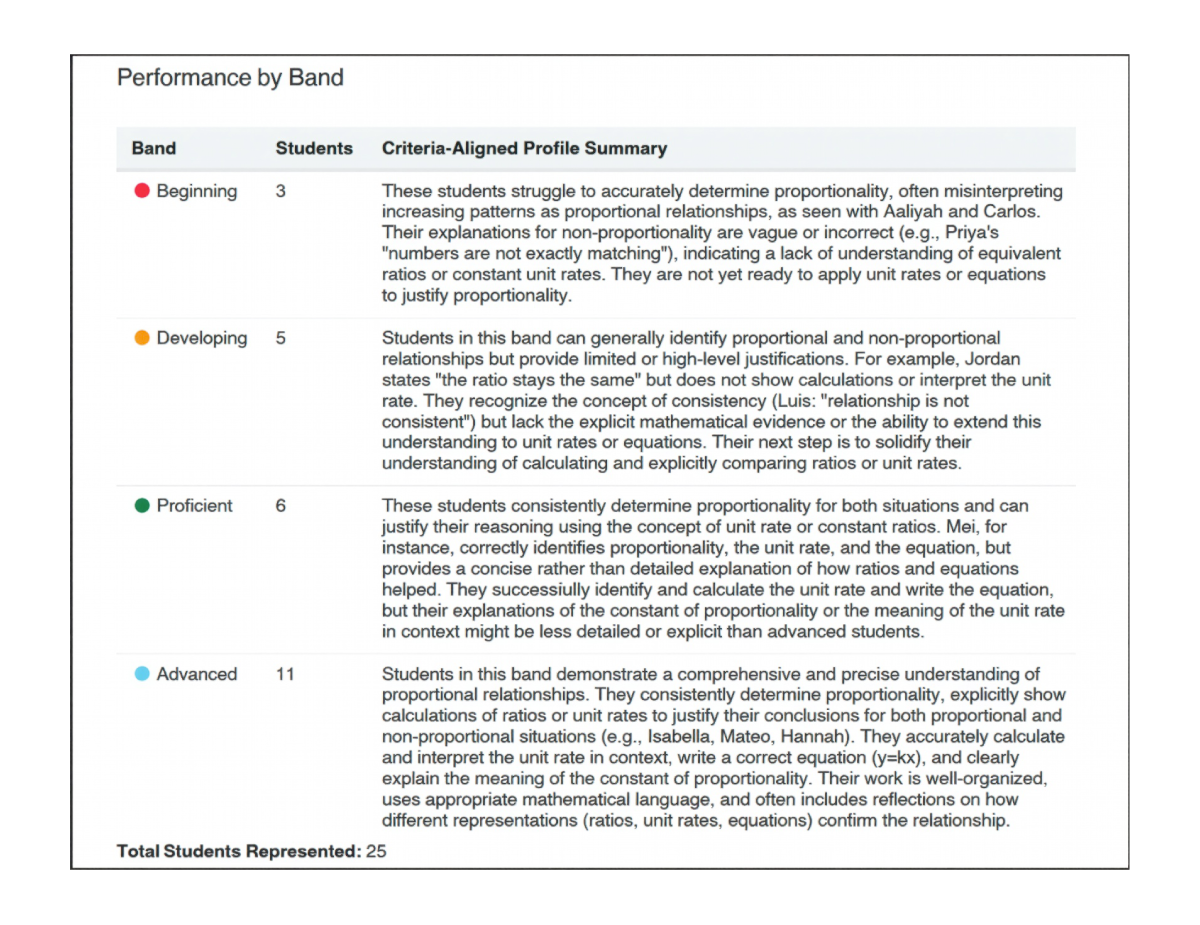
This is where AI‑informed PLC tools can play a helpful role. One example is an AI‑assisted PLC process that analyzes anonymized student work uploaded by teachers across classrooms, groups it into broad mastery bands (for instance, Beginning, Developing, Proficient, Advanced), and highlights common misconceptions such as treating any increasing pattern as a proportional relationship.
Figure 1. Mastery bands summarize what learners at each level can generally do with proportional relationships, giving PLCs a shared starting point for planning instruction.
Building on that analysis, the same report can suggest a whole‑class focus such as improving students’ ability to construct clear mathematical justifications, not just compute answers. It then offers practical moves—using anonymized exemplar responses, co‑creating criteria with students, and providing structured templates for explanations—that align with research on effective explicit instruction and clarity.
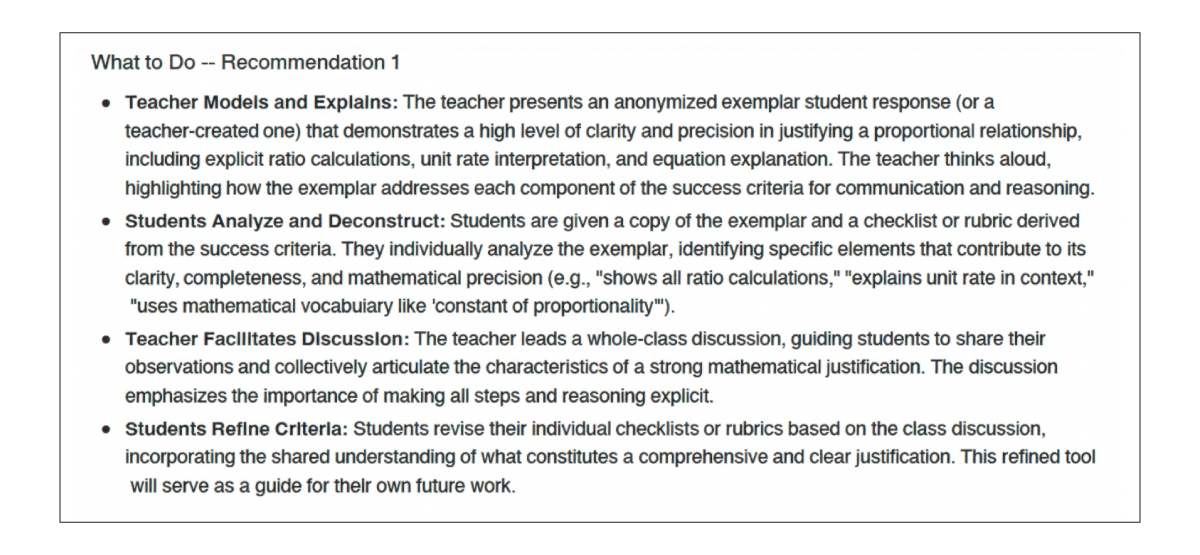
To make this concrete, one “What to Do – Recommendation 1” sequence encourages teachers to: model and think aloud through a strong exemplar response; have students analyze that exemplar using a success‑criteria checklist; facilitate a whole‑class discussion about what makes the explanation strong; and then support students as they refine their own checklists for future work. This sequence turns abstract success criteria into something students can see, name, and use.
Figure 2. Example of an AI‑generated ‘What to Do’ sequence that supports teachers in modeling, analyzing, and co‑constructing criteria for strong mathematical explanations.
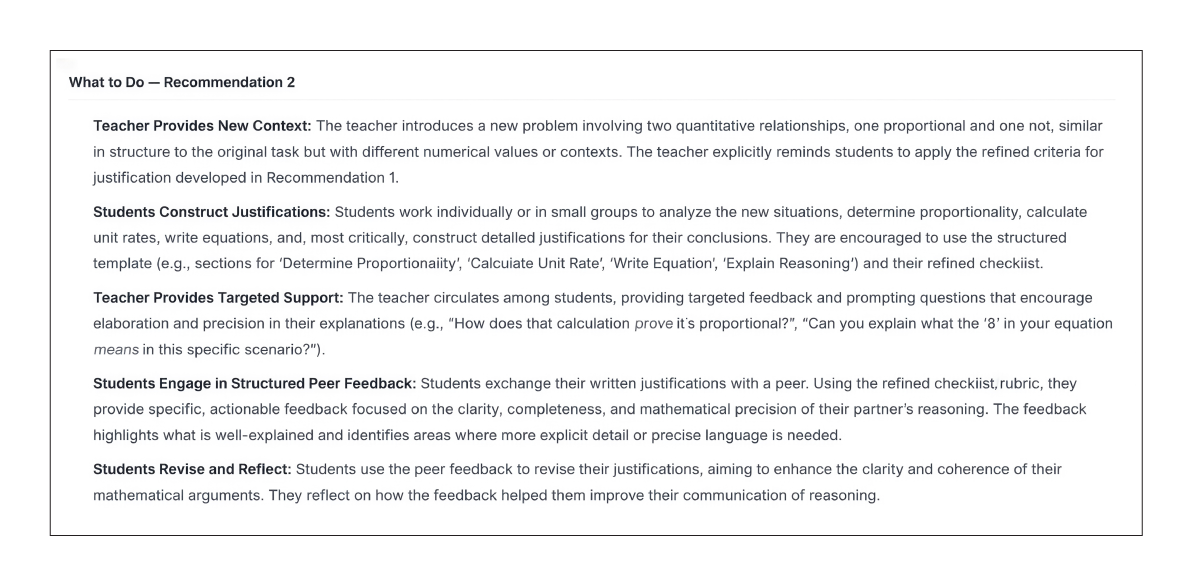
A follow‑up “What to Do – Recommendation 2” then invites teachers to bring a new proportionality problem, ask students to apply the refined criteria, and provide a structured template with sections such as ‘Determine Proportionality,’ ‘Calculate Unit Rate,’ ‘Write Equation,’ and ‘Explain Reasoning.’ Students use the template to make their thinking explicit and then revisit their work using the co‑created criteria, strengthening both understanding and communication.
Figure 3. Guidance for applying shared criteria to a new task, including a structured template that prompts students to show and explain every step.
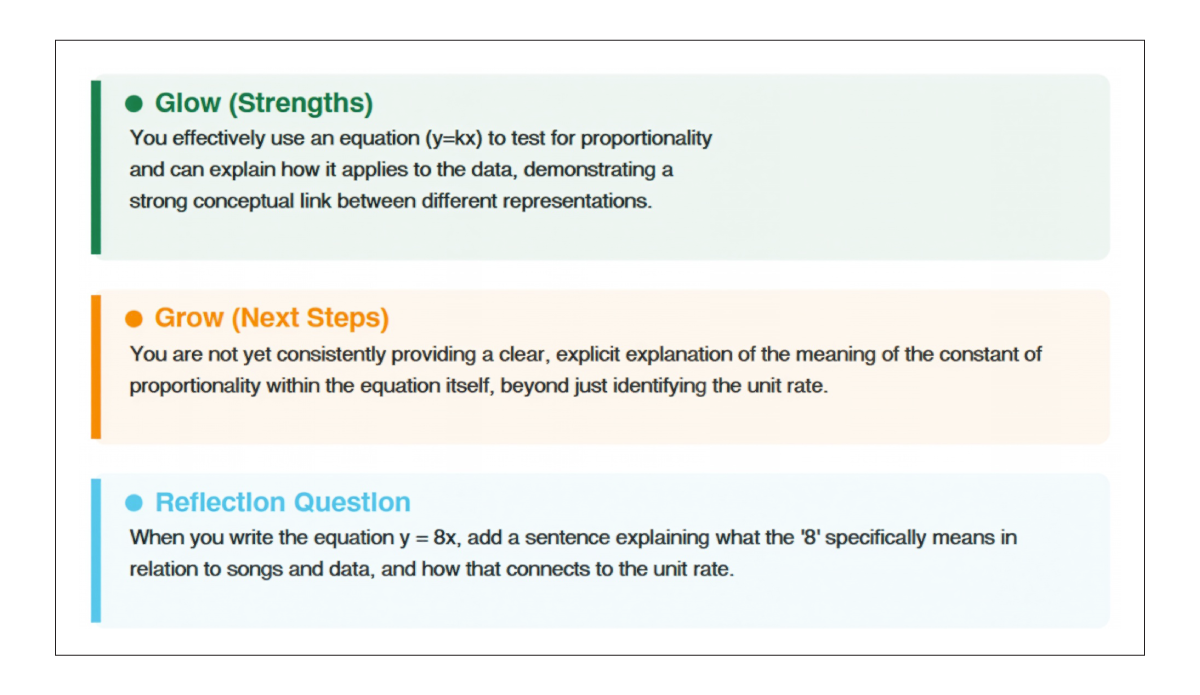
At the individual level, the tool can generate short, strengths‑based feedback statements (a “glow,” a “grow,” and a reflective question) that recognize what a student is already doing well—for example, noticing patterns between quantities—while coaching them toward more precise reasoning, such as checking whether ratios remain constant. Because this feedback is tied directly to agreed-upon success criteria, it can help students who have historically been underserved understand exactly what progress looks like and what to try next, rather than receiving vague messages about effort or ability.
Figure 4. Sample strengths‑based individual student feedback that pairs a specific ‘glow’ with a clear next step and a question to prompt deeper reasoning. The student’s name is not visible.
Finally, by looking at learning evidence across classrooms rather than in isolation, and by using performance bands rather than names, this kind of tool supports a culture of shared responsibility and privacy‑conscious practice. Teacher teams can see when groups of students are clustered in the Beginning or Developing bands and ask: Are expectations consistent? Who is getting access to key concepts and courses, and who is not? Where do we need to adjust instruction or support? Those questions sit at the heart of CRPE’s call to confront math inequities directly and to redesign systems so that students who have been furthest from opportunity are actively brought into the center of planning and improvement.
In short, AI‑informed PLC tools do not replace teacher expertise or solve equity problems by themselves. But when they are used thoughtfully, they can help educators act on research like CRPE’s by making student learning more visible, focusing attention on conceptual understanding and explanation, and supporting more consistent, strengths‑based feedback. That combination gives PLCs a concrete way to close opportunity gaps in math—one unit, one task, and one conversation at a time.