

Across the country, Career and Technical Education (CTE) is creating real momentum for students. Classrooms are more engaging, pathways feel more relevant, and students are more likely to graduate and see a future for themselves.
That matters.
👉 See how schools are strengthening learning inside CTE pathways
Systems have invested heavily in Programs of Study, career planning, industry credentials, and dual enrollment. These are strong moves. They are helping students connect school to life beyond it in ways that traditional structures often have not.
When Engagement Isn’t Enough
But as more students move through these pathways, a quieter issue is surfacing in classrooms.
Students are busy. They are building, creating, completing tasks, and often doing so with enthusiasm. Yet when you pause and ask them deeper questions—what are you trying to improve, how do you know your work is strong, or what you would revise—the answers are often unclear or surface-level.
This is not about effort. It’s about Metacognitive Clarity.
Students can be fully engaged and still lack a clear understanding of:
- The specific goal of their learning
- What quality work actually looks like
- The steps needed to improve their performance
When Metacognitive Clarity is missing, learning becomes uneven. Some students intuitively figure it out. Others quietly fall behind—not because they aren’t capable, but because they don’t have visibility into how to improve.
The Shift: From Activity to Metacognitive Clarity
The opportunity in CTE is not to add more programs or initiatives—it is to strengthen what is already happening inside classrooms.
When educators intentionally build Metacognitive Clarity into instruction, the impact is immediate and visible. Students begin to articulate what they are learning and why it matters. They start to recognize the difference between average and high-quality work. Most importantly, they begin to take ownership of revision and improvement.
This shift transforms tasks into learning experiences. Instead of simply completing work, students engage in a process of growth. They understand the purpose behind what they are doing and can track their own progress over time.
A Simple Move You Can Try Tomorrow
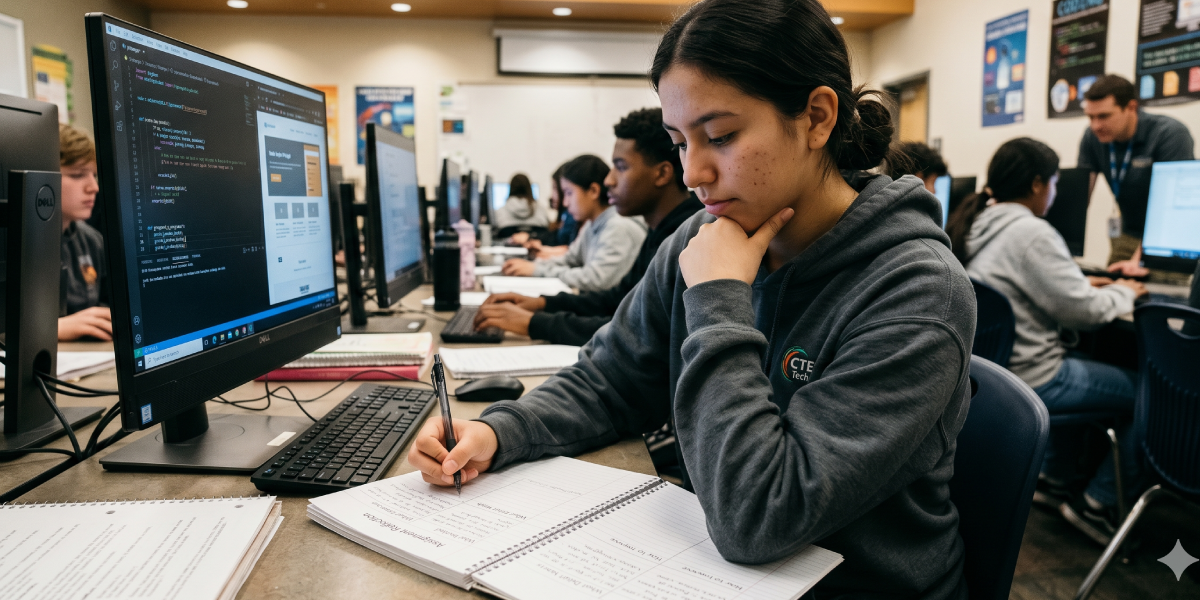
Take one current task or project and build in a short reflection before submission.
Ask students to:
- Name the specific skill they are trying to improve
- Describe what strong work looks like for that task
- Identify one thing they would revise to improve their work
This move takes only a few minutes but introduces Metacognitive Clarity into the learning process. Over time, these small moments build students’ ability to self-assess and improve independently.
👉 Explore how competency-based systems build Metacognitive Clarity and ownership in CTE