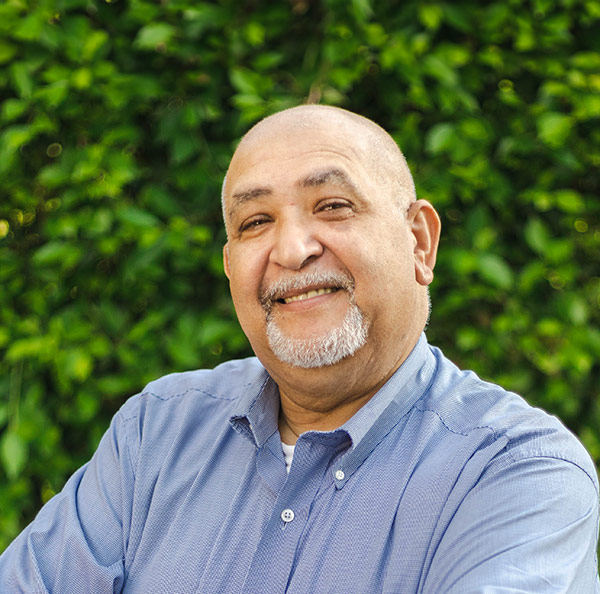


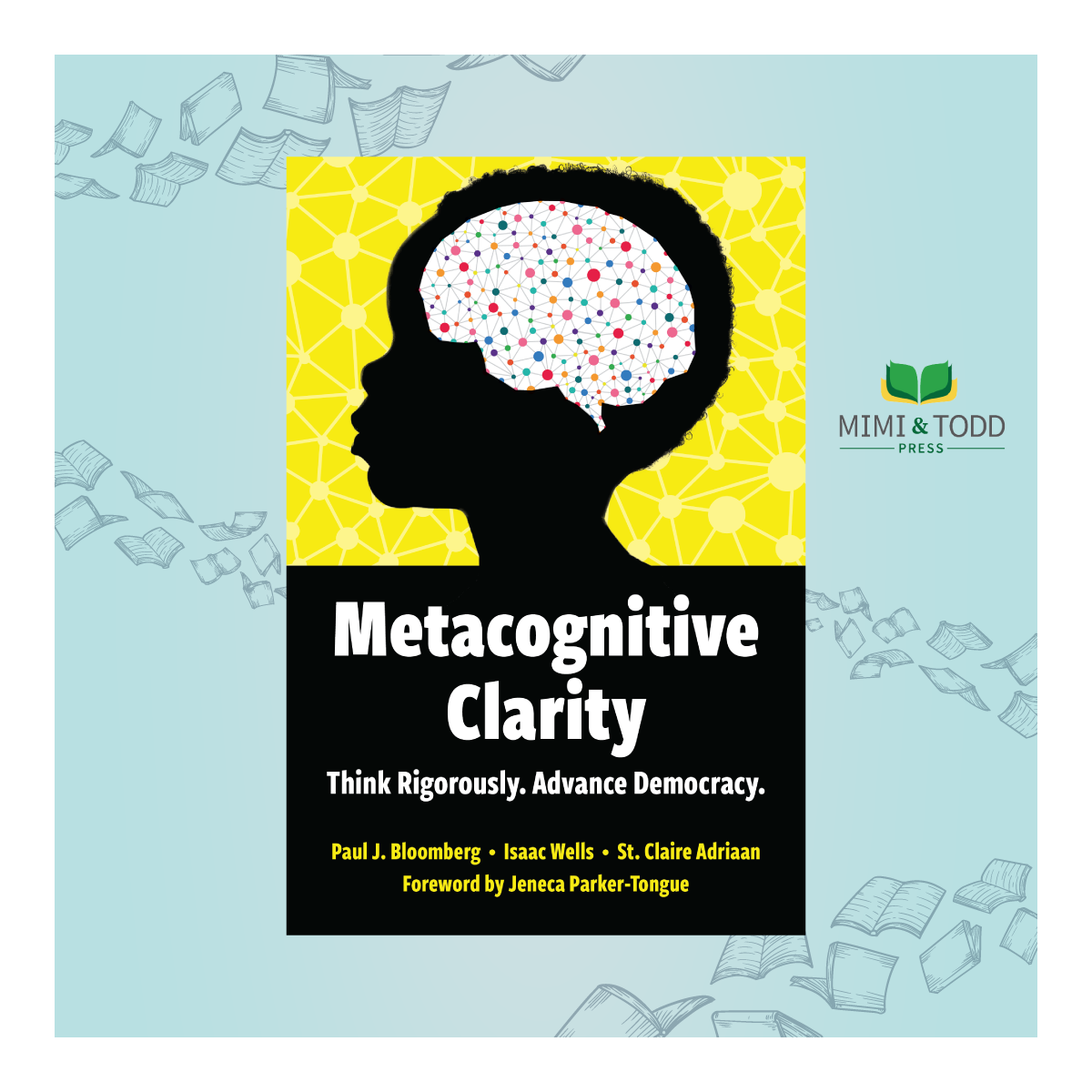
At Mimi & Todd Press, we publish and market authors who are making a difference, have a story to tell, and are making an impact. We are proud to feature authors who are both thought leaders and practitioners dedicated to creating real change in schools. Few embody this mission as powerfully as St. Claire Adriaan, co-author of the upcoming book, Metacognitive Clarity: Think Rigorously. Advance Democracy. Born and educated under the brutal constraints of Apartheid South Africa, St. Claire learned early that schooling can either limit human possibility or unlock it. That understanding continues to shape his life’s work as a teacher, principal, consultant, and champion for justice-centered learning.
In this conversation, St. Claire reflects on how his upbringing informs his approach to teaching and leadership, why metacognition is essential for equity, and how educators can cultivate classrooms where every learner’s identity, voice, and thinking are valued. He invites us to see metacognition not as an academic add-on, but as a democratic habit that prepares students to navigate complexity, challenge injustice, and participate fully in shaping their futures.
This interview continues our Mimi & Todd Press Author Series, where we go beyond the page to explore the people, vision, and purpose behind each book.
Inspiration and Purpose for Writing
Q: What pivotal experiences or insights motivated you to co-write this book, and what impact do you hope it has on educators and learners?
A: Growing up as a brown person in Apartheid South Africa, I experienced firsthand what it means to be systematically excluded from quality education and opportunity. The schools I attended were segregated, under-resourced, and designed to limit rather than liberate. I watched brilliant minds around me—classmates, family members, neighbors—denied the chance to reach their full potential simply because of the color of their skin.
These early experiences didn’t just anger me; they awakened in me a profound understanding that education is never neutral. It either perpetuates injustice or works actively to dismantle it. This realization has shaped every aspect of my career.
The pivotal moment for co-writing Metacognitive Clarity came during my work as a principal, when I noticed a disturbing pattern: the same students who were historically marginalized—our minority students, neurodiverse learners, and English learners—were the ones most often denied access to rigorous, thinking-centered instruction. Instead, they were given compliance-based learning that asked them to follow rather than to think, to memorize rather than to question.
I hope this book helps educators see what I’ve come to understand: that teaching students how to think, not just what to think, is the most powerful tool we have for advancing equity and democracy. When we make thinking visible and metacognition explicit, we give every student—regardless of background—the agency to navigate complexity, challenge injustice, and shape their own futures.
Envisioning Change
Q: How does your work challenge traditional views regarding how learning happens in school? What are the long-term goals and possibilities of this shift?
A: Traditional schooling operates on a fundamental assumption that learning is about the transfer of knowledge from expert to novice. The teacher knows; the student receives. This model may have served an industrial era, but it fails our students today—and it particularly fails those who have been historically marginalized.
Our work challenges this by positioning learning as a process of developing conscious control over one’s own thinking. When we teach metacognitively, we’re not just delivering content; we’re making the invisible processes of expert thinking visible and accessible to all learners. We’re saying: “Here’s not just what I know, but how I came to know it, and here are the tools for you to think this powerfully too.”
The long-term possibilities of this shift are transformative. Imagine classrooms where students don’t ask “What’s the answer?” but “How do I figure this out?” Where they don’t say “I can’t do this” but “What strategy should I try next?” Where learning isn’t about performing for the teacher but about developing genuine intellectual agency.
This shift moves us from a compliance-based model that reproduces inequality to a clarity-based model that can interrupt it. It prepares students not just for tests, but for citizenship in a democracy that desperately needs people who can think critically, listen empathetically, and engage across difference.
Advancing Democracy
Q: Metacognitive Clarity connects rigorous thinking to democratic habits. What does that look like in classrooms where every student’s identity and voice are valued?
A: Democracy requires more than knowing facts about government; it requires habits of mind—the ability to consider multiple perspectives, to revise thinking based on evidence, to engage in civil discourse with those who disagree, and to question authority constructively.
In a classroom where every student’s identity and voice are valued, metacognitive clarity looks like several interconnected practices:
Making thinking visible for everyone. When a teacher models their reasoning process aloud, they’re not performing expertise; they’re demonstrating that all thinking involves uncertainty, revision, and strategy. This levels the playing field—thinking isn’t a mysterious gift some have, and others don’t; it’s a set of moves everyone can learn.
Creating space for multiple pathways. Students learn to ask themselves: “What do I already know about this? What strategies might work? How is my approach similar to or different from my classmates’?” This honors the diverse funds of knowledge students bring while building a shared intellectual community.
Centering student voice in intellectual work. Rather than the teacher being the sole arbiter of what counts as “good thinking,” students learn to evaluate their own reasoning and that of their peers. They practice the democratic skill of justifying their ideas while remaining open to changing their minds.
Connecting personal identity to intellectual identity. When students see how their lived experiences inform their thinking, and when that thinking is valued in the classroom, they develop what I call “intellectual belonging”—the sense that their minds and voices matter in academic spaces.
In my school, I’ve watched this transform classrooms. A student who was labeled “defiant” became a powerful questioner when we taught her that challenging ideas is a strength. An English learner who rarely spoke found his voice when we made thinking routines visual and gave him tools to organize his thoughts before sharing.
Justice-Centered Teaching
Q: How can metacognitive routines help dismantle inequities still present in schools and communities?
A: Metacognitive routines are a powerful tool for educational justice precisely because they make explicit what has historically been kept implicit—and that implicit knowledge has always advantaged those with cultural capital.
Consider how inequity operates in schools: Students from privileged backgrounds often arrive already familiar with academic discourse, with strategies for breaking down complex problems, with confidence that their thinking matters. They’ve absorbed these things through dinner table conversations, museum visits, and bedtime stories. Students without that access are then labeled as “lacking skills” or “not ready” when really, they’ve simply not been taught explicitly what others learned implicitly.
Metacognitive routines disrupt this by teaching the thinking moves directly:
- Planning routines help students who’ve never seen what “good preparation” looks like to develop systematic approaches
- Monitoring routines give students tools to notice when they’re confused and do something about it, rather than just giving up
- Reflection routines build the habit of learning from experience, which compounds over time into genuine expertise
But here’s what’s crucial: these routines must be paired with restorative practices and culturally sustaining pedagogy. It’s not enough to teach thinking strategies if we’re simultaneously punishing students for thinking in ways that challenge dominant norms. It’s not enough to value “critical thinking” if we silence students who think critically about racism, inequality, or injustice in their own schools.
In my practice as a principal committed to restorative justice, I’ve seen how metacognitive clarity and restorative practices reinforce each other. When a conflict arises, we don’t just ask “What happened?” We ask metacognitive questions: “What were you thinking at the time? What have you thought about since? How has your thinking changed?” This develops moral reasoning while also building community accountability.
To truly dismantle inequity, we must pair metacognitive instruction with:
- High expectations for all students without exception
- Culturally relevant content that honors students’ identities and experiences
- Discipline with dignity that doesn’t criminalize or pathologize difference
- Authentic family partnerships that position families as intellectual resources, not problems to fix.
Navigating Complexity
Q: What was the most surprising challenge you faced while writing the book, and how did it deepen your understanding of clarity, agency, and/or justice in learning?
A: The most surprising challenge in writing this book was confronting my own complicity in systems I claim to resist. As someone who experienced apartheid’s injustice, I’ve always seen myself as working against oppressive systems. But the writing process forced me to examine how, even with the best intentions, I’ve sometimes perpetuated the very patterns I oppose.
For example, in my early years as an administrator, I prided myself on “high standards” and “rigor.” But I had to ask myself: Was I actually building clarity and agency, or was I sometimes just replicating traditional gatekeeping with fancier language? Was I making space for neurodivergent students to think powerfully in their own ways, or was I still privileging neurotypical approaches?
This deepened my understanding of what justice in learning truly requires. It’s not enough to have the right values or even the right intentions. We must constantly interrogate our practices, examining them for hidden biases and unintended consequences. Metacognitive clarity isn’t just for students—as educators, we must apply it to ourselves, asking: “What am I assuming? What am I not seeing? Whose voices are centered and whose are marginalized in my classroom structures?”
The writing also challenged me to articulate concepts I’d been using intuitively for years. Having to find language for the connection between metacognition and democracy, between clarity and justice, forced me to think more rigorously about my own pedagogical beliefs. It was humbling and generative in equal measure.
Personal Growth Through Writing
Q: In what ways did the process of writing this book influence your own beliefs about teaching, learning, and/or leadership?
A: This book transformed how I think about the relationship between love and rigor. Early in my career, I believed I had to choose: I could be the compassionate, restorative educator who centers relationships, or I could be the rigorous academic who holds high standards. The work of writing Metacognitive Clarity helped me see that this is a false dichotomy created by systems that want to deny rigorous thinking to the very students who need it most.
True love for students demands that we teach them to think powerfully. When we give marginalized students worksheets while privileged students get Socratic seminars, we’re not being kind—we’re being complicit. When we excuse low-quality work because students “have been through trauma,” we’re not being compassionate—we’re limiting their futures.
I now understand that teaching metacognitive clarity is an act of love and justice. It says to every student: “Your thinking matters. You have the capacity for complex intellectual work. I will give you the tools to think as powerfully as anyone, and I will hold you to that standard because I believe in you.”
This has also influenced my leadership. I now see my role as a principal differently—not as managing compliance, but as cultivating the conditions where both students and teachers can develop as thinkers. This means protecting time for collaborative inquiry, modeling my own metacognitive processes in faculty meetings, and consistently asking: “Whose thinking is being developed here, and whose is being stifled.
Advice for Educators
Q: If educators take one idea from Metacognitive Clarity to transform practice immediately, what should it be? What first step would you recommend?
A: If I could have educators take one idea from Metacognitive Clarity and transform their practice immediately, it would be this: Start making your own thinking visible.
Before you ask students to “think critically” or “analyze deeply,” show them what that actually looks like. The next time you’re working through a problem, reading a complex text, or making a decision, narrate your thinking process aloud:
“I’m noticing I’m confused by this paragraph, so I’m going to reread it and look for the main claim… Okay, I think the author is arguing that… but I’m not sure yet, so let me look for evidence… This part supports that interpretation, but this other part seems to contradict it, so now I need to revise my thinking…”
This simple practice—think-aloud modeling—is the first step toward metacognitive clarity because it demystifies expertise. Students see that even skilled thinkers get confused, use strategies, and revise their thinking. It makes the invisible visible.
Here’s how to start tomorrow:
Choose one lesson where students typically struggle. Maybe it’s analyzing a primary source, solving a multistep problem, or constructing an argument.
Before asking students to try it, do it yourself aloud. Narrate every thought, question, and strategy you use. Include your false starts and revisions—those are the most instructive parts.
Then, use a routine to structure student thinking. Try a simple three-part routine:
Before: What do I already know? What’s my plan?
During: What’s working? What should I try if I get stuck?
After: What did I learn about the content? What did I learn about my own thinking?
Make this a consistent practice, not a one-time event. Metacognitive clarity develops through repeated exposure and practice.
The beauty of this approach is that it requires no special materials, no budget, no permission. You can start today. And when you do, you’ll be taking the first step toward building classrooms where thinking isn’t a mystery accessible only to some, but a set of powerful tools available to all.
What is St. Claire reading?
Q: What are you currently reading for work or pleasure that you would recommend and why?
A: I’m currently reading two books that are shaping my thinking:
For work: The Deepest Well by Dr. Nadine Burke Harris. As someone committed to restorative practices and trauma-informed education, this book has deepened my understanding of how adverse childhood experiences shape brain development and learning capacity. But what I appreciate most is that Burke Harris doesn’t use trauma as an excuse for low expectations—instead, she argues that understanding neuroscience should drive us toward more sophisticated, compassionate interventions. This aligns perfectly with my belief that love and rigor must work together.
For pleasure (though it’s influencing my work too): Braiding Sweetgrass by Robin Wall Kimmerer. Kimmerer’s indigenous perspective on reciprocity, gratitude, and our relationship with the natural world offers a powerful counter-narrative to the extractive, individualistic mindset that dominates Western education. Her writing reminds me that learning is fundamentally about relationship—to each other, to knowledge, to the world. This resonates deeply with my commitment to community-centered, restorative approaches to education. I recommend both books to any educator seeking to deepen their practice in ways that honor the full humanity of their students.