

Students don’t struggle in math because they “can’t do it.” They struggle because the system never ensured they could build it. Fluency is often misunderstood as speed, but in reality it is accuracy, flexibility, and efficiency grounded in understanding. In Tier 3, fluency is not optional—it is foundational.
When students are missing fluency, every new concept becomes a strain on working memory. Instead of engaging in problem-solving, they are trying to hold together unfinished skills. Over time, cognitive overload leads to frustration, confidence erodes, and avoidance becomes a pattern. This is not a student problem; it is a systems problem.
What Tier 3 Math Actually Requires
Don’t Wait—Diagnose Early
If your team is seeing early signs of gaps, don’t wait until middle school to respond.
👉 Partner with our Math Coaches for a virtual coaching session to determine Tier 3 Response.
Too often, Tier 3 becomes more worksheets, slower pacing, and re-teaching without clarity. That is not intervention—it is repetition without impact.
Strong Tier 3 systems operate differently. They are intentional, precise, and designed to accelerate learning rather than simply revisit it. Three shifts make the difference:
1. Explicit Instruction is Non-Negotiable
Students need clear modeling (I do), structured practice (We do), and supported independence (You do). This is not about simplifying content—it is about making thinking visible. There is no guessing, no ambiguity, and no skipping steps. Teachers explicitly name the thinking, demonstrate the process, and make success criteria visible so students understand what quality looks like.
2. Fluency is Built Through Deliberate Practice
Deliberate practice is not random and it is not endless problem sets. It is focused, intentional, and designed for improvement. Effective practice targets one skill at a time, includes immediate feedback, creates opportunities for revision, and is distributed across multiple days. Students are not simply asked to try again; they are supported to improve with intention.
3. Progressions Drive Everything
High-quality Tier 3 systems are anchored in research-based intervention approaches that explicitly build foundational mathematics through carefully sequenced progressions. These approaches focus on deep conceptual understanding, strategic practice, and cumulative review—not isolated skills or disconnected worksheets.
When implemented well, they provide a clear roadmap for rebuilding unfinished learning while accelerating students toward grade-level expectations.
You cannot intervene effectively if you do not understand what comes before the current skill. Tier 3 success depends on identifying and systematically addressing prerequisite gaps so that new learning has something stable to build on.
The Math Progression That Changes Everything
When Tier 3 works, it is because systems are built around a tight progression of mastery. Each domain builds on the one before it, and gaps are addressed with precision rather than assumption.
1. Number Sense & Place Value
- Composing and decomposing numbers
- Understanding magnitude
- Base-ten structure
If this is shaky, everything else collapses.
2. Addition & Subtraction
- Fact fluency grounded in strategies (not memorization alone)
- Understanding relationships (part-part-whole)
- Flexibility with numbers
Students must think with numbers—not just compute.
3. Multiplication & Division
- Conceptual understanding of groups, arrays, and scaling
- Strategy-based fluency (skip counting, distributive property)
- Connection between multiplication and division
No shortcuts without structure.
4. Fractions
- Fractions as numbers (not just parts of shapes)
- Equivalence and comparison
- Operations grounded in meaning
Fractions expose every unfinished understanding underneath.
What This Looks Like in Practice
Most Tier 3 students are not struggling primarily with grade-level content; they are struggling with unfinished learning from years prior. Without intentional systems that go back and rebuild those foundations, intervention efforts remain surface-level and long-term outcomes do not change.
Before instruction, teams must identify the exact prerequisite gap, set a clear and narrow learning goal, and define success criteria. During instruction, teachers model explicitly, use academic talk to surface student thinking, and check for understanding continuously. After instruction, students receive immediate feedback, are expected to revise, and have their progress monitored daily.
This is how math expertise is built—not through coverage, but through coherence.
What Does the Science Say?
- Working memory is limited. When foundational skills are not automatic, students cannot engage in complex problem solving.
- Retrieval practice strengthens long-term memory and fluency.
- Feedback without revision has minimal impact. Growth happens when students act on feedback.
Fluency reduces cognitive load. Metacognitive clarity increases transfer.
Real Systems. Real Growth.
We’ve designed Tier 3 systems across elementary and middle schools that:
- Accelerate fluency growth
- Target prerequisite skills with precision
- Build student confidence and independence
This is not remediation. It’s a system for rebuilding mathematical thinking.
 Try This Tomorrow
Ask one question before your next intervention block:
What prerequisite skill must be mastered for this student to be successful next?
Then:
- Teach it explicitly
- Practice it deliberately
- Monitor it daily
Deliberate Practice. Big impact.
The Reality We Don’t Say Out Loud
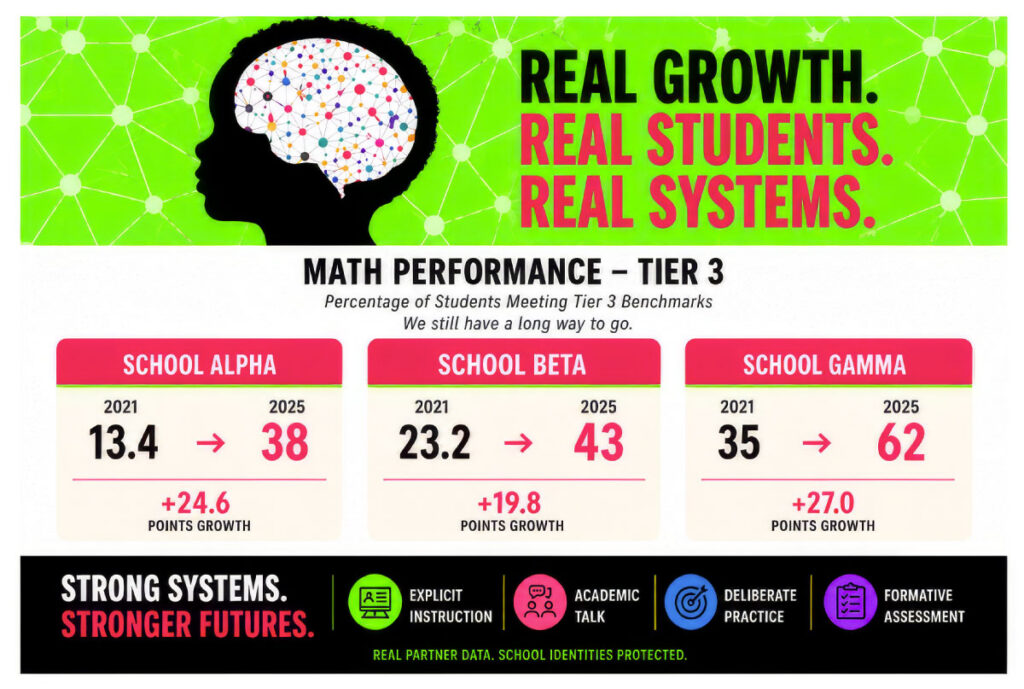
There is another uncomfortable truth sitting underneath these numbers: our systems are not consistently designed for mastery.
Too often, pace and coverage take priority. Pacing guides, competing demands, and limited time push instruction forward—even when students have not yet secured the foundation. This is not about a lack of care; it is about system conditions that make mastery difficult to guarantee.
The Elementary Gap
In elementary classrooms, this can be hard to see at first. Students move from unit to unit carrying partial understanding. Sometimes the gaps are subtle. Sometimes they are visible but there isn’t a clear, shared way to respond. Either way, students advance without firm mastery of foundational skills.
Over time, those gaps compound. A small misunderstanding in number sense or place value becomes a barrier to operations, then to fractions, and eventually to grade-level mathematics. By middle school, the work required is no longer a small adjustment—it requires intensive, targeted intervention.
The Middle School Gap
Middle school teams are then asked to respond to years of unfinished learning, often without the time, structures, or materials needed to do it well. When students struggle significantly, grading can become the default response—not because teachers don’t care, but because the system has not made intervention doable at scale.
What we are seeing is not a lack of commitment. It is a mismatch between the level of student need and the strength of the system designed to support it.
Math Mastery Must Be Non-Negotiable
This is why mastery must be non-negotiable in the early grades and intervention must be systematized in the later grades. Not as an added burden, but as a shared, supported process.
- In elementary: Can we confidently say students have mastered this before we move on?
- In middle school: Do we have a viable way to respond when they haven’t?
This is not about blame. It is about alignment. Educators care deeply about students, but without systems that make mastery visible and intervention doable, effort alone will not close gaps.
A relentless pursuit of mastery—paired with the structures to make it possible—is what prevents Tier 3 from becoming a middle school reality.
Tier 3 is not a small gap. In many cases, it means students are two to three years below grade level. In middle school, that reality becomes difficult to ignore: students in grades 6–8 are often working on elementary mathematics.
We are currently working with a middle school where 70 students qualified for Tier 3 support in number sense and place value, and another where more than 200 students qualified for Tier 3 intervention. These are foundational skills typically developed in early elementary grades.
This did not happen overnight. It is the result of gaps that were never fully addressed—year after year—until they compounded into something much harder to resolve. This is what system failure looks like—not because educators do not care, but because the system was not designed to respond early or precisely enough.
Ready to Interrupt the Pattern?
If your school is seeing the same trend—students arriving years behind without a clear plan to respond—there is a better way.
👉 Assess your current system and identify where gaps are forming:
Turn Data Into Action—Not Just Awareness
If your teams have the data but struggle to act on it, we can help you build a system that moves from evidence → instruction → intervention → results.
What Happens If We Don’t Fix This?
 This is the question we have to be willing to confront because it extends far beyond math scores. It is about life trajectories. When students do not develop math expertise, they are more likely to avoid advanced coursework, opt out of STEM pathways, and struggle with financial literacy and everyday decision-making. Repeated academic difficulty shapes how they see themselves as learners, often leading to disengagement.
Over time, these patterns compound into limited career options, reduced earning potential, and fewer opportunities for upward mobility. Perhaps most concerning is the belief many students internalize: “I’m just not good at math.” Once formed, that belief is incredibly difficult to change.
Final Thought
If we don’t build fluency, we don’t build access. And if we don’t build access, we limit what students believe is possible.
Ready to Build a System That Works?
If your teams are drowning in data but unsure what to do next, we can help.
We partner with schools and districts to design Tier 3 systems that:
- Use evidence to drive action
- Build fluency through intentional progressions
- Turn intervention into measurable growth
👉 Explore how Impact Teams can transform your system!
Real Coaching. Real Thinking. Real Growth.