

Mentoring is not primarily about giving answers.
This past week I had the privilege of exploring these ideas with mentors in Kern High School District, alongside district TOSAs Leanne Raddatz and Carrie Newman. Their vision for mentoring brought this work to life. From the beginning, their belief was clear: mentoring should not create dependence. It should build clarity, confidence, and professional agency in every new teacher. These kinds of teacher leaders strengthen the profession from within.
The most powerful mentors do something deeper. They help teachers see their own practice clearly, reflect with honesty, and make intentional instructional decisions. In other words, mentoring develops professional judgment.
At the center of effective mentoring is one essential outcome: teacher self‑efficacy.
Psychologist Albert Bandura demonstrated that people persist longer, solve problems more effectively, and grow more rapidly when they believe they are capable of succeeding. When teachers believe they can positively influence student learning, they take instructional risks, analyze evidence, and refine their practice.
Mentoring should therefore focus on building teacher efficacy—not dependence.
One structure that powerfully supports this goal is the Coaching for Efficacy Framework. When used intentionally, these coaching messages guide reflection while activating the four sources of efficacy identified by Bandura.
That belief is what we worked toward all week with mentors in Kern High—creating mentoring conversations where teachers leave not with answers from someone else, but with greater clarity about their own thinking.
The Four Sources of Efficacy
Every mentoring conversation either strengthens or weakens a teacher’s belief in their own capability. Bandura identified four experiences that most strongly shape that belief.
1. Mastery Experiences
Teachers see evidence that their actions made a difference.
I have succeeded before, so I can succeed again.”
2. Vicarious Experiences
Teachers see models of success and realize the work is possible.
Someone like me can do this.”
3. Social Persuasion
A trusted mentor communicates belief in the teacher’s ability.
Someone credible believes I can succeed.”
4. Emotional and Physiological State
Teachers feel safe enough to think clearly and try again.
Challenge does not mean failure. I can handle this.”
Mentors influence these experiences every time they speak. Coaching language can either reinforce confidence or unintentionally create doubt. This is why thoughtful mentoring structures matter.
Psychological Safety and the Iceberg of Culture
Before teachers can reflect honestly, they must feel psychologically safe.
Anthropologist Edward T. Hall’s Iceberg of Culture reminds us that much of what shapes teaching decisions lives below the surface. Classroom practices are visible, but the beliefs that drive those practices often remain hidden.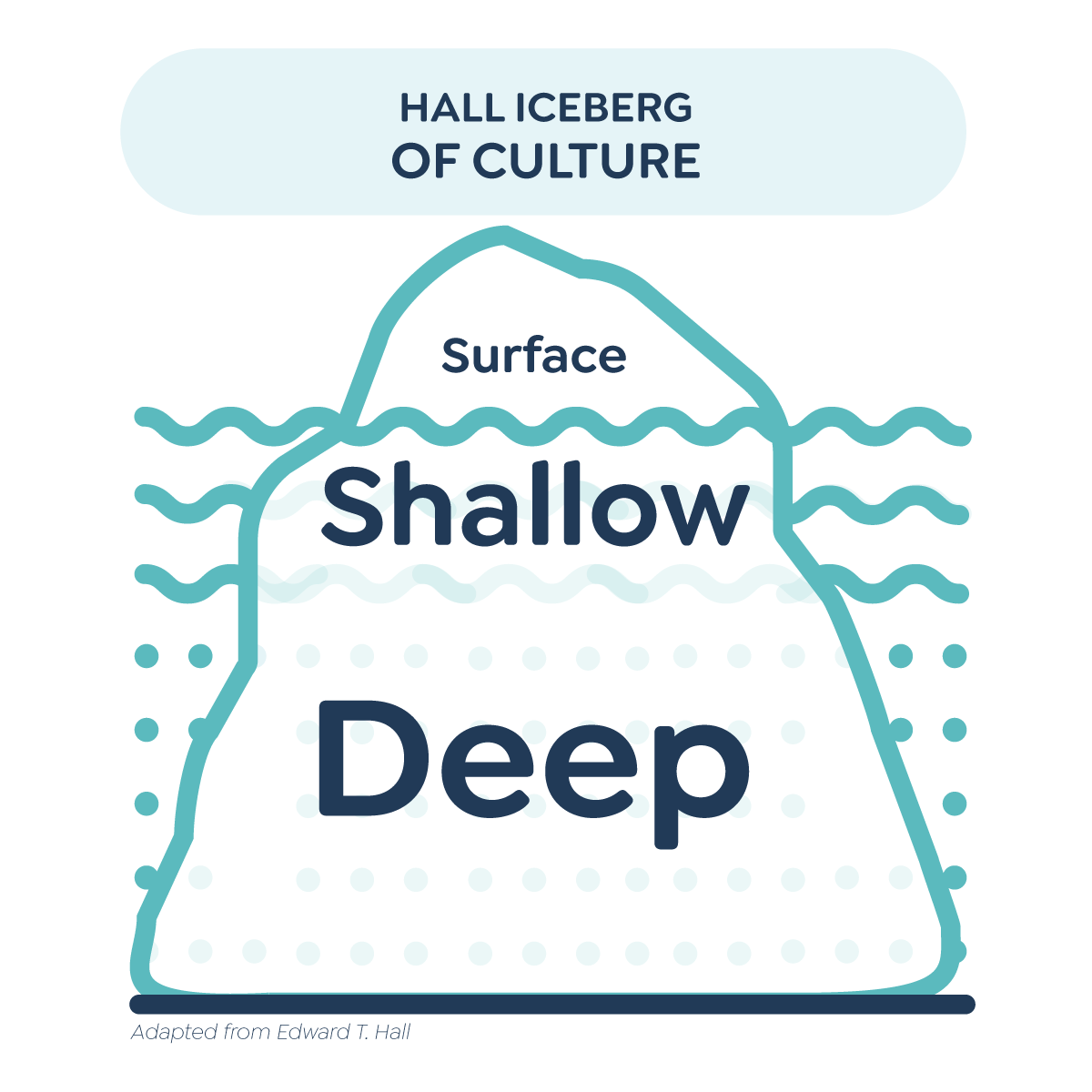
Above the surface, we see:
- instructional strategies
- lesson design
- questioning techniques
- classroom management moves
Below the surface live deeper influences:
- beliefs about intelligence
- assumptions about student motivation
- cultural norms about participation
- personal experiences as a learner
- beliefs about authority, effort, and success
If a mentoring conversation jumps quickly to correction, the teacher’s brain often moves into defense. Reflection shuts down.
But when mentors begin with curiosity and evidence-based language, teachers can safely examine what lies beneath the surface. Psychological safety makes reflection possible.
This is exactly where the A–B–C–D coaching messages become powerful.
Coaching for Efficacy Framework
The A–B–C–D framework provides mentors with four types of coaching messages that guide reflection while strengthening teacher efficacy.
Each message activates different sources of efficacy and keeps professional thinking with the teacher.
 A — Acknowledge
Acknowledging highlights effective instructional moves and connects them directly to student learning.
Example:
“When you asked students to justify their reasoning, more voices entered the conversation and students began building on each other’s ideas.”
This message activates Mastery Experiences because teachers see concrete evidence that their instructional decisions mattered.
Acknowledgement does more than praise. It clarifies the relationship between teacher action and student learning.
Effective acknowledgement typically includes:
- the specific instructional move
- the observable student impact
- a brief rationale for why it matters
When mentors name effective practice clearly, teachers begin to recognize their own instructional strengths.
 B — Brainstorm
Brainstorming is used when instruction could be strengthened through small adjustments. Instead of providing solutions, the mentor invites the teacher to generate possibilities.
Example:
“Several students participated in the discussion, but a few voices dominated. What structures might help more students contribute their thinking?”
Brainstorming activates two sources of efficacy:
- Mastery Experiences, because teachers generate their own solutions
- Emotional Regulation, because the conversation remains supportive rather than corrective
Brainstorming works best when mentors:
- pose open questions
- encourage multiple possibilities
- allow the teacher to select the next step
Ownership remains with the teacher, which strengthens professional confidence.
 C — Cognitive Coaching
Cognitive coaching invites deeper reflection through carefully crafted questions. This approach works especially well with teachers who already have developing reflective habits.
Examples include:
- “What evidence did you notice about student engagement?”
- “How did the learning goal influence student thinking?”
- “What might you adjust if you taught this lesson again?”
These questions activate two sources of efficacy:
- Vicarious Experiences, when teachers connect their work to professional standards or peer practice
- Social Persuasion, because the mentor communicates trust in the teacher’s thinking
Over time, teachers internalize these questions and begin reflecting independently.
 D — Direct

Direct coaching is used when an essential practice is missing or ineffective and clarity is needed.
Example:
“Students were unsure of the learning goal. Let’s look at how we might make the target visible and revisit it throughout the lesson.”
Even in direct coaching, mentors should maintain respect and psychological safety.
This message activates:
- Vicarious Experiences, by modeling effective practice
- Emotional Regulation, by reducing confusion and overwhelm
Direct coaching should still end with teacher ownership of implementation.
How Coaching Messages Strengthen Efficacy
When mentors intentionally choose their coaching message, they activate specific sources of teacher efficacy.
- Acknowledge strengthens mastery by helping teachers see evidence of success.
- Brainstorm strengthens mastery and emotional safety by keeping problem-solving with the teacher.
- Cognitive Coaching strengthens social persuasion and modeling through reflective dialogue.
- Direct Coaching strengthens emotional clarity and provides concrete models of practice.
Over time, these conversations accumulate. Teachers begin to believe they can analyze their practice, adjust instruction, and improve student learning.
That belief is self‑efficacy.
Connecting Coaching to Teaching Standards
Professional teaching frameworks emphasize reflection, responsiveness, and student engagement. Mentoring conversations become even more powerful when they connect teacher reflection to shared professional language.
In California, the revised California Standards for the Teaching Profession (CSTP) explicitly weave culturally responsive and sustaining education throughout the standards. Two standards are especially relevant to mentoring conversations: CSTP 1 – Engaging and Supporting All Students in Learning and CSTP 5 – Assessing Students for Learning. CSTP 1 calls on teachers to build learning experiences that affirm student identity, participation, and belonging, while CSTP 5 focuses on using evidence from student thinking and performance to guide instructional decisions. Together, these standards create a powerful bridge between culturally responsive teaching and reflective instructional practice. Teachers are expected not only to deliver content effectively, but to understand students’ identities, cultures, languages, and lived experiences as assets that strengthen learning.
For example, the standards call on teachers to:
- design learning experiences that affirm student identities and build belonging
- draw on students’ cultural and linguistic assets to support engagement
- create inclusive learning environments where every student participates and contributes
- reflect on their own assumptions and biases to improve equitable outcomes
These expectations make mentoring conversations especially important. When mentors ground reflection in CSTP 1 and CSTP 5, teachers begin to examine not only what they taught, but how students experienced the learning and what evidence shows about their understanding. When mentors guide reflection using the A–B–C–D messages, they help teachers examine how their instructional choices influence participation, belonging, and access to learning.
Mentors might ask questions such as:
- “How did this lesson invite students to participate and contribute their thinking?”
- “What evidence showed that students were making meaning during the discussion?”
- “How did your instructional move support belonging and engagement for different students?”
- “Whose voices were heard during the learning experience?”
Questions like these help teachers connect everyday instructional decisions to the broader goals of culturally responsive and sustaining teaching.
Frameworks provide the language, but mentoring conversations bring that language to life.
 From Rescuing to Empowering

One of the most common mentoring mistakes is rescuing.
When mentors immediately provide answers, teachers may follow the suggestion but fail to develop their own professional judgment. Dependence grows instead of confidence.
The A–B–C–D framework helps mentors resist the urge to rescue. Instead, mentors:
- highlight teacher strengths
- encourage reflection
- surface underlying assumptions
- build instructional ownership
Through this process teachers develop the capacity to analyze and adjust their own practice.
The Core Goal of Mentoring
The ultimate goal of mentoring is not simply improving individual lessons. Strong mentoring helps teachers develop the clarity and confidence to examine their own practice over time.
At its best, mentoring builds metacognitive clarity—the ability for teachers to notice what is happening in their classroom, interpret evidence from students, and make intentional adjustments. When teachers can see their practice clearly, they are no longer dependent on someone else for answers. They become reflective decision makers.
The goal is helping teachers believe:
“I can examine my practice clearly.”
“I can adjust instruction when students struggle.”
“I can positively influence student learning.”
When mentors intentionally activate Bandura’s four sources of efficacy through their coaching language, they strengthen this belief. Teachers begin to see patterns in their own success, learn from colleagues, hear credible encouragement, and feel safe enough to take instructional risks.
And when teachers believe they can make a difference, they persist longer, innovate more confidently, and grow continuously.
That belief—teacher self‑efficacy—is the foundation of powerful teaching and the heart of effective mentoring.
Subscribe to the TCC Newsletter for practical strategies, classroom resources, and highlights from educators working to advance equity, belonging, and powerful learning.
References
- Bandura, A. (1997). Self‑Efficacy: The Exercise of Control. New York: W.H. Freeman.
- Hall, E. T. (1976). Beyond Culture. New York: Anchor Books.
- California Commission on Teacher Credentialing. (2024). California Standards for the Teaching Profession (CSTP). Sacramento, CA.
- Danielson, C. (2013). The Framework for Teaching. Princeton, NJ: The Danielson Group.
- Bloomberg, P. J., et al. (2017). Leading Impact Teams: Building a Culture of Efficacy. Bloomington, IN: Solution Tree.
- Bloomberg, P. J., et al. (2018). Peer Power! Unite, Learn, and Prosper: Activate an Assessment Revolution. Thousand Oaks, CA: Corwin.
- Bloomberg, P. J., et al. (2021). Amplify Learner Voice through Culturally Responsive Assessment. Thousand Oaks, CA: Corwin.
- Bloomberg, P. J., Wells, I., Adriaan, S. C., et al. (forthcoming). Metacognitive Clarity: Think Rigorously. Advance Democracy. Mimi & Todd Press.
Works by Dr. Paul Bloomberg and colleagues are available at the Amazon Author Central page.