
Metacognition is often described as “thinking about one’s thinking,” but in practice, it is what keeps learning moving. Metacognition is the learner’s ability to plan intentionally, monitor progress in real time, and evaluate outcomes in ways that continuously generate next steps. When taught explicitly and used consistently, metacognition turns learning into a self-sustaining process rather than a series of isolated tasks.
In Metacognitive Clarity: Think Rigorously. Advance Democracy., metacognition is framed as both a learning accelerator and a justice-centered practice. When learners understand how they learn, why strategies work, and how to adjust when learning becomes challenging, they develop agency. That agency is not static. It compounds over time. Each successful reflection strengthens the learner’s ability to engage productively with the next challenge, creating momentum that carries forward.
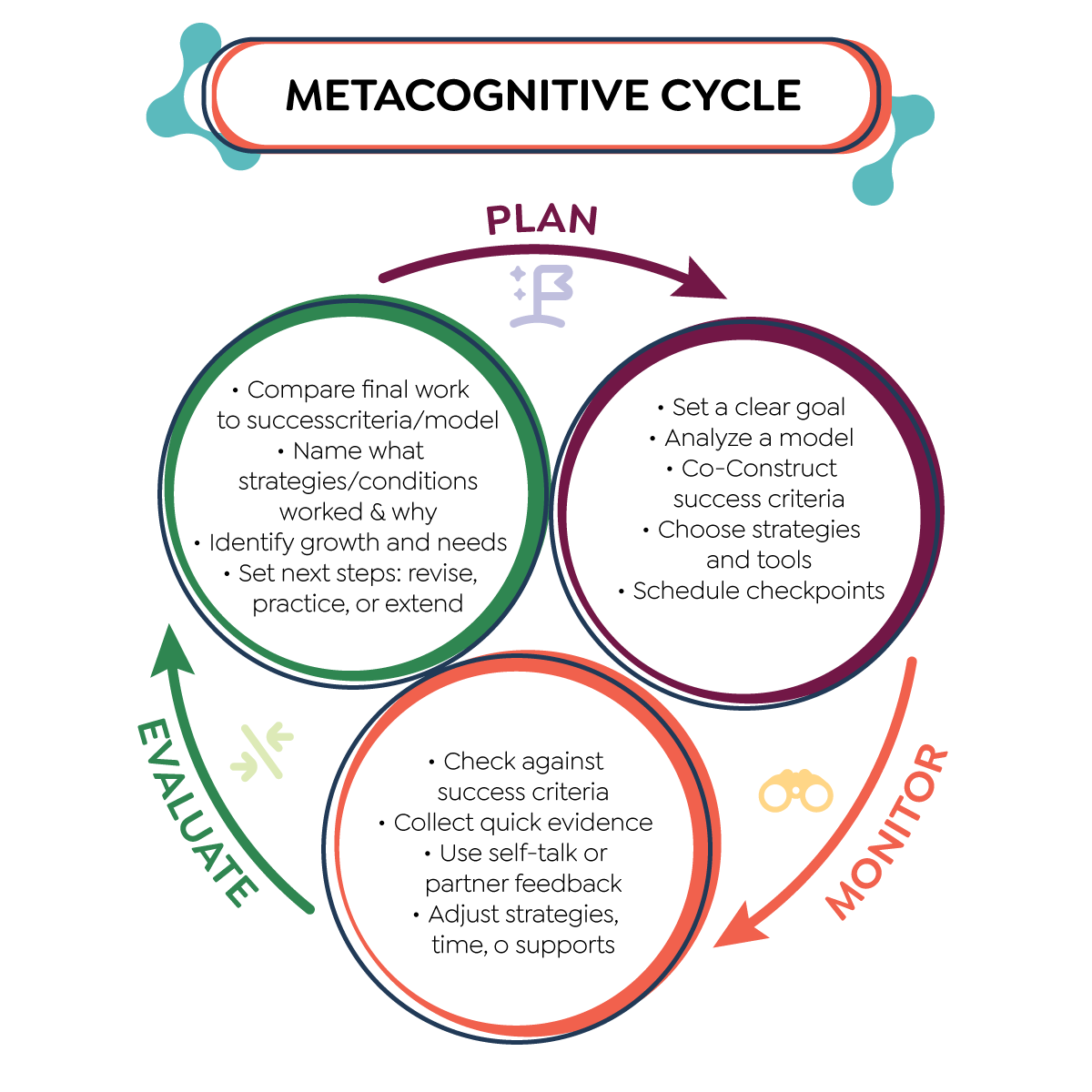
The Metacognitive Cycle: Plan, Monitor, Evaluate makes this momentum visible. Rather than a linear checklist, the cycle functions like a perpetual motion machine for learning. Each phase feeds the next. What learners discover at the end of one cycle becomes the starting energy for the next, reducing dependence on external direction and increasing ownership.
Plan
Planning initiates motion by clarifying purpose. Learners define the learning goal, examine models or exemplars, and co-construct success criteria so expectations are clear and accessible. They choose strategies intentionally and anticipate where they may need to adjust. Effective planning does more than prepare learners for a task. It sets up the conditions for meaningful monitoring and evaluation later, ensuring the cycle can continue.
Monitor
Monitoring sustains motion while learning is underway. Learners check progress against success criteria, gather evidence, and reflect on what is and is not working. This ongoing awareness allows them to make timely adjustments rather than waiting for the end. Monitoring feeds directly into evaluation by generating insights about strategy use, effort, and understanding as learning unfolds.
Evaluate
Evaluation captures and redirects energy. Learners reflect on their final work in relation to success criteria, identify which strategies supported success, and name areas for growth. Most importantly, they determine next steps. Those insights do not end the process. They power the next round of planning. Evaluation becomes the fuel that launches the next cycle, rather than a stopping point.
What makes the Metacognitive Cycle especially powerful is that it feeds itself. Each pass through the cycle builds greater clarity, confidence, and strategic awareness. Over time, learners internalize the process. Learners begin to plan with intention, monitor with purpose, and evaluate with insight across tasks, subjects, and contexts. Learning continues to move forward because learners know how to keep it in motion.

Metacognitive Clarity goes far deeper than this overview, providing classroom-ready tools, reflection prompts, protocols, and examples that show educators how to teach metacognition explicitly and embed the cycle into daily instruction, assessment, and feedback. Make it a New Year’s resolution to kick off this perpetual motion machine with your students!