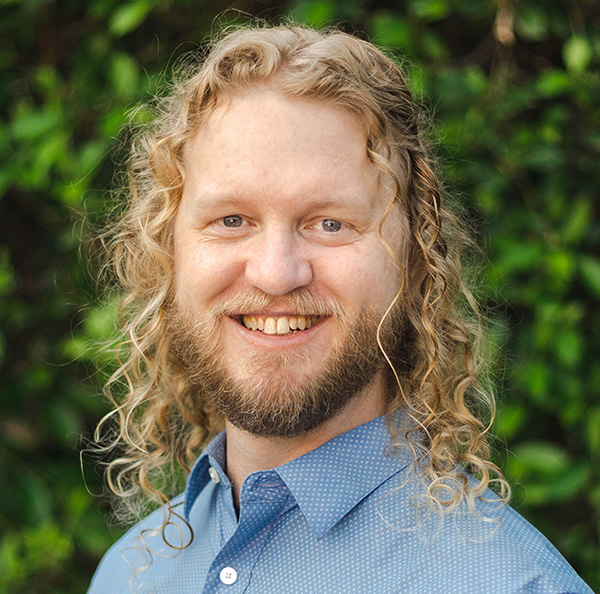

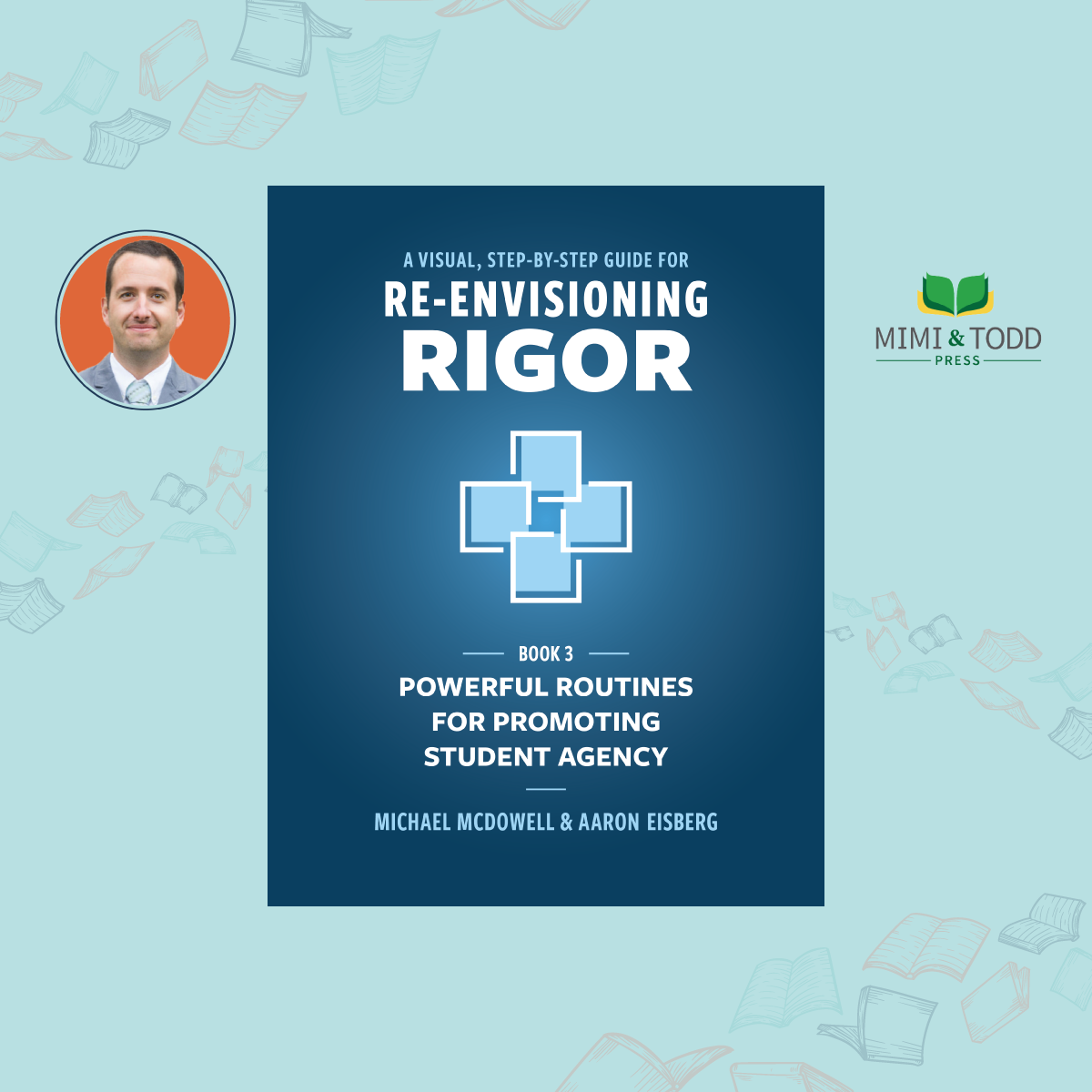
 In this interview, Dr. Michael McDowell reveals how simple daily routines can unlock real agency and authentic rigor for every learner. He offers a fresh way to think about teaching by showing that rigor is not about doing more. It is about doing what matters with clarity and intention.
Michael shares the insight that inspired his newest book with co-author Aaron Eisberg, A Visual, Step-by-Step Guide for Re-Envisioning Rigor: Powerful Routines for Promoting Student Agency. He also shares the challenge that reshaped his thinking and the one practice he hopes every educator will try. His perspective is practical, hopeful, and focused on what teachers can do right away. This is a great place to start establishing a clearer path to deeper learning.
Inspiration and Purpose for Writing
Q: What pivotal experience or insight motivated you to write this book, and what impact do you hope it has on educators and learners?
A: A pivotal insight behind this book came from watching what happens when students and teachers both experience agency; not as a slogan, but as a set of simple, repeatable routines. We often talk about student agency as if it lives independently in students, but agency is always interdependent. Teachers must model it first. Teachers must go first so students have permission, clarity, and confidence to follow.
I wrote this book with Aaron to show that agency becomes visible and powerful when it is woven into small, everyday routines across surface, deep, and transfer learning. My goal is to help educators see that agency isn’t something students “have”; it’s something we build together through intentionally designed habits that make learning clearer, stronger, and more sustainable.
Re-Envisioning Rigor: New Thinking on an Old Topic
Q: How does your work challenge traditional views regarding academic rigor, and why is re-envisioning rigor so important now?
A: Our work challenges the traditional view of rigor as a ladder that students climb or an event that happens only when tasks get harder. Rigor is not a hierarchy; it’s a taxonomy and a routine.
Re-envisioning rigor means treating it as something doable, accessible, and grounded in practice rather than perfection. At a time when educators are overwhelmed by tools, programs, and initiatives, we need a clearer, more human definition of rigor: short, powerful habits that help students think more deeply, reason more clearly, and transfer their learning with confidence.
This shift matters now more than ever because rigor should empower, not exhaust. When routines make rigor visible, every student can do it, and every teacher can lead it.
Navigating Complexity
Q: What was the most surprising challenge you encountered while writing your book, and how did it deepen your understanding of the subject matter?
A: The most surprising challenge I encountered while writing this book was realizing just how small the work of improvement really is. We often assume that rigor and agency require massive systems or dramatic shifts. But the deeper I went, the clearer it became: the key is relentless consistency with a few high-leverage routines.
Understanding this reshaped the entire book. Complexity is solved by doing the right things, simply and repeatedly.
Personal Growth Through Writing
Q: In what ways did the process of writing this book influence your own beliefs about teaching, agency, or leadership?
A: Writing this book reshaped my own thinking about agency, teaching, and leadership. I’ve always believed in agency, but I realized it must be less conceptual and more operational. Agency grows when we can see it, when we turn it into visuals, routines, and rhythms that make abstract ideas actionable.
Advice for Educators
Q: If educators could take just one key idea from your book to immediately transform their practice, what would it be, and why?
A: If educators take only one idea from this book, let it be this: Start with one routine, stick with it without judgment for several weeks, and look for marginal gains.
Most teams are actually good at choosing a routine. The challenge is sticking with it long enough for it to become a habit. When we stay consistent, the routine begins to do the work. That’s where the transformation happens.
What is Michael reading?
Q: What are you currently reading for work or pleasure that you would recommend and why?
A: I recently finished Everything Is Tuberculosis, a powerful exploration of bias, uncertainty, and the deeply human instinct to cling to certainty, especially when the world feels overwhelming. One of the threads that stayed with me is how quickly our minds reach for simple narratives when the truth is complex. We create tidy explanations not because they’re accurate, but because they shield us from the discomfort of ambiguity.
I recommend this book because it reinforces a theme central to my own work: meaningful progress doesn’t come from grand gestures but from the quiet, consistent routines we choose to honor. When we resist the pull of simple narratives, stay small, stay focused, and balance urgency with the discipline to go slow to go far, we build the capacity, for ourselves and for our students, to see the world as it actually is and move it toward what it can become.
Thanks to Michael from all of us at MTP, and stay tuned for next month’s conversation with another one of our inspiring authors.
Ready to dive deeper?
Pick up a copy of A Visual, Step-by-Step Guide for Re-Envisioning Rigor: Powerful Routines for Promoting Student Agency and discover how simple, intentional routines can transform the way your students think, learn, and apply their understanding every day.