 What Are Student-Led Instructional Rounds?
Student-Led Instructional Rounds are a democratic improvement process in which students serve as co-researchers of teaching and learning. Rather than positioning students as subjects of observation, Student-Led Instructional Rounds position students as partners in inquiry who help frame questions, gather evidence, analyze patterns, and contribute to school improvement.
Drawing inspiration from instructional rounds, improvement science, and democratic education, the process creates structured opportunities for students and adults to learn alongside one another. Students observe classrooms, engage in evidence-based dialogue, identify strengths and opportunities, and help generate actions that improve learning conditions for all learners.
At their best, Student-Led Instructional Rounds create feedback loops that strengthen trust, collective efficacy, and shared ownership of school improvement.
Why Learner Identity?
This round focused on learner identity—the story students tell themselves about who they are as learners.
Learner identity influences how students answer questions such as:
- Do I belong here?
- Am I capable of success?
- What do I do when learning becomes difficult?
- Does my voice matter?
- Is my culture, language, and lived experience valued?
- Can I influence my own growth?
Research consistently demonstrates that students’ beliefs about themselves influence engagement, persistence, achievement, and long-term success. Learner identity is not fixed; it is shaped through daily interactions with peers, teachers, curriculum, assessment systems, and school culture.
When students experience success, connection, and meaningful participation, positive learner identities grow stronger. When students experience exclusion, invisibility, or repeated failure, learner identities can become barriers to achievement.
The Connection Between Belonging and Achievement
A growing body of research demonstrates that belonging is not separate from academic achievement—it is a prerequisite for it.
Students are more likely to engage in rigorous learning when they feel known, valued, respected, and psychologically safe. When students experience belonging, they are more likely to:
- participate in discussions,
- take intellectual risks,
- seek feedback,
- persevere through challenges,
- collaborate with peers,
- and view themselves as capable learners.
Belonging strengthens engagement, and engagement creates opportunities for achievement.
For this reason, this round explored learner identity through questions of belonging, relationships, psychological safety, participation, and meaningful learning. The goal was not simply to understand what students were doing in classrooms, but to understand how students were experiencing learning and how those experiences shape both achievement and agency.
As the students in this round reminded us, the most important question is not whether students appear engaged. The deeper question is whether students see themselves as learners who belong, contribute, and can succeed.
Student-Led Instructional Rounds Through the Lens of Learner Identity
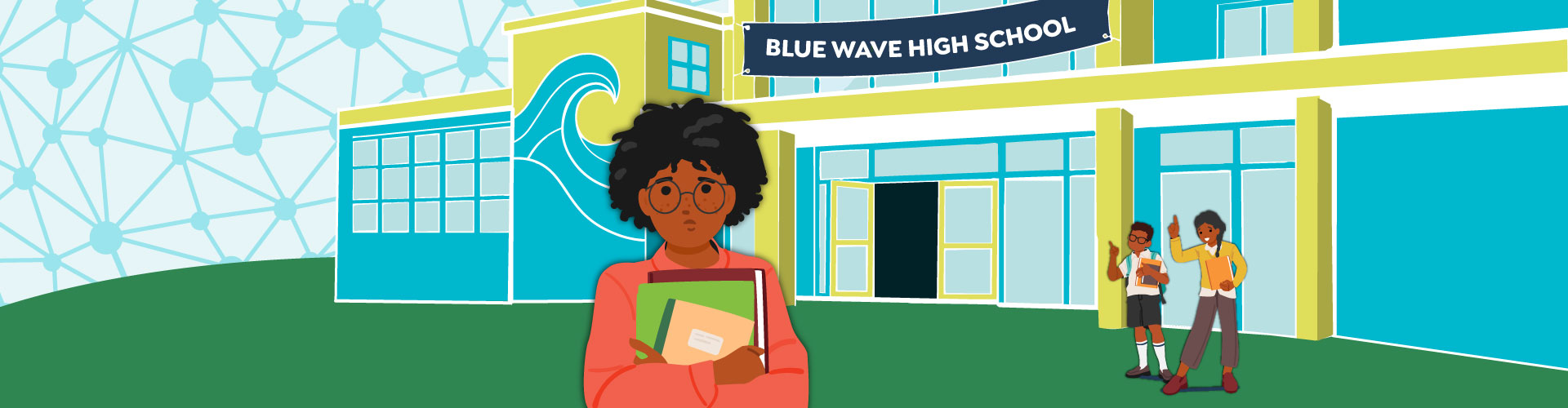
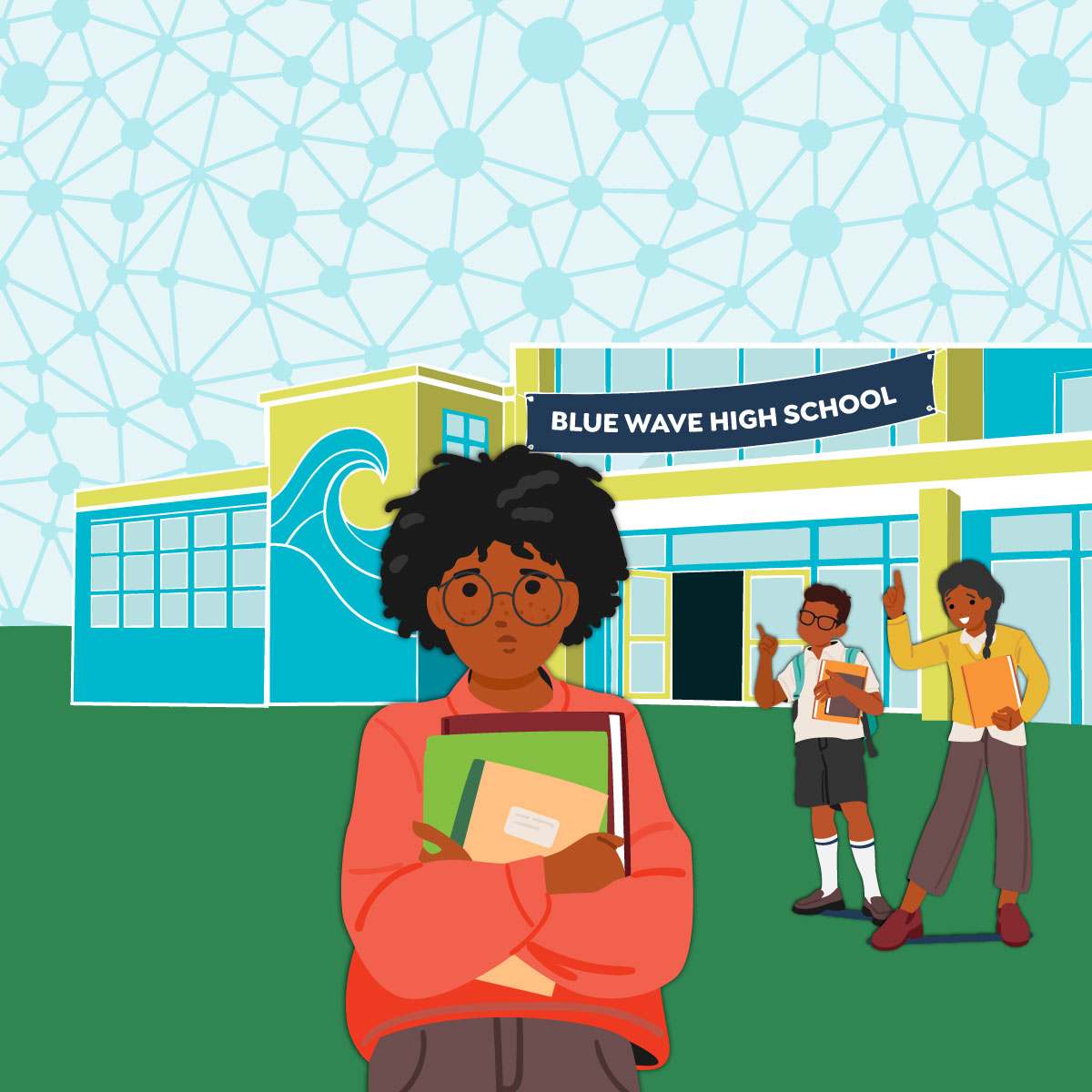
Blue Wave High School
Introduction
I can really pretend to learn and like not think at all and just be completely blank inside.”
The room went quiet for a moment after the student said it.
Not awkward quiet. Thinking quiet.
Several students nodded almost immediately. One laughed softly in recognition. Another added that it was easier to do during first period when you were exhausted. Someone else called it “playing school.”
What struck me was not just the honesty of the statement, but how quickly the other students understood exactly what she meant.
Before we had even entered a classroom observation, students at Blue Wave High School had already surfaced one of the central tensions of modern schooling:
the difference between visible compliance and authentic learning.
That moment fundamentally changed the direction of the instructional round.
I have facilitated instructional rounds in schools across the country for years. In many systems, rounds begin with adults identifying the problems, adults determining the look-fors, adults gathering the evidence, and adults deciding what the findings mean. Students may occasionally participate, but they often remain positioned as subjects of observation rather than co-constructors of inquiry itself.
For this round, I wanted to lean into the district’s focus on agency and to do that we wanted to ensure we dug into learner identity. Learner identity is the story a person tells themselves about who they are as a learner.
It is the collection of beliefs, experiences, dispositions, values, and social messages that shape how someone answers questions such as:
- Am I capable?
- Do I belong here?
- What am I good at?
- What do I do when learning gets difficult?
- Is my culture, language, and lived experience valued in this space?
- Can I influence my own success?
Learner identity develops over time through experiences with family, peers, teachers, schools, communities, and society. It is not fixed. It can strengthen, weaken, or transform based on the experiences learners have.
So, before we visited a single classroom, I wanted to understand how students themselves defined meaningful learning. I wanted to know:
- What makes students feel engaged?
- What makes students feel psychologically safe enough to take risks?
- What helps students move beyond compliance into genuine intellectual engagement?
- What conditions help students feel connected to learning?
- What makes classrooms feel relational rather than transactional?
Instead of beginning with protocols and observation tools, we began with students. What unfolded over the next several hours became far more than a traditional instructional round.
Students co-constructed observation lenses rooted in:
- collaboration,
- curiosity,
- relevance,
- contribution,
- emotional safety,
- relationships,
- risk-taking,
- and learner identity.
As the day progressed, students moved far beyond surface-level feedback. They began theorizing about:
- grading and self-worth,
- psychological safety,
- belonging,
- reciprocal teaching,
- relational trust,
- representation,
- cognitive overload,
- and the emotional conditions necessary for authentic learning.
Most importantly, the intellectual authority in the room shifted. Students were not simply responding to adult questions. They became:
- researchers,
- analysts,
- facilitators,
- theorists,
- and co-designers of school improvement itself.
This case study documents three interconnected phases of the work:
- Planning the Round Through Learner Identity
- The EAA Debrief Process (Evidence → Analysis → Action)
- Democratic Inquiry and the Reconstruction of Student Voice
What happened at Blue Wave High School reinforced something I have increasingly come to believe:
student voice is not democratic simply because students are asked to speak.
Democratic participation requires students to help frame the inquiry, interpret the evidence, critique the system, and influence the response. At Blue Wave, students did exactly that. And in the process, they helped redefine what instructional rounds can become.
Part I: Planning the Round Through Learner Identity
 Beginning with Students, Not the Protocol
When I first walked into the room, I intentionally resisted the urge to immediately explain protocols, observation forms, or logistics. I have learned over time that if students are going to tell the truth about learning, they first need to know what kind of space they are entering.
So we started slowly.
Students introduced themselves. Some talked about sports. Some talked about trying new experiences. Some described themselves as social. Others were more reserved, quietly trying to figure out what this experience was actually going to be.
I could feel the uncertainty in the room. Students were still trying to determine whether this was another performative school activity where adults would collect student feedback only to move on unchanged, or whether their thinking was genuinely going to matter.
One student summarized the purpose of the day this way:
“We are going around to different classrooms and writing down the strengths in each class and then we’re going to share about it.”
That framing mattered because, from the beginning, the process was intentionally strengths-based. Students were not entering classrooms looking for “bad teaching.” They were entering classrooms looking for evidence of meaningful learning conditions.
I told them:
“This whole school experience is really your experience.”
And I meant it.
The goal was not to evaluate teachers. The goal was to understand learning through the lived experiences of students themselves.
Introducing Learner Identity
Instead of presenting pre-made observation criteria, I introduced the concept of learner identity and posed a deceptively simple question:
“What does it actually feel like to learn?”
The response was immediate. Students began naming learning not as compliance, but as a deeply relational and cognitive experience.
They described learning as:
- understanding concepts,
- asking questions,
- making connections,
- collaborating,
- immersion,
- contribution,
- trial and error,
- and relevance to their lives.
One student explained:
“It’s not just worksheet after worksheet without getting understanding.”
Another emphasized that learning becomes more meaningful when students can identify themselves within the material itself:
“Being able to identify yourself with the material that you’re learning.”
As students continued talking, a clear distinction emerged between authentic learning and performative compliance.
Then came the moment that shifted the room:
“I can really pretend to learn and like not think at all and just be completely blank inside.”
Several students immediately agreed, and one student described it as “playing school.”
What students were articulating with remarkable sophistication was the difference between:
- visible participation,
- and actual cognitive engagement.
They understood how to comply without learning, and they understood how to perform attentiveness while remaining intellectually disconnected. That insight became one of the central anchors of the round itself because it exposed how easily schools can confuse visible participation with genuine intellectual engagement.
Co-Constructing the Observation Lenses
As students continued describing meaningful learning, we began translating their language into observation lenses for the round.
Importantly, I was not feeding students categories. I was listening carefully and organizing their language back into themes so the observation lenses emerged from students’ lived experiences rather than adult assumptions about learning.
Together, students co-constructed observation lenses around:
- collaboration,
- hands-on learning,
- curiosity,
- risk-taking,
- relevance,
- contribution,
- student voice,
- psychological safety,
- and relationships.
That distinction mattered deeply. Students were not observing classrooms through adult-created indicators. They were observing classrooms through frameworks rooted in their own lived experiences as learners.
The ownership in the room shifted almost immediately. Students were no longer passive participants in an adult-designed process. They became co-designers of the inquiry itself.
Slowing Down Student Thinking
One facilitation move I found myself using repeatedly throughout the planning session was paraphrasing students’ thinking back to them. Partly, I was checking my own understanding, but I was also intentionally slowing the room down.
Students often expressed important insights quickly, almost casually. By paraphrasing and revisiting their thinking, I wanted students to hear the depth of their own ideas reflected back to them.
At one point, I explained directly why I was doing it:
“When I summarize what you’re saying, I’m checking for understanding… but it’s also a sign of respect.”
That clarification mattered because the process itself was democratic. Students were not being mined for quotes. Their thinking was being treated as intellectually significant enough to revisit, refine, challenge, and build upon collectively.
The more we slowed the thinking down, the deeper the analysis became. Students began building on one another’s ideas rather than simply responding to adult questions, and the conversation gradually shifted from individual reactions to collective meaning-making.
The room increasingly started to feel less like a school activity and more like collaborative inquiry.
Teaching Students to Gather Evidence
Before entering classrooms, we discussed the difference between:
- observation,
- interpretation,
- and judgment.
I introduced students to low-inference note-taking and told them:
“You’re researchers today.”
That language was intentional. I did not want students entering classrooms looking for “good” teachers or “bad” teachers. I wanted them looking for evidence of learning conditions. I also repeatedly reinforced that we were looking for “bright spots.” That strengths-based framing became critical because it protected the process from becoming deficit-oriented while still allowing students to engage in honest critique and analysis.
By the time we left for classroom observations, students had already begun theorizing about:
- engagement,
- belonging,
- emotional safety,
- collaboration,
- learner identity,
- and intellectual risk-taking.
And we had not even entered the first classroom yet.
Part II: The EAA Debrief (Evidence → Analysis → Action)
 From Observation to Collective Meaning-Making
By the time we returned from classroom observations, students were no longer simply collecting notes. They were already comparing classrooms internally.
Students entered the debrief carrying:
- patterns,
- tensions,
- questions,
- emotional reactions,
- and emerging theories about learning itself.
Some students had become fascinated by collaboration. Others focused on relationships. Some became deeply interested in emotional safety. Others were paying attention to student voice, belonging, or teacher-student trust.
Without explicitly planning it, many students had developed their own informal research questions. The room felt different now. Students were no longer waiting for adults to tell them what mattered; they were trying to make sense of what they had seen together.
As students spread out their observation sheets across the tables, I asked them to identify the categories where they had gathered the most evidence. Collaboration emerged almost immediately as a shared focal point.
What fascinated me was how naturally students began moving between:
- evidence,
- interpretation,
- systems thinking,
- and action.
They were not simply reporting observations. They were theorizing together.
Collaboration as Relationship, Not Compliance
Students repeatedly returned to collaboration as one of the strongest indicators of meaningful learning.
Across classrooms, students consistently connected strong collaboration to emotional safety, trust, and relationships rather than simply academic task completion.
But students did not define collaboration superficially.
They were not talking about students merely sitting in groups.
They were talking about:
- trust,
- comfort,
- relationships,
- belonging,
- organization,
- contribution,
- and emotional safety.
One student described noticing classrooms where collaboration felt “organic” rather than forced.
Another student later echoed the same idea almost word-for-word while describing classrooms where students appeared comfortable enough to question one another naturally. Students were naturally questioning one another, helping one another, and solving problems together without heavy teacher prompting.
As I paraphrased the observation back to the group, Iris immediately moved into analysis:
“Having more organic stuff means students are usually way more comfortable.”
That insight shifted the conversation, and students began connecting collaboration directly to psychological safety. Jaylen explained that students often feel more comfortable collaborating when they are allowed to work with peers they already trust and feel connected to.
Another student added:
“If you have relationships with one another, it might make you like the subject more.”
Students were not separating learning from relationships. They were describing relationships as a condition for learning itself.
Reciprocal Teaching, Shame, and Dignity
One of the most sophisticated conversations of the day emerged unexpectedly during a discussion about reciprocal teaching and peer support. Students described classrooms where teachers intentionally paired higher-scoring students with lower-scoring students to support collaborative learning.
Initially, students acknowledged the potential benefits of peer teaching. But almost immediately, Carly complicated the conversation. She explained that reciprocal teaching only works under certain relational conditions. Otherwise, it can unintentionally create shame. She described how feedback from a close friend feels fundamentally different than feedback from someone you do not trust or know well.
Students nodded throughout the room.
Learning, students reminded us, is not emotionally neutral. The conditions surrounding collaboration matter. Relationships matter. Trust matters. Dignity matters. Students were not rejecting collaboration or reciprocal teaching. They were identifying the conditions necessary for those structures to remain humane.
The students were no longer simply discussing instructional strategies. They were theorizing about the emotional architecture of learning environments.
Grades, Self-Worth, and Learner Identity
The conversation deepened even further when students began discussing grades.
What started as a conversation about reciprocal teaching gradually evolved into a larger discussion about identity and self-worth. One student reflected that nearly every peer they interviewed defined success almost entirely through grades.
That realization seemed to land collectively across the room.
Students began discussing how grading systems shape:
- confidence,
- belonging,
- motivation,
- and self-perception.
What stood out was how consistently students connected success to grades and scores. Across multiple interviews, students described grades as the primary way they determined whether they were successful, intelligent, or doing well in school.
Iris quietly reflected:
“Everyone eventually fails one or two assignments.”
Then Jaylen added:
“No one wants to feel stupid.”
The room became noticeably quieter after that, not because students disagreed, but because they recognized the truth inside the statement immediately. What students were articulating was not simply frustration about grades.
They were describing how grading systems can become identity systems. Students repeatedly returned to the idea that grades often become labels attached to a person’s worth rather than feedback intended to support learning. One student explained that when self-worth becomes attached entirely to grades, failure begins to feel personal rather than instructional.
The students collectively arrived at one of the most important conclusions of the day:
people are more than grades and points.
Importantly, I did not introduce that idea. The students arrived there together through dialogue, disagreement, reflection, and analysis. That mattered because democratic inquiry is not about adults delivering conclusions to students.
It is about creating conditions where meaning can be constructed collectively.
Welcoming Environments and Human Relationships
As students moved into the Action phase of the EAA process, they began proposing concrete ways schools could strengthen learning conditions. What stood out immediately was how relational their recommendations were.
Students recommended:
- stronger classroom community,
- intentional relationship-building,
- greater student agency,
- more welcoming learning environments,
- and more opportunities for authentic human connection.
One student explained that learning environments become more welcoming when students know something about their teachers as people, not just as authority figures. Another argued that school culture is shaped not only inside classrooms, but also through shared experiences outside of them:
- assemblies,
- activities,
- events,
- and communal experiences.
Students repeatedly described learning as fundamentally social and relational. Regardless of grade level or classroom, students consistently returned to the importance of:
- relationships,
- comfort,
- belonging,
- and emotional connection.
Very few students described meaningful learning primarily through compliance, grades, or task completion alone.
Not transactional or procedural. Relational.
Democratic Participation and Representation
One of the most important democratic critiques emerged during a discussion about student voice itself. Students began discussing how schools often rely on a narrow group of students when gathering feedback.
Multiple students independently raised concerns that schools often center the perspectives of students already succeeding academically while overlooking students who may feel disconnected, overwhelmed, or less visible within the system.
Jaylen reflected that schools frequently elevate students who are already successful academically while overlooking:
- disengaged students,
- struggling students,
- students with lower grades,
- or students who feel disconnected from school entirely.
Another student pushed further, arguing that authentic school improvement requires hearing from a much wider range of student experiences.
What students were critiquing was not simply representation. They were critiquing performative voice systems. Students understood instinctively that if schools only gather feedback from students already succeeding inside the system, the resulting analysis will remain incomplete.
Even participation itself can become inequitable. And students recognized that immediately.
Students Becoming System Leaders
By the end of the debrief, the conversation had shifted again. Students were no longer simply reflecting on the experience.
They were proposing:
- future focus groups,
- anonymous surveys,
- expanded classroom observations,
- new research methods,
- and systems for communicating findings back to teachers.
Several students expressed interest in facilitating future rounds themselves.
That moment mattered deeply.
Because the transformation was no longer theoretical, students had begun to see themselves not simply as participants within the school system, but as contributors capable of improving it.
The instructional round had evolved into something far more significant than a feedback protocol. It had become a model of democratic inquiry grounded in learner identity, relationships, and collective meaning-making.
Part III: Democratic Inquiry and Learner Identity
Beyond Performative Student Voice
What happened at Blue Wave High School reinforced something I have increasingly come to believe:
Student voice is not inherently democratic.
Too often, schools gather feedback from students after decisions have already been made. Students are invited to share opinions, but not to shape inquiry, analyze evidence, critique systems, or influence action.
That is consultation, not democratic participation.
At Blue Wave, students:
- framed the inquiry,
- co-constructed observation lenses,
- gathered evidence,
- analyzed patterns,
- surfaced tensions,
- challenged assumptions,
- and proposed systemic responses.
The intellectual authority in the room shifted.
Students became:
- researchers,
- facilitators,
- analysts,
- theorists,
- and contributors to organizational learning.
Importantly, they handled that responsibility with seriousness, care, and sophistication.
Psychological Safety as a Condition for Participation
One of the clearest findings across the round was that students participate differently when they feel emotionally safe.
Again and again, students connected:
- collaboration,
- engagement,
- risk-taking,
- belonging,
- and contribution
to whether or not they felt safe enough to participate authentically.
Students repeatedly described meaningful learning environments as places where
- mistakes feel survivable,
- voice is honored,
- relationships matter,
- and people feel emotionally known.
What struck me most was how deeply students understood the emotional dimensions of learning.
They talked openly about:
- shame,
- intimidation,
- fear,
- anxiety,
- belonging,
- and social vulnerability.
Not as distractions from learning. As conditions that shape learning itself. Again and again, students returned to the same underlying truth: people participate differently when they feel psychologically safe.
And that insight has enormous implications for democratic education because students cannot fully participate in classrooms where they do not feel emotionally safe enough to contribute honestly.
 Learner Identity as Democratic Work
The biggest realization I left Blue Wave with was this: learner identity and democratic participation are deeply interconnected.
When students:
- feel known,
- feel valued,
- feel psychologically safe,
- and believe their thinking matters,
They participate differently. Not only academically, but communally, relationally, and civically. The instructional round itself gradually became a model of the kind of learning culture students were describing:
- collaborative,
- reflective,
- relational,
- inclusive,
- dialogic,
- and rooted in collective meaning-making.
Students did not merely analyze instruction.
They analyzed:
- relationships,
- identity,
- representation,
- power,
- belonging,
- emotional safety,
- and participation itself.
And they did so with a level of sophistication that schools often underestimate in young people.
What stayed with me most was not simply that students had valuable feedback. It was that students were capable of helping adults think differently about learning itself. They helped us see the difference between students appearing connected to learning and students actually feeling connected to learning.
And once students begin naming that difference honestly, school improvement can no longer remain performative either.
From Student Voice to Student Stewardship
The success of this round will not be measured by the quality of the observations students made. It will be measured by what happens next.
Too often, schools ask students for feedback without creating meaningful pathways for action. Students learn quickly whether their voices are being collected or whether they are being trusted as partners in improvement. If this work is to remain democratic, the findings from this round must become more than a report. They must become a catalyst for change.
The students surfaced important opportunities for growth. They challenged us to strengthen relationships and community across the school. They reminded us that collaboration is most powerful when it is rooted in trust and psychological safety. They raised important questions about how grading systems influence self-worth and learner identity. They called attention to the need to hear from students whose experiences are often absent from school improvement conversations.
As school leaders reflect on the findings, several possibilities emerge:
- Expand opportunities for student voice through ongoing focus groups, advisory structures, and future instructional rounds.
- Strengthen schoolwide systems that foster belonging, relationships, and psychological safety.
- Examine grading and assessment practices through the lens of learner identity and growth.
- Increase authentic opportunities for collaboration, contribution, and student agency.
- Ensure that a wider range of student perspectives are represented in school improvement efforts.
Most importantly, the school must close the feedback loop. Students deserve to know what adults learned from this experience, what actions will be taken, and how their thinking influenced those decisions. Democratic participation is strengthened when students can see a direct connection between their observations and meaningful change. Without that connection, student voice risks becoming performative. With it, students begin to see themselves as contributors to the community and stewards of its improvement.
Perhaps that is the greatest lesson from this round. The goal was never simply to study learner identity. The goal was to strengthen it. When students are trusted to help improve the very systems that shape their daily experiences, they learn something powerful about themselves: their voice matters, their ideas matter, and they possess the capacity to help create a better school for everyone.
This work draws upon research from Bandura (1997), Dweck (2006), Hattie (2023), Ladson-Billings (1995), Osterman (2000), Walton & Cohen (2011), Cook-Sather (2009), Mitra (2018), and Fielding (2002) regarding learner identity, belonging, student voice, and democratic participation in schools.