Puzzle of Practice
By Joanne Buckheit
It was a lively December morning at P.S. 249 in Brooklyn, NY. Staff and students exchanged greetings and giggles in the hallway, pausing to admire one another’s holiday sweaters. There was a sense that something a little different was happening that day.
The student members of the Student Council certainly felt it. They gathered eagerly in the assistant principal’s office, fully aware that this was no ordinary school morning. They were there to participate in Student-Led Instructional Rounds.
Collective Goal
Setting the Focus: What Were We Looking For?
Before heading into classrooms, the administrative team and I were intentional about clarifying our focus. We agreed to center our visit on the teaching and learning process, specifically Domain 3 of Charlotte Danielson’s Framework for Teaching:
- Questioning and discussion techniques
- Engaging students in learning
- Using assessment in instruction
School leaders also wanted to understand how their schoolwide instructional goals were showing up for students, so they named specific “look-fors” to guide student observations:
- Quality of questions and prompts
- Discussion techniques and opportunities for students to justify their thinking with evidence
- Small-group instruction, differentiation, enrichment, and scaffolds
- Use of academic and content-specific vocabulary
- Student goal setting, feedback, and success criteria
With this shared lens, students entered classrooms with purpose.
Collective Action
What Students Noticed in Classrooms
During classroom visits, students captured low-inference observations that reflected both careful attention and a strong understanding of instructional priorities. It was especially impressive to see how thoughtfully the fifth graders documented what they observed.
Rather than offering opinions, students focused on what they could see and hear. Their notes consistently highlighted readers’ notebooks, evidence-based responses, and instructional strategies that supported comprehension, discussion, and reflection across classrooms.
Here are a few examples of the low-inference observation notes recorded by students:
- “Students have their readers notebook to keep track of learning and goal sheet and binder to help.”
- “Students receive feedback on their work; when they answer a question, they have to find a detail to prove it.”
- “Students jot about different parts of the text. Students are making predictions.”
- “Students debate what they are learning in a topic. Teacher helps them go back to the text to see what’s correct.”
- “Students have their readers notebook out while reading. They are jotting about important moments so they can understand better.”
- “I like how the teacher has a poster of the book and it shows a trail of events for students to remember what’s going on.”
- “The students in this small group are writing in their reader’s notebook and looking back in the text. The teacher is giving a model so they can understand.”
- “Teacher was working with students and they were going back to the text to justify and prove their answer.”
Collective Impact
The Debrief: Evidence, Analysis, Action
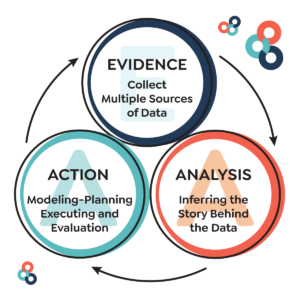 After classroom visits, we came back together for a debrief using the Evidence–Analysis–Action (EAA) protocol. Students sat shoulder to shoulder with their teachers, sharing what they had seen and heard.
What stood out immediately was how naturally students demonstrated metacognitive awareness. They:
- Clearly named observable evidence.
- Thoughtfully analyzed how those practices supported—or sometimes limited—learning.
- Helped identify meaningful next steps for instruction.
Together, students and teachers generated the following actionable next steps:
- Increase productive struggle in small groups.
Use small-group time to extend thinking with more challenging questions and open-ended tasks. Encourage students to explain and defend their reasoning before stepping in with support. - Balance support with independence.
Be intentional about when to help and when to step back, allowing students time to grapple independently. - Leverage Amplify Math to build independence.
Continue using structures that promote independent problem-solving and student confidence. - Use student self-reflection data intentionally.
Regularly review reflection responses (e.g., “How do you feel about this?”) to better understand student confidence, interest, and frustration. - Respond to student self-assessment.
Incorporate insights from “Show What You Know” self-assessments to adjust pacing, grouping, and support. - Create opportunities for student-driven interest groups.
Explore independent or interest-based clubs or projects that allow students to pursue topics they care about, building ownership and voice beyond the core curriculum.
“It Felt Like My Voice Actually Mattered”
When asked how it felt to participate in Student-Led Rounds at P.S. 249, Ayad, a fifth-grade student, captured the heart of the experience:
For me, it kinda felt like I was included because most of the time it’s just the teachers who are doing this. It felt really cool that my voice actually mattered because now the school can know what the students want and what the students need and their opinion of it, because sometimes teachers don’t see everything that we see.
Moments like this remind us that when students are invited into the work of school improvement, not as observers but as partners, their voices don’t just inform practice.
They help shape it.
What might change if students helped adults see learning more clearly? Student-Led Instructional Rounds help schools turn student observations into evidence, reflection, and instructional action.
Learn how this aspect of Impact Teams can help your school build student voice into meaningful instructional improvement.