
A Schoolwide Need for Student Voice
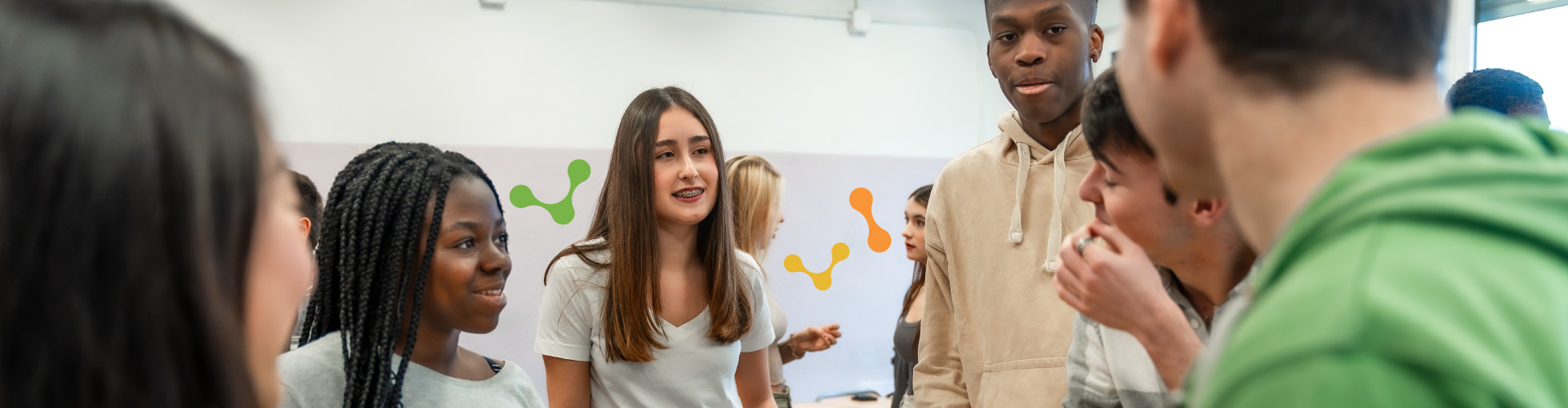
Two years ago, in the lingering wake of the pandemic, isolation still shaped daily life, and screens had begun to replace much of the real conversation students needed. At Mountain House High School, classrooms were quieter than anyone wanted them to be. Although that silence reflected a pattern seen in many high schools, MHHS chose not to treat it as unavoidable. Students make meaning through collaborative talk. English learners develop fluency and confidence when they have frequent opportunities to speak. Classrooms become true communities when discourse is active, purposeful, and shared. For these reasons, the school committed to sparking change (Moser & Zimmermann, 2025).
A Shared Inquiry Across the School
That commitment quickly became a schoolwide effort. Mountain House High School’s entire staff soon united around a bold collaborative inquiry: How could they empower students to take greater ownership of their learning through Accountable Talk®? The goal was not simply to get students talking more. It was to help them speak with purpose, listen with intention, build on one another’s ideas, and use discussion as a tool for deeper learning.
The Framework for Purposeful Talk
Accountable Talk® offered the structure the school needed. Developed by researchers at the University of Pittsburgh’s Institute for Learning, the framework asks students to be accountable in three important ways: to the learning community by respecting and building on others’ ideas, to accurate knowledge by grounding statements in evidence, and to rigorous thinking by reasoning deeply and challenging ideas thoughtfully (Michaels, O’Connor, Hall, & Resnick, 2010).
Creativity Within Each Discipline
The creativity of the work emerged as departments translated this shared focus into the language of their own disciplines. Rather than adopting Accountable Talk® as a generic discussion routine, staff engaged in collaborative inquiry to determine what purposeful, evidence-based student talk should look and sound like in each content area. Departments unpacked relevant disciplinary standards, the California Common Core ELA standards, and the California English Language Development Standards, then designed ways for students to use talk to strengthen specific academic skills. They also identified how they would assess students’ success with Accountable Talk®. From there, the work became intentionally varied. In World Language, teachers used Accountable Talk® to strengthen reading comprehension. In Health, the focus was on helping students reason through healthy decision-making. In ninth-grade English, teachers used Accountable Talk® to increase student ownership of self- and peer assessment. Across departments, the common inquiry remained the same, but each team creatively adapted the approach so student discourse became a pathway to deeper learning in its discipline.
Collaborative Evidence Cycles
As the inquiry unfolded, MHHS PLCs remained united by a shared purpose: using Accountable Talk® to strengthen student ownership of learning within each discipline. Yet the work did not unfold in a one-size-fits-all way. Each department designed creative, discipline-specific approaches while staying grounded in a common cycle of evidence, analysis, and action. Three times throughout the year, PLCs collected and analyzed student learning evidence by performance level, identifying student strengths, opportunities for growth, and high-leverage instructional actions to take next. Teams also monitored student work over time to track progress across performance levels and better understand how students were developing as learners and thinkers. To deepen the work, PLCs gathered classroom observation evidence through Micro-Teaching, Lesson Study, or Evidence Walks. These collaborative protocols gave teachers structured opportunities to learn from one another, refine research-based practices, and strengthen the instructional moves that supported Accountable Talk®. Finally, teams collected student voice data to better understand how students experienced the work and whether Accountable Talk® was helping them take greater ownership of their learning. Across the school, creative collaboration became the engine of improvement: departments adapted the inquiry to fit their content, while PLCs used shared evidence to study impact, refine practice, and move student learning forward.
Impact Teams help educators use shared evidence, disciplined inquiry, and collaborative protocols to strengthen student ownership across classrooms.
The Sharing Symposium: Creativity Made Visible
The work culminated on April 24, 2026, at the end of the second year of the inquiry, in a schoolwide Sharing Symposium that made the depth and creativity of the work visible. Staff were organized into interdisciplinary groups, and each department representative shared their PLC’s story while also learning from at least four other departments. The room itself reflected the creative collaboration that had defined the journey. Teachers experienced the World History team’s puzzle of practice from a student’s perspective, watched a video capturing the impact of the English department’s work, and participated in an Escape Room designed to reveal the steps the Health team took to strengthen student decision-making through Accountable Talk®. Across the symposium, staff saw how one shared inquiry had generated many discipline-specific approaches, all aimed at increasing student ownership of learning.
Early Impact After Year One
The impact was evident in both practice and outcomes. Teachers developed stronger shared language around student discourse, used evidence more intentionally to refine instruction, and created more opportunities for students to speak, listen, reason, question, and build understanding with their peers. State assessment data after the first year of the inquiry also reflected meaningful progress. Following one year of focused work on Accountable Talk®, Mountain House High School’s CAASPP English Language Arts/Literacy results increased from 74.01% of students meeting or exceeding standard in 2023–24 to 80.79% in 2024–25, a 6.78 percentage-point gain. The percentage of students exceeding standard rose from 45.16% to 53.86%. Outcomes for English Learners showed a smaller increase, moving from 9.09% to 11.11% met or exceeded, reinforcing both the promise of the work and the need to continue strengthening language-rich, discipline-specific opportunities for English Learners.
Looking Ahead to Year Two Results
Because the Sharing Symposium occurred at the end of the second year, the full state assessment impact of year two is still forthcoming. Those results are expected in fall 2026 and will offer another opportunity to examine how the schoolwide inquiry influenced student learning over time. Even before those results are released, the symposium made one thing clear: MHHS had not simply implemented a strategy. Through creative collaboration, disciplined inquiry, and shared evidence, the staff had built a schoolwide movement around student voice, academic ownership, and deeper learning.
The Core Collaborative partners with schools to strengthen PLCs, deepen student ownership, and turn collaborative inquiry into measurable impact.
References
- Michaels, S., O’Connor, C., Hall, M. W., & Resnick, L. B. (2010). Accountable Talk® sourcebook: For classroom conversation that works. University of Pittsburgh, Institute for Learning. https://www.fredhutch.org/content/dam/www/about-us/education/sep/2020/AT-Sourcebook.pdf
- Moser, M., & Zimmermann, M. (2025). Meaning-making through dialogic classroom discourse in history classes: Multi-perspective case studies from a teacher professional development program. The Journal of Social Studies Research, 49(1). https://doi.org/10.1177/23522798241278284