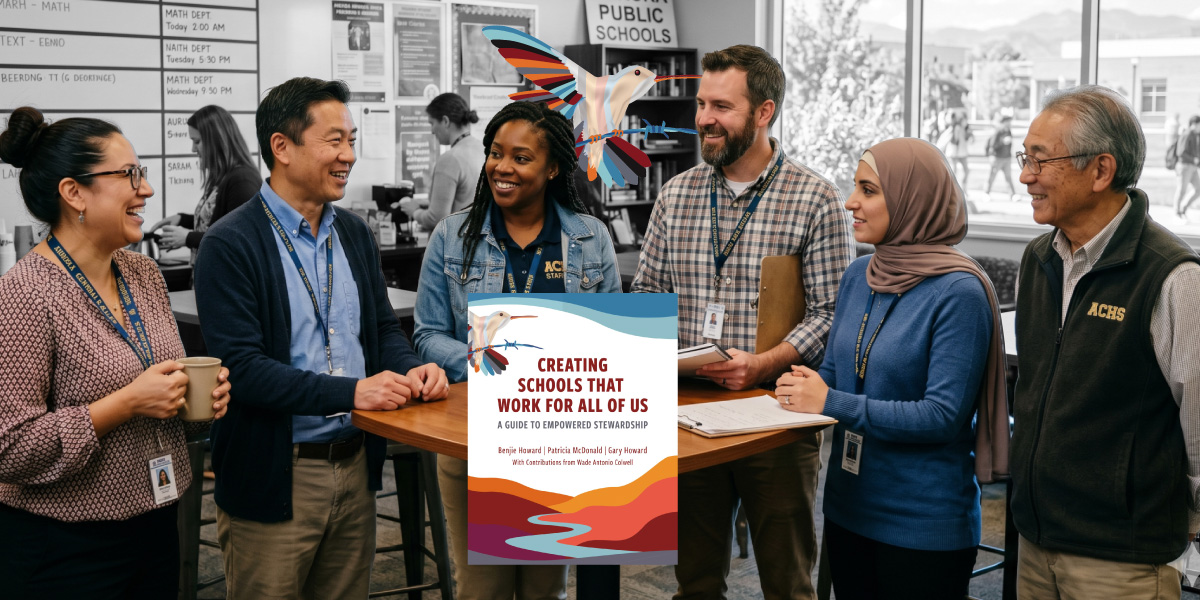
The Four Dispositions and Seven Commitments of Empowered Stewardship
What are the qualities of personhood that we as teachers and leaders in our nation’s schools must embody to be worthy of serving our richly diverse students? In my fifty years working with educators throughout the country and overseas, there are four dispositions that consistently surface, personal dispositions that are inextricably connected to the work of Empowered Stewardship.
 A Disposition for Difference.
In our current climate, where the very idea of diversity is under attack, we are called to be courageous Stewards of the rich diversity that our students and communities bring to our schools. An attack on diversity is an attack on all of us — and a violation of the true meaning and purpose of education. We learn from, with, and through our differences, and rather than dampen that focus, we elevate it and invite our students and colleagues to bring more of their unique selves and cultural expressions into the school setting. This Disposition speaks to two of our Empowered Stewardship Commitments:
1. Our cultural identities are affirmed and valued.
2. Our relationships are rooted in earned respect and cultural humility.
 A Disposition for Dialogue.
It is through conversation across our many different experiences and perspectives that we release the full power and genius of diversity. Those who deny or attack diversity are afraid to have their view of reality tested in the rich context of authentic dialogue infused with many points of view. Empowered Stewards, on the other hand, are committed to the co-creation of brave spaces of belonging where our stories can be shared and heard, where our unique gifts are appreciated, and where everyone becomes smarter together. The Disposition for Dialogue grows from two more of our Stewardship Commitments:
3. Our learning environments are inviting, culturally relevant, and vibrant.
4. Our expectations and actions amplify adult and student brilliance.
 A Disposition for Disillusionment.
Authentic dialogue across differences is powerful precisely because it allows us to see beyond the barriers of our own culturally conditioned realities. Abraham Lincoln said in an address to Congress in 1862, “We must disenthrall ourselves“ because “the dogmas of the quiet past are inadequate to the stormy present.” With these words, Lincoln called himself and other leaders to a profound reckoning with their own illusions, challenging his fellow citizens to break through old images and hostilities, to claim a higher path to community. Likewise for us as educational Stewards, we are called to dis-illusion ourselves from our own race-, class-, gender-, and religion-based biases and assumptions about our students, their families, and the communities we serve. This is a positive form of disillusionment, inviting us to be creatively critical of our own perspectives and beliefs. This Disposition for Disillusionment is reinforced by two additional Stewardship Commitments:
5. Our interactions celebrate and adapt to diverse ways of knowing, learning, and being.
6. Our educational experiences reinforce creative and critical thinking.
 A Disposition for Democracy.
Another phrase that Lincoln coined in his time of crisis, and one that certainly echoes in ours, was a call to the nation to come together to ensure that “government of the people, by the people, and for the people shall not perish from the earth.” The Disposition for Democracy carries this same passion for community, for justice, and for healing — what we call in the Stewardship work, “the good of the many over the greed of the few.” For this purpose, we come together in intergenerational collaboration to honor and follow our own personal dreams and possibilities, and at the same time call each other into serving the well-being of the whole — our families, our school, our community, our nation, and our planet. The Disposition for Democracy is embodied in the final Stewardship Commitment:
7. Our interactions honor individual aspirations and collective responsibilities.