
The Problem No One Wants to Admit
Sit next to a student during independent reading and listen—not for accuracy, but for understanding. They move through the words. They keep the pace. They don’t stumble on every line. By most traditional measures, they’re “reading.”
But ask them what it means—and the cracks show.
They lose the thread in longer sentences. They miss relationships between ideas. They can’t explain what changed from one paragraph to the next. These are the students we often call “almost there.” In reality, they’re stuck in the space between decoding and comprehension.
They’ve learned how to read. They haven’t yet learned how to understand.
This Isn’t a Student Problem—It’s an Instructional Gap
When this pattern shows up across classrooms and grade levels, it’s not about effort. It’s about design. Over the past decade, many systems rightly strengthened phonics and early decoding. That work matters.
But it also created a new blind spot: what happens after students can read the words?
Reading is not a single skill. It’s a coordinated system of word recognition, language comprehension, knowledge, and cognitive processing. When any part is underdeveloped, meaning breaks down.
Right now, too many students are progressing through content without the tools to make sense of it.
The Missing Middle in Literacy Instruction
Between “can decode” and “can comprehend deeply” sits a set of skills that are often under-taught.
This is the missing middle.
Students need structured, explicit development in:
- Fluency – so cognitive energy is freed for meaning, not word-by-word effort
- Sentence comprehension – so complex syntax doesn’t block understanding
- Morphology – so students can unlock academic vocabulary across disciplines
When these are not systematically taught, students plateau. They can access text—but not the ideas inside it.
 PLCs Aren’t Driving Results?
If your teams are meeting but not seeing real impact on student learning, you’re not alone.
See how Impact Teams turn collaboration into measurable results.
Why Most Interventions Don’t Work
Schools respond with more: more time, more programs, more support. But without alignment, “more” becomes noise. Different classrooms emphasize different skills. Expectations shift from room to room. Data is collected, but not consistently used to guide instruction.
So while effort increases, impact remains uneven.
Students experience inconsistency.
Teachers carry the burden individually.
And the system keeps cycling.
What Does the Science Say?
More recent literacy research sharpens our understanding of why so many students stall between decoding and comprehension.
Scholars like Nell Duke and Kelly Cartwright emphasize that skilled reading is not just about decoding or language alone—it requires active, flexible coordination of multiple processes at once.
- Duke & Cartwright (2021) highlight that readers must integrate word recognition, language comprehension, and executive function—the ability to monitor, adjust, and make sense of text in real time.
- This means students need explicit support not just in what to read, but in how to think while reading.
- Executive skills like attention, cognitive flexibility, and self-monitoring play a direct role in comprehension—especially as texts become more complex.
This aligns directly with what we see in classrooms:
Students can decode… but they don’t always:
- Notice when meaning breaks down
- Repair confusion
- Hold multiple ideas in mind across sentences
In other words, they lack the strategic processing that turns reading into understanding.
This research also reinforces three critical instructional moves:
- Explicit modeling of thinking (not just skills)
- Deliberate practice with feedback tied to comprehension and language
- Ongoing progress monitoring so instruction responds to student need
When these elements are aligned—across classrooms, not in isolation—students begin to move beyond surface reading and into deep comprehension.
Individually, these practices matter. Systemically aligned, they are transformative.
Without Practice and Progress Monitoring, It’s Guesswork
Even when schools identify the right focus areas, one critical piece is often missing: time and structure for practice. Instruction moves quickly from teaching to task completion, with limited guided or independent practice in between.
But that “in between” is where learning is built. Students need repeated opportunities to apply a skill, receive feedback, and try again.
Without that cycle, exposure replaces mastery.
The Missing Skill: Learning How to Practice
There’s another layer to this challenge. Students don’t just need practice. They need to learn how to practice well.
Many students cannot yet:
- Set a clear goal (e.g., improve fluency rate or sentence accuracy)
- Monitor their performance
- Adjust when they struggle
So practice becomes passive. And passive practice doesn’t produce growth.
When students learn to monitor their own progress—tracking, reflecting, adjusting—they begin to take ownership. That shift is what sustains effort over time.
Where Impact Teams Change Everything
Impact Teams create the conditions where all of this comes together. Instead of isolated efforts, teams align around a shared problem of practice.
They:
- Identify a precise literacy gap
- Agree on a small set of high-impact strategies
- Implement consistently across classrooms
- Monitor progress using common measures
- Adjust based on evidence
This is what turns good ideas into reliable results.
What This Looks Like in Practice
In aligned classrooms, learning is visible. A student working on fluency knows their baseline and their goal—and tracks it over time. A student working on sentence comprehension can identify where meaning breaks and repair it.
A student learning morphology can deconstruct unfamiliar words and apply that knowledge in new contexts. Practice is no longer a task.
It’s a process.
The Result: Real, Measurable Growth
When instruction, practice, and monitoring are aligned, outcomes change. Students read more fluently, understand more deeply, and transfer skills across subjects. Teachers gain clarity about what works and adjust faster. Leaders see patterns in the data—and can act on them.
The system improves because the work is coherent.
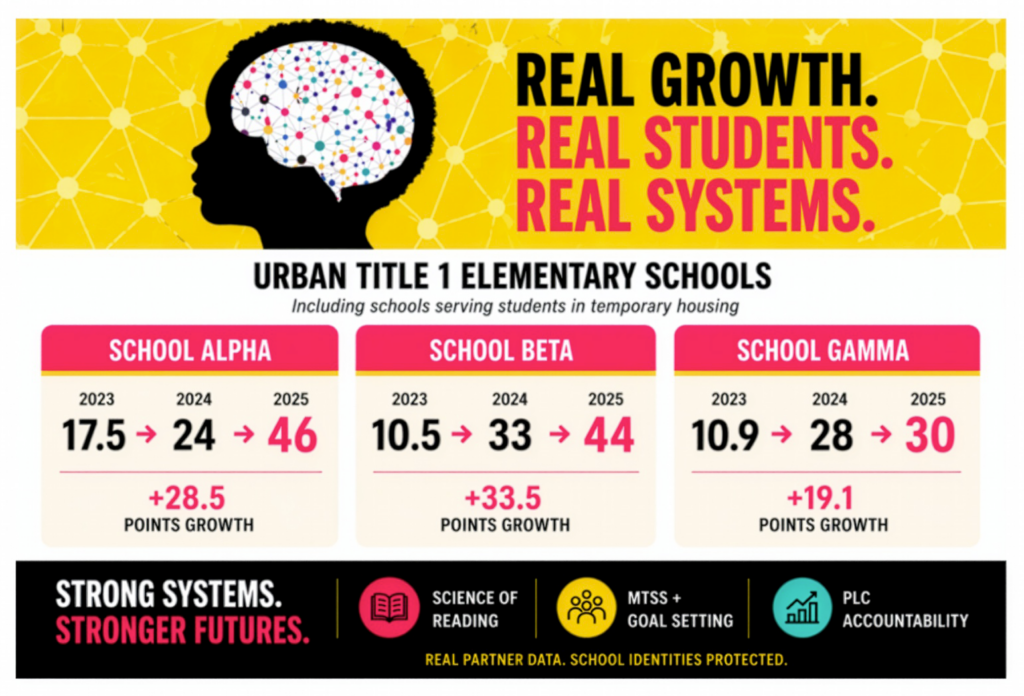
Impact Team Growth in 3 Urban Systems
Quick Tip You Can Use Tomorrow
Choose one focus. Define it clearly. Align one strategy across your team. Measure it weekly. Discuss the results.
That tight feedback loop is what accelerates growth.
Need Clear Evidence Your Instruction Is Working?
If you can’t clearly see what’s working across classrooms, your system isn’t giving you the right signals.
Learn how Impact Teams build clarity, alignment, and real-time evidence of impact.
The Bottom Line
Students don’t need more worksheets. They need a system that:
- Targets the right skills
- Builds time for deliberate practice
- Teaches students how to monitor their learning
- Aligns teams around evidence of impact
That’s how literacy scores rise. Not by chance.
By design.