
Part 2 of the Human-Centered MTSS Mathematics Series
In the first article in this series, I argued that one of the missing layers in many secondary mathematics MTSS systems is what I called a prerequisite skill architecture.
Most schools have intervention systems. Many have Tier 2 supports. Some have strong Tier 3 services. Yet secondary teachers continue to encounter the same challenge.
Students arrive in Algebra, Geometry, and higher-level mathematics courses carrying unfinished learning from previous years. Teachers find themselves balancing two competing responsibilities: teaching grade-level content while simultaneously addressing gaps that make that content difficult to access.
Human-Centered MTSS rejects the false choice between intervention and access.
Students deserve both.
They deserve rigorous grade-level learning, and they deserve systems that strengthen the prerequisite knowledge needed to engage successfully in that learning. The question becomes:
What does that actually look like in practice?
One answer is the intentional use of short, high-leverage mathematical routines embedded within Tier 1 instruction.
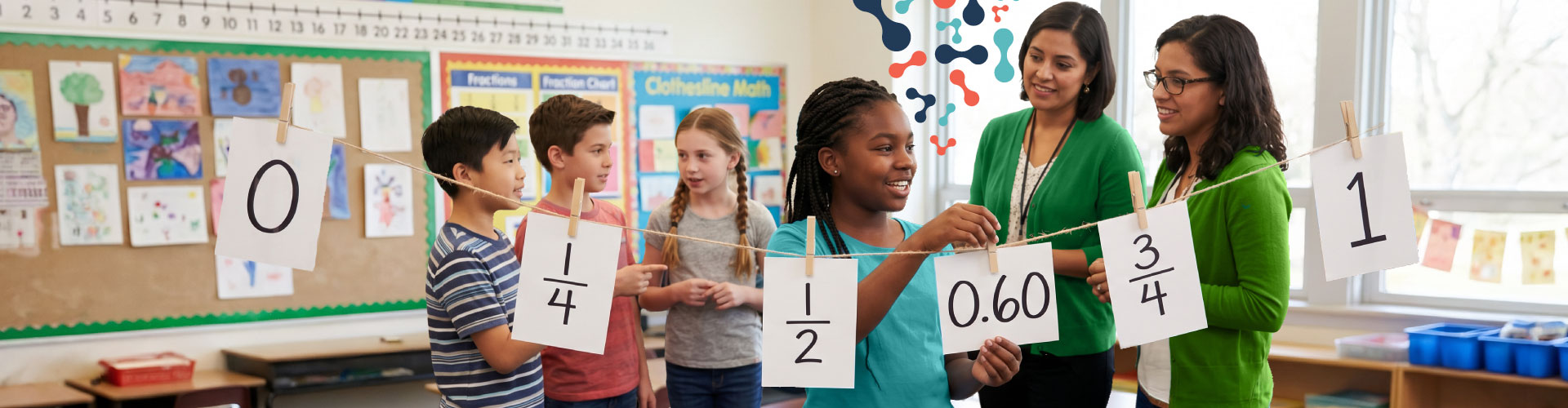
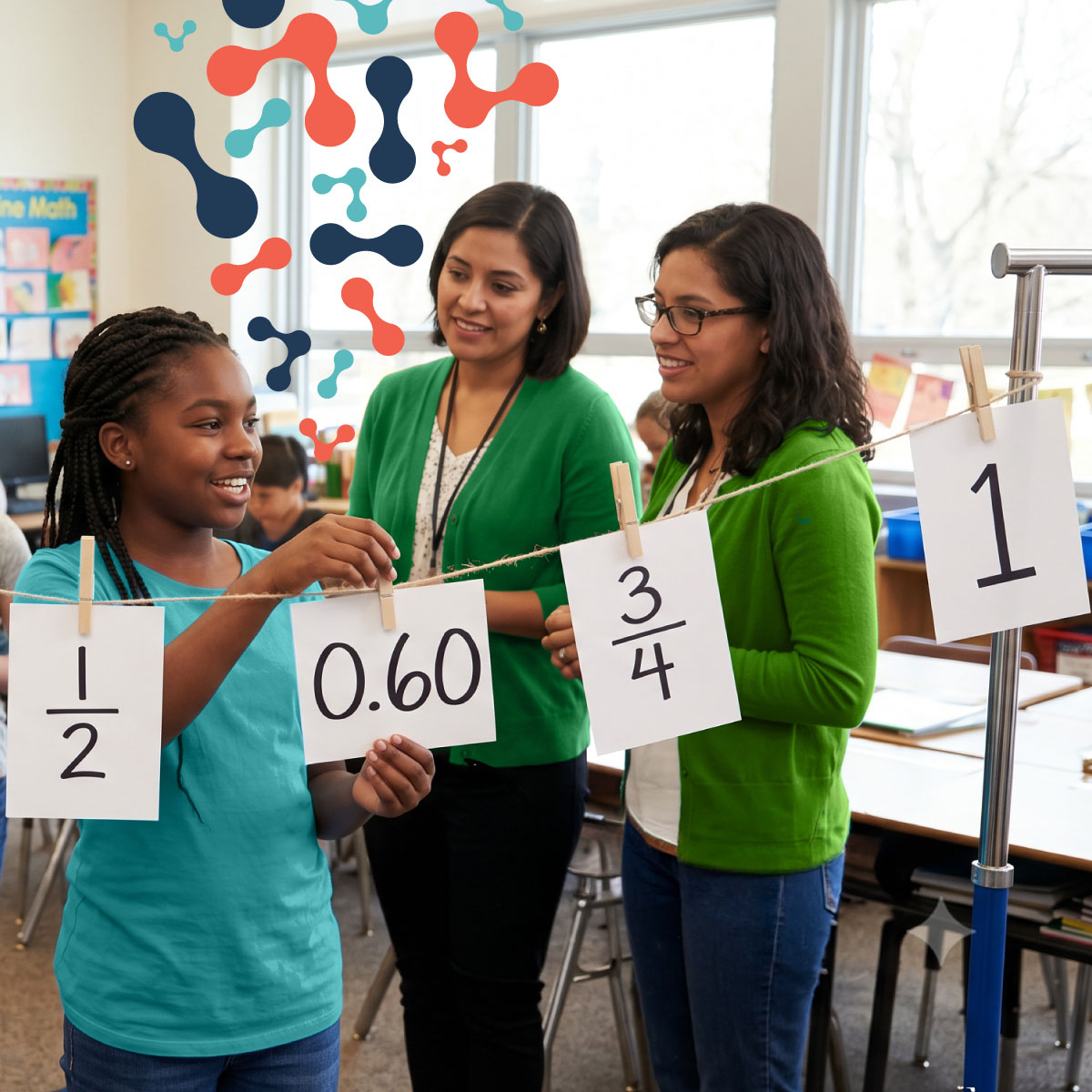
A Practical Example: Clothesline Math
Clothesline Math is not an intervention program. It is not a remediation strategy. It is a formative routine designed to surface thinking, strengthen conceptual understanding, and provide students with repeated opportunities to revisit important mathematical ideas.
Suppose a seventh-grade team is preparing students for a unit on proportional relationships.
The upcoming standards require students to compare ratios, determine unit rates, and reason proportionally. However, successful proportional reasoning depends upon prerequisite understandings that many students have not fully mastered:
- Fraction magnitude
- Fraction equivalence
- Decimal relationships
- Percent concepts
- Benchmark reasoning
Rather than waiting for those gaps to appear during the unit, the teacher intentionally addresses them beforehand.
Step 1: Identify the Prerequisite Learning
The first step is not selecting a routine. The first step is identifying the mathematical understanding students will need. This is where MTSS begins.
Ask:
What concepts are most likely to become barriers during the upcoming unit?
For proportional reasoning, the answer is often magnitude and equivalence. Once those concepts are identified, the routine becomes purposeful rather than random.
Step 2: Design the Mathematical Task
The teacher creates a simple clothesline with endpoints labeled 0 and 1.
Students receive cards containing values such as:
- 25%
- 1/4
- 0.50
- 3/4
- 0.60
- 80%
- 0.90
- 1/10
At first glance, the task appears simple. It is not. Students must reason about relationships among multiple representations of quantity.
Step 3: Think Before Placing
Before any cards are placed, students are asked to think independently.
Questions might include:
Is my value closer to 0, 1/2, or 1?
What benchmark helps me?
Can I represent my value another way?
Which values might belong near mine?
This individual think time is important because it requires every learner to engage in mathematical reasoning.
 Step 4: Place, Justify, and Debate
Students place their values on the clothesline and explain their thinking. The teacher’s role is not to tell students whether they are right or wrong. The teacher’s role is to make reasoning visible.
A student might explain:
“I placed 0.60 between 1/2 and 3/4 because it is equivalent to 60%, which is greater than 50% but less than 75%.”
Another student may disagree. A third may offer additional evidence. The conversation becomes the lesson.
Step 5: Revise Thinking
This step is often overlooked. After discussion, students are invited to revise their placements.
Why?
Learning is not demonstrated by immediate correctness; learning is demonstrated when students use evidence to improve their thinking. This is one reason routines such as Clothesline Math support metacognition as well as mathematical understanding.
Step 6: Connect the Learning Forward
The final step is essential. The teacher explicitly connects the routine to the upcoming unit.
For example:
“Over the next few weeks, we will be working with ratios and proportional relationships. Understanding magnitude and equivalence will help us compare quantities, reason about rates, and determine whether relationships are proportional.”
Students begin to see mathematics as a connected discipline rather than a collection of isolated units.
Why This Works
Several decades of research help explain why routines such as Clothesline Math are effective. Retrieval practice strengthens long-term retention by requiring students to reconstruct previously learned knowledge rather than simply review it. Formative assessment provides teachers with immediate evidence about student thinking and misconceptions.
Mathematical discourse strengthens conceptual understanding by requiring students to explain, justify, and defend their reasoning. Metacognitive processes develop when students evaluate evidence and revise their thinking.
In other words, the routine is not powerful because students place cards on a line.
The routine is powerful because it combines retrieval, discourse, formative assessment, conceptual understanding, and metacognition in a single instructional experience.
Differentiating Within the Same Routine
Another advantage of this routine is that every student participates in the same mathematical experience while engaging at different levels of complexity.
Students who need additional support may work with benchmark fractions, visual models, partner discussions, or fewer representations. Students who need greater challenge might compare irrational numbers, algebraic expressions, scale factors, solutions to equations, or multiple function representations.
The routine remains consistent. The mathematical demand changes. That is one of the hallmarks of a Human-Centered MTSS approach.
The support changes. The opportunity to engage in rigorous learning does not.
Beyond the Routine
Clothesline Math is only one example.
Number Talks, Number Strings, Error Analysis, Retrieval Practice, and other routines can serve a similar purpose. The larger lesson is that strong MTSS systems do not wait until students fail to provide support.
They intentionally design opportunities for students to strengthen prerequisite understanding before those gaps become barriers.
That is not intervention. That is prevention.
And prevention remains one of the most underutilized components of Human-Centered MTSS.
Bonus: The Fraction Benchmark Routine
A ten-minute daily routine for building the fraction sense most curricula skip.
Most students don’t have a fractions problem. They have a fraction sense problem. They can follow the steps. Find a common denominator. Cross-multiply. Flip and multiply.
What they can’t do is tell you, without calculating, whether 5/8 is closer to a half or a whole.
That gap is where most of the struggle lives.
Why This Happens
For years, students build number sense around one rule: bigger digits mean bigger numbers.
Fractions break that rule. 1/4 looks smaller than 1/2, but the 4 is bigger than the 2.
Researchers call this the natural number bias — the instinct to apply whole-number logic to fraction problems. It doesn’t go away on its own. It has to be out-practiced.
Even adults compare fractions more slowly than whole numbers of the same size. The instinct never fully retires. We just get better at overriding it.
There’s a second piece. Researchers tracking students from elementary school into high school found that how well a student understood fraction magnitude — not fraction procedures, magnitude — predicted algebra readiness years later, more strongly than whole-number arithmetic skill did.
Translation: knowing where a fraction lives matters more, long-term, than knowing how to compute with it.
There’s a working-memory cost too. A student who has to calculate every fraction comparison from scratch is spending all their effort on the calculation. There’s nothing left over for the reasoning the problem actually needs.
Fluency is not a nice-to-have add-on to mathematical thinking. It is the price of admission.
The Routine
This is a five-minute warm-up, not a new program. It runs inside the Core block you already have.
All it needs: a number line on the board, and a way for every student to answer at once — whiteboards, fingers, or thumbs.
One more design choice worth naming: every student talks, every time. Calling on a single student to explain — the classic popcorn share — means only that student does the work of putting reasoning into words, while the rest of the room gets to coast. Researchers studying classroom talk find the same pattern over and over: students who verbalize their own reasoning out loud retain it better than students who only hear someone else explain it. A single called-on student gets that benefit. The other twenty-nine don’t. The routine below builds in a moment where every student defends their thinking out loud before anyone is called on for the group.
- Flash the fraction. Put one fraction on the board. Nothing else. (15 sec)
- Silent estimate. Students decide, without calculating, whether it’s closer to 0, to 1/2, or to 1. (30 sec)
- Everyone answers at once. Thumbs, fingers, or whiteboards — every student commits before anyone talks. (15 sec)
- Turn and defend. Every student turns to a partner and explains, out loud, why they placed the fraction where they did. Both partners talk. No one just listens. (45–60 sec)
- Spotlight one explanation. Now — and only now — the teacher can call on a student or pair to share with the whole group. Everyone has already rehearsed their reasoning once, so the cold call isn’t the only moment anyone had to think out loud. It’s just the moment one explanation gets amplified for the class. (30–45 sec)
- Name the benchmark fact. State the takeaway as a fact students can reuse tomorrow — e.g., “5/8 is more than half because the numerator is more than half the denominator.” (30 sec)
- Optional stretch. Ask for one equivalent fraction or decimal for the same number. (30–60 sec)
Total: about five to six minutes, depending on how much partner talk runs.
How to Use It
- Run it daily, or at minimum three times a week. The benchmark sense builds through repetition spaced over time, not through one good lesson.
- Use it as the first five minutes of math Core, before the day’s lesson. It primes number sense without taking time away from instruction.
- Start with friendly benchmark fractions — halves and quarters — and build toward less familiar ones, like sevenths, eighths, and mixed numbers, as the year progresses.
- The same routine works in a WIN block, unchanged, for students who need more repetitions. Only the complexity of the fraction changes.
- Use the quick whole-class check as an informal data point. A student who consistently applies whole-number logic — saying 1/4 is bigger than 1/3 because 4 is bigger than 3 — is showing you exactly where Tier 2 support should start.
- Keep partner pairings consistent — a standing elbow partner — so the turn into paired explaining takes seconds, not minutes of shuffling.