

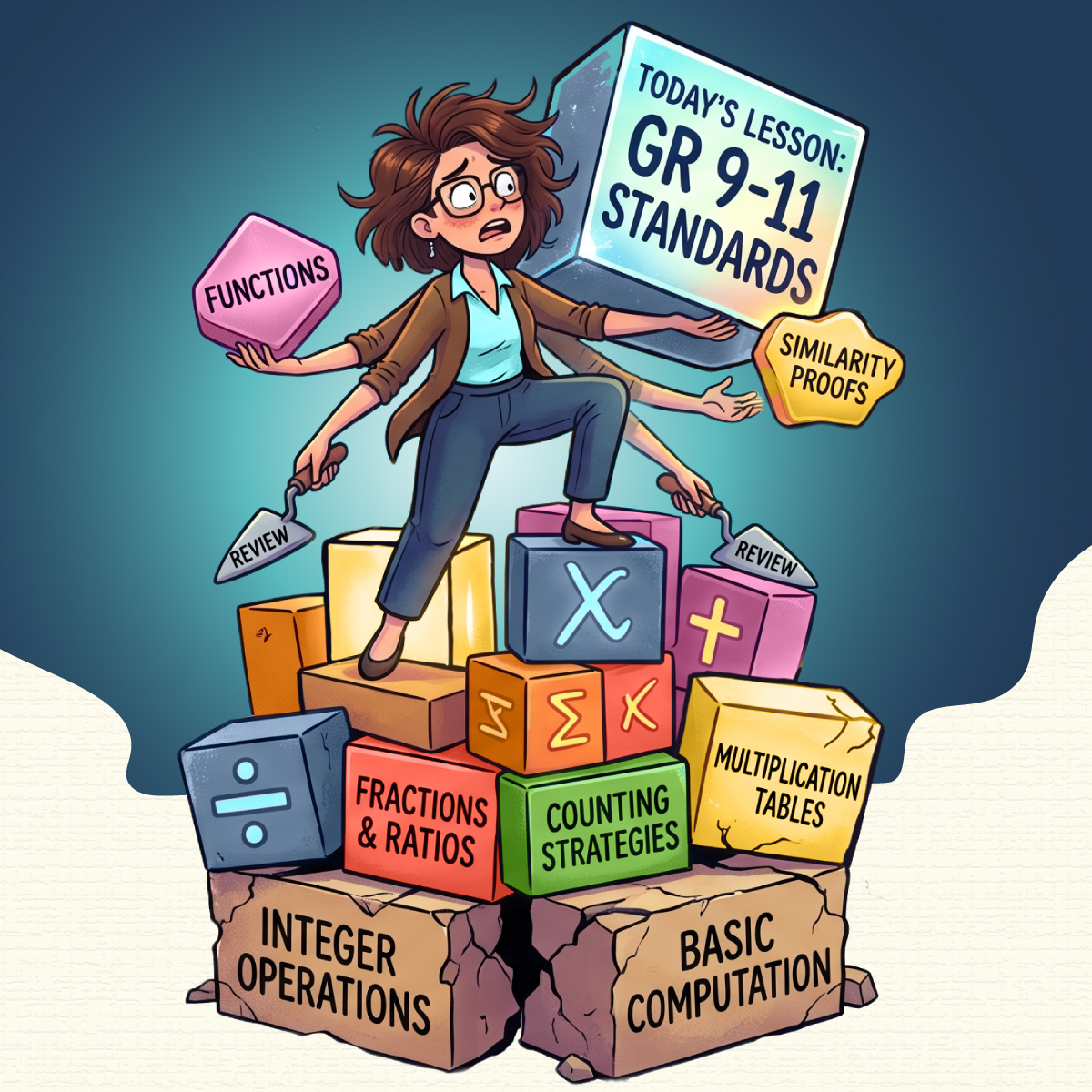
 Every secondary mathematics teacher knows the feeling.
You begin teaching the lesson you are supposed to teach.
Within minutes, you realize many students do not possess the mathematical knowledge needed to access it.
An Algebra I teacher introduces linear equations and discovers students struggle with integer operations.
A Geometry teacher begins similarity and proportional reasoning only to find students are insecure with fractions and ratios.
An Algebra II teacher launches a lesson on functions and realizes students still rely on counting strategies for basic computation.
The problem is not the lesson.
The problem is that the lesson depends on prerequisite knowledge that many students never fully developed.
As a result, secondary mathematics teachers face an impossible challenge.
They are expected to teach grade-level standards while simultaneously addressing years of unfinished learning.
The False Choice
Too often, schools approach this challenge as though there are only two options.
- Option one is to teach grade-level mathematics and hope students catch up.
- Option two is to remediate unfinished learning and sacrifice access to grade-level content.
Neither option works.
Students deserve access to rigorous grade-level mathematics.
At the same time, students cannot successfully engage in Algebra, Geometry, or higher-level mathematics if foundational concepts remain fragile. The answer is not choosing one or the other.
The answer is creating systems that support both.
Why Intervention Alone Cannot Solve the Problem
When schools identify significant gaps in mathematics, the response is often to strengthen intervention.
- Additional intervention classes.
- Double-dose mathematics.
- Pull-out support.
- Tier 2 groups.
- Tier 3 intensive services.
These supports matter. Students with substantial skill deficits need intensive intervention.
But intervention alone cannot solve the challenge facing most secondary schools.
Consider a student receiving forty-five minutes of intervention each day.
For the remaining six hours, that student continues encountering mathematics that depends on prerequisite skills that remain weak.
The interventionist works to build understanding.
The rest of the system unintentionally exposes the same weaknesses.
As a result:
- Students make gains but struggle to sustain them.
- Intervention caseloads remain high.
- Teachers continually reteach foundational concepts.
- Grade-level pacing becomes increasingly difficult.
- Students lose confidence in their mathematical ability.
The issue is not intervention quality.
The issue is system design.
The Missing Layer: Prerequisite Skill Architecture
Strong MTSS systems need more than intervention.
They need a deliberate plan for strengthening prerequisite mathematical understanding across Tier 1 instruction.
- This is not remediation.
- This is not lowering expectations.
- This is not spending half the year teaching elementary standards.
It is the intentional use of short, high-leverage routines that strengthen the mathematical knowledge students need to access current learning.
The question becomes:
What prerequisite concepts are most likely to create barriers to upcoming learning, and how will we strengthen them consistently?
For example:
In a unit on linear equations, students may need opportunities to revisit:
- Integer operations
- Properties of operations
- Equality and equivalence
- Order of operations
Before a unit on proportional reasoning, students may need opportunities to revisit:
- Fraction magnitude
- Multiplicative reasoning
- Unit rates
- Benchmark fractions
Preparatory to a unit on quadratic functions, students may need opportunities to revisit:
- Factoring
- Patterns
- Expressions
- Multiple representations
The goal is not to reteach entire courses.
The goal is to strengthen the foundations that support current learning.
What This Can Look Like in Secondary Classrooms
Many schools already use instructional routines that can serve this purpose.
Number Talks
Brief discussions that build flexibility with numerical reasoning and computation.
Clothesline Math
Students place values, fractions, expressions, or functions on a number line and justify their reasoning.
Number Strings
Carefully sequenced problems designed to reveal mathematical relationships and strategies.
Error Analysis
Students identify and explain misconceptions in mathematical work.
Which One Doesn’t Belong?
Students compare representations and justify their thinking.
Notice and Wonder
Students analyze mathematical situations before solving.
Retrieval Practice
Students revisit previously learned concepts through strategic review and spaced practice.
These routines require relatively little time.
Yet they create repeated opportunities to strengthen prerequisite knowledge that often becomes a barrier to success.
What About Tier 3?
Some readers may wonder whether these routines can replace intensive intervention.
They cannot.
Students who are several years behind often require:
- Diagnostic assessment
- Explicit instruction
- Additional instructional time
- Deliberate practice
- Frequent progress monitoring
- Intensive Tier 2 and Tier 3 support
Those students deserve specialized intervention.
The point is that intervention and prerequisite skill routines solve different problems.
Tier 3 addresses significant learning gaps.
Prerequisite skill routines address the daily erosion of foundational understanding that prevents students from fully accessing grade-level mathematics.
Schools need both!
A Human-Centered MTSS Perspective
The goal of MTSS is not simply to identify students who need intervention.
The goal is to design systems where more students experience success.
That means providing intensive support when necessary.
It also means asking a question that is often overlooked:
How are we intentionally strengthening the prerequisite knowledge students need before they experience failure?
The strongest secondary MTSS systems do not rely solely on intervention classes.
They build an architecture that supports learning throughout the day.
Because the challenge facing secondary mathematics is not simply unfinished learning.
It is the reality that today’s mathematics depends on yesterday’s understanding.
And when that foundation is weak, no amount of intervention alone can carry the weight.