
A school is not just a building where learning happens; it is a system of support designed to respond to what each learner brings through the door.
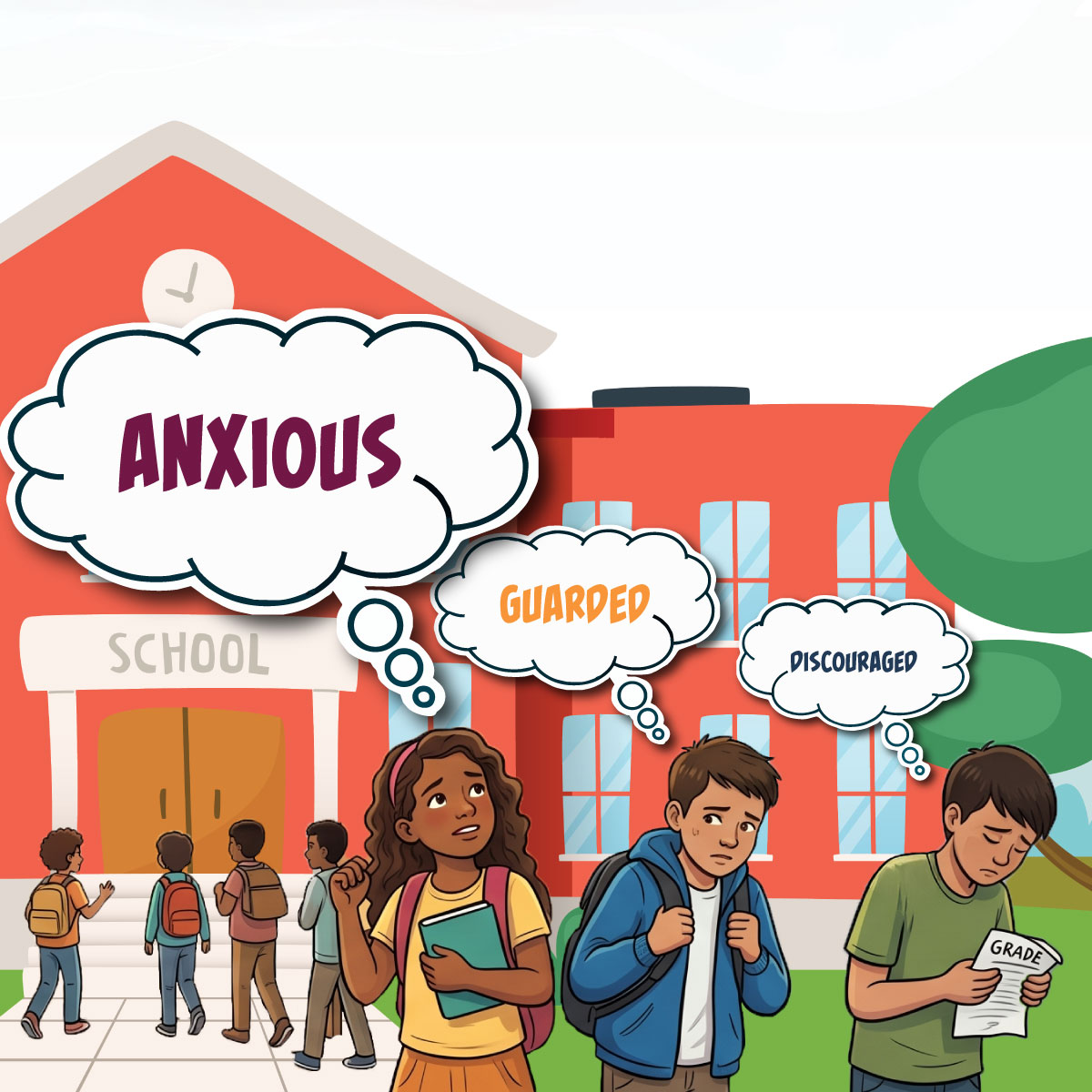
Everyone enters the same physical doorway on the ground floor, but no one enters with the same social, emotional, or academic readiness. Some students arrive confident and curious, others anxious and guarded, others already discouraged by prior experiences. What each student enters with determines what they need next. The school exists to notice, respond to, and continually adjust to those needs. In this sense, a school in and of itself is the multi-tiered system of support.
If we see it this way, MTSS is not an add-on framework or a set of disconnected interventions. It is the living, breathing way a school organizes its people, time, and practices across multiple levels and multiple pathways to success. The system is the school; the school is the system.
Why Human-Centered MTSS?
The word “system” often makes us think of flowcharts, software, dashboards, and automated processes. It can feel cold, mechanical, or compliance-driven, as if the goal is to move students through predetermined steps with as little human interaction as possible.
But every system is designed, initiated, and sustained by people. Even the most sophisticated automation exists to serve humans, not replace them. When we forget this, we risk centering efficiency over dignity, data over story, and forms over faces.
Human-Centered MTSS flips that script. It insists that every process exists to serve a person, whether that person is a student, family member, educator, or leader. It reminds us that data is a tool for empathy and insight, not a label or verdict. It keeps us focused on the human questions beneath every decision about tiers, supports, and interventions: Who is this learner? What do they care about? What strengths do they bring? What have they already lived through and learned? What do they need next in order to grow?
Human-Centered MTSS keeps us anchored in purpose. If a practice erodes relationships, diminishes student voice, or strips away agency, it is out of alignment with the very system it claims to support.
The Primacy of Relationships
When students enter the school, they are not entering a schedule or a program; they are entering a relationship.
Before we ask, “How will this student perform?” we must ask, “How will this student be received?” Every interaction, from a hallway greeting to a classroom entry routine to the first five minutes of a lesson, signals to students whether they are seen, safe, and significant.
This is more than warmth or niceness. Relationships create the psychological conditions under which learning can occur at all. They determine whether students are willing to take risks, struggle productively, ask for help, and trust that adults will walk with them through difficulty rather than judge them for it.
That is why relationships are not separate from MTSS. They are the foundation of it. Without relationships, supports can become transactions. With relationships, supports become pathways.
From Relationships to Belonging to Achievement
There is a progression at the heart of Human-Centered MTSS:
Relationships precede belonging.
Belonging precedes achievement.
Relationships are the initial bridge: “You matter to me. I notice you. I am invested in your growth.” Through consistent, caring relationships, students begin to experience belonging: “People like me are meant to be here. My full self is welcome in this space.”
Only when belonging takes root can academic challenge feel like an invitation rather than a threat. Students are more likely to engage in rigorous learning when they believe the adults around them are committed to their success and when they see themselves as capable contributors to the learning community.
In other words, achievement is not simply the outcome of curriculum and instruction. It is the outcome of being known, valued, challenged, and supported within an intentional system of relationships.
The 7 Commitments of Empowered Stewardship
This brings us to the 7 Commitments of Empowered Stewardship.
If a school is a system of support, and that system is human-centered, then every adult is more than a role or job description. Each adult is a steward of the conditions that make learning, belonging, and growth possible.
Empowered Stewardship means adults understand that they hold power and use it responsibly in service of students. It means they see themselves as co-creators of the system, not simply implementers of someone else’s plan. It means they commit to shared ways of seeing, deciding, and acting so that dignity, identity, agency, and learning remain at the center of the work.
The 7 Commitments give adults a common way to live the human side of the system. They shape how teams interpret evidence, how leaders design supports, how educators respond to struggle, and how schools make decisions that affect students’ daily experiences.
They answer the question: Who must we become for this system to truly serve every learner?
The 5 Drivers of Human-Centered MTSS
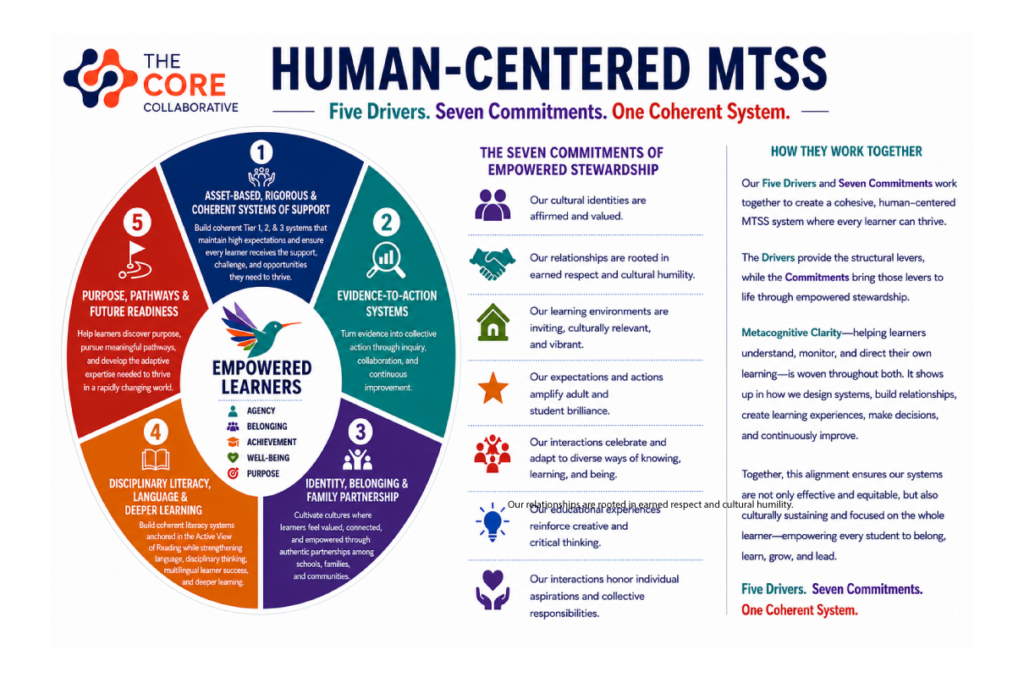
The Five Drivers of Human-Centered MTSS answer the next question: Where must the system focus its energy so every learner is known, supported, challenged, and prepared?
If the Seven Commitments describe who adults must become as empowered stewards, the Five Drivers describe what the system must consistently design, strengthen, and monitor.
The Five Drivers help schools move from isolated programs to one aligned system of support. They give leaders and teams a shared way to examine instruction, intervention, relationships, data, literacy, belonging, and future readiness.
They focus the system on five essential areas:
- Asset-based, rigorous, coherent supports ensure that students are not defined by deficits, but are supported through clear expectations, strong Tier 1 instruction, timely intervention, and meaningful access to challenging learning.
- Evidence Analysis and Action ensure that data does not sit in dashboards or reports. Instead, evidence becomes a catalyst for reflection, decision making, and responsive action. This is where PLCs/Impact Teams become essential engines of Human-Centered MTSS. Through collaborative inquiry, teams examine student work, analyze progress, identify patterns, and determine what students need next. PLCs/Impact Teams help adults move from noticing needs to taking collective action, strengthening instruction, adjusting supports, and monitoring whether those actions are making a difference for learners.
- Identity, belonging, and family partnership ensure that students and families are not treated as recipients of support, but as essential voices in shaping the conditions for learning.
- Disciplinary literacy, language, and deeper learning ensure that students have access to the language, thinking, reading, writing, and problem solving required for meaningful participation across content areas.
- Purpose, pathways, and future readiness ensure that school is connected to students’ lives, identities, aspirations, and futures.
Together, the Five Drivers help a school ask: Are our structures, practices, and decisions creating real pathways to success for every learner?
How the Drivers and Commitments Work Together
When we weave the Five Drivers together with the Seven Commitments of Empowered Stewardship, Human-Centered MTSS becomes more than a framework. It becomes a way of being a school.
The Drivers provide the structural where and how: where we focus our design energy and how we organize our policies, practices, time, resources, and supports.
The Commitments provide the human who and why: who we are choosing to be with students and why we refuse to design systems that ignore dignity, identity, relationship, and agency.
Asset-based, rigorous, coherent supports are only possible when adults are committed to seeing students through a strengths-based lens and sharing responsibility for outcomes. Evidence-to-action systems only work when teams are committed to curiosity, transparency, and honoring student and family voice as part of the evidence. Identity, belonging, and family partnership flourish when adults commit to relational trust, cultural responsiveness, and examining their own assumptions. Disciplinary literacy and deeper learning demand a commitment to intellectual equity, meaning complex thinking for every learner, not just a few. Purpose, pathways, and future readiness are realized when adults see themselves as stewards of students’ long-term flourishing, not merely gatekeepers of credits.
The Drivers keep the system coherent. The Commitments keep the system human. One without the other is incomplete.
One Coherent System
Together, the Drivers and Commitments create one coherent system.
It is a system where every student who walks through the ground-floor door is met first with relationship, then with belonging, and ultimately with meaningful achievement.
It is a system in which tiers of support are not labels, but lifelines that flex and adjust as students grow.
It is a system that remembers, in every meeting and metric, that we are working with human beings whose lives extend far beyond our walls.
Human-Centered MTSS invites us to see our schools as they truly are: living ecosystems of support, powered by empowered adults and designed for empowered learners. When we align our structures with our deepest commitments, we do more than implement a framework—we become the kind of school where every student has a pathway to dignity, belonging, and a future they can see themselves in.