Most conversations about MTSS focus on interventions: which program to adopt, how many interventionists to hire, how often students should receive support. These are important questions, the kind that dominate planning meetings and budget conversations alike. But there is a more fundamental question that often gets overlooked.
Does our schedule allow students to receive what they actually need?
At The Core Collaborative, we work with a lot of schools where the MTSS-RTI triangle is inverted, and it’s worth pausing to explain exactly what that means. In a healthy system, the triangle is wide at the base and narrow at the top: most students thrive with Tier 1 instruction alone, fewer need Tier 2, and fewer still need the intensive support of Tier 3. In many of the schools we partner with, though, that shape doesn’t hold. More students need Tier 3 — the most intensive level of support there is — than need Tier 1 or Tier 2 alone.
The triangle is inverted.
There’s more than one reason this happens, and most of the time, more than one is true at once.
Sometimes it’s the students walking through the door. Many arrive three, four, or five years behind — not because of anything that happened inside a school building, but because of homelessness, poverty, or trauma absorbed long before they ever entered the building. Tier 1 hasn’t failed these students; life reached them first.
Sometimes it’s the system itself. A school adopts the same intervention block, the same staffing model, and the same schedule everyone else is using, without ever asking whether any of it fits this particular building — its size, its staff’s expertise, the specific needs actually sitting in the room.
A system built for a school of 1,200 doesn’t fit a school of 300. It hangs differently. It rubs in different places.
And sometimes, yes, it really is Core. Tier 1 instruction simply isn’t strong enough yet to catch the number of students it should be catching, so more students fall further behind and need more.
Naming the cause isn’t the same as excusing the outcome — it’s how you know where the real work has to start. But that diagnosis, however accurate, isn’t especially useful to the student sitting in a classroom today. Building a stronger Core takes years. So does building a system that actually fits the school running it. So does helping a student recover what instability took before they ever sat in a classroom. The student in front of a teacher right now cannot wait years.
So when the triangle inverts, the answer isn’t a new program, and it isn’t a new model.
It’s a different relationship with time.
You stop asking how to fit students into the schedule you already have, and you start asking what time needs to do for the students who are actually in the building right now. Traditional systems begin with adult structures and then try to fit students into them; when the triangle inverts, that order has to flip, with time organized around student need first and adult structures following after. This may sound obvious. Yet many schools discover that schedules built for the typical triangle make it nearly impossible to provide the intensity of support an inverted one actually requires.
The Reality Facing Many Schools
This challenge is especially common in schools serving large numbers of multilingual learners, students experiencing poverty, students with interrupted formal education, and students who enter significantly below grade level. In these schools, it’s not unusual to find students who need intensive literacy support and intensive mathematics support at the same time: a fifth grader reading at a second-grade level while also struggling with multiplication, fractions, and proportional reasoning, or a third-grade multilingual learner who needs foundational reading intervention and mathematics intervention simultaneously. These aren’t isolated cases. In many schools, they represent a significant share of the student population — which raises the real question.
How do we design a system capable of responding to those needs?
Why One Intervention Block Often Falls Short
Many schools attempt to solve this challenge with a single intervention or WIN block. While this may work where intervention populations are relatively small, it often creates real limitations where needs run deeper. Students may receive one cycle of literacy intervention and one cycle of math intervention simply because that’s what the schedule allows — the schedule becomes the driver, not the evidence.
And sometimes the constraint isn’t even time. It’s fit: a school delivering a strong program with real fidelity, just not the program the student in front of them actually needs.
This creates a significant challenge when implementing evidence-based intervention programs. Programs like SIPPS, SPIRE, Phonics for Reading, and Do The Math were designed to provide the intensity and frequency required to actually accelerate learning, and students who need them typically require daily support delivered with fidelity. Yet many schedules can’t accommodate that level of intensity, since intervention time has to be divided equally across subjects. The result: students receive whatever the schedule permits, rather than what the evidence says they actually need.
The Departmentalization Dilemma
This challenge becomes even more complicated when schools departmentalize instruction. Departmentalization can strengthen content expertise and planning efficiency, but it can also create rigid schedules that limit intervention flexibility: students rotate through predetermined blocks, teachers inherit fixed schedules, and intervention opportunities become increasingly difficult to adjust. In some cases, schools discover that the students with the greatest needs are the least able to receive the intensity they require, simply because the schedule has no room left to give it.
This isn’t a problem with departmentalization itself. It’s a reminder that every scheduling decision has to be examined through an MTSS lens. If the schedule prevents students from getting the intervention they need, the system has to adapt.
Not the learner.
Human-Centered MTSS Requires a Different Architecture
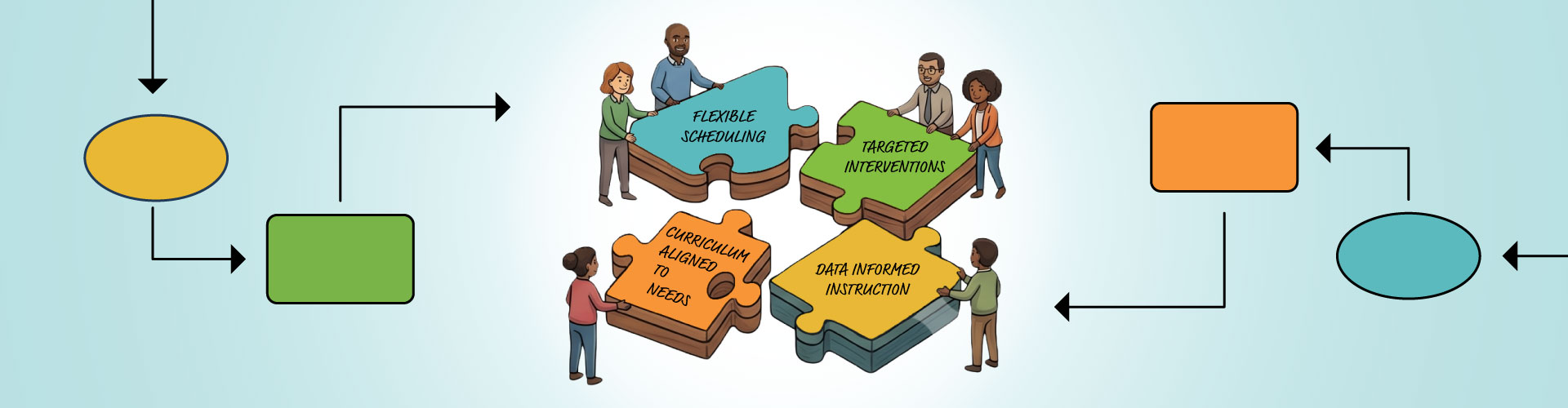
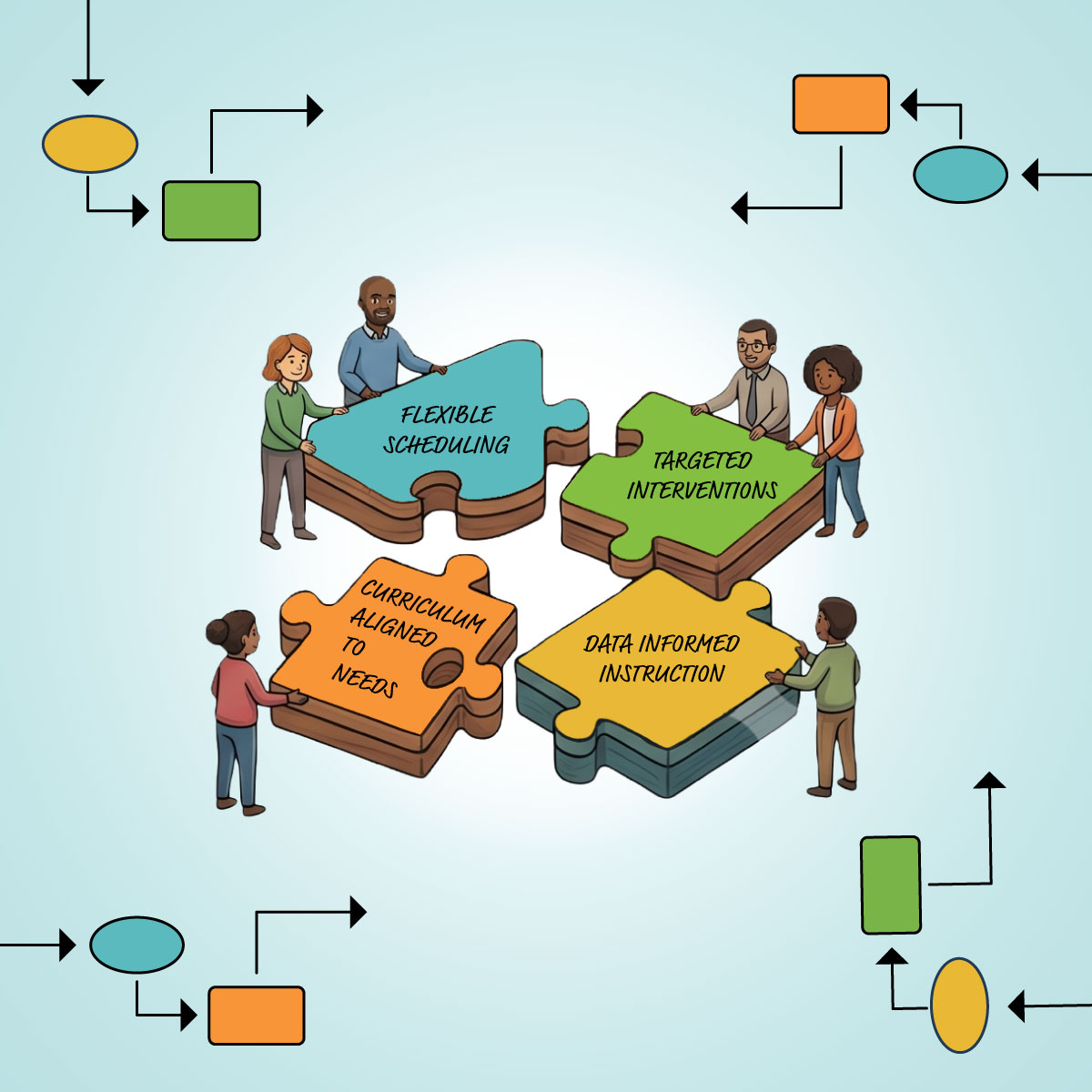
Schools working through an inverted triangle often arrive at a different conclusion about how time should work. Rather than treating intervention as an add-on to the schedule, they design the schedule around student needs from the very beginning — which frequently means protecting six distinct instructional experiences:
- A reading block focused on comprehension, vocabulary, language development, and knowledge building
- A writing block focused on communication, composition, and evidence-based thinking
- An ELA WIN block where intervention, acceleration, and language support can occur
- A mathematics block focused on grade-level reasoning and problem solving
- A mathematics workshop block where teachers provide small-group instruction, mathematical discourse, fluency development, retrieval practice, and prerequisite skill routines
- A mathematics WIN block where students receive intensive Tier 2 and Tier 3 intervention when necessary
Here’s the reason behind that workshop block. A student who has to count on fingers to find six times seven is spending working memory on a fact instead of a strategy, and there’s nothing left over for the proportional reasoning the word problem actually requires.
Fluency is not a nice-to-have add-on to mathematical thinking. It is the price of admission.

Want to see what one of these routines actually looks like? We’ve put together a free five-minute fraction routine — the Fraction Benchmark Routine — that you can run during Core tomorrow, no new program required. It’s yours to download and try this week.
This is why these routines can’t live in one strong classroom, dependent on one teacher’s instinct. They have to be built into the system: scheduled, practiced, protected, and scaled to every section — not just the ones lucky enough to have a teacher who already does this well. Each component serves a different purpose, and none can fully replace the others.
Infrastructure Is Built in Layers, Not Launched in Full
Everything described above is the destination, not the starting line. Most schools can’t stand up all six blocks in a single August, and trying to is often exactly how a good design fails before it has a chance to work. We’ve watched schools attempt the complete model in year one and lose it by November — not because the architecture was wrong, but because the adults hadn’t yet built the muscle to run it.
You don’t pour the second floor before the foundation cures.
A more sustainable build often looks something like this. In Year One, schools get ELA Core and WIN solid first, while also building math routines into Core — the fluency work, the retrieval practice, the small daily habits that serve every student during Tier 1 instruction. Done well, those same routines absorb a meaningful share of Tier 2 need, which means a dedicated math WIN block isn’t required yet to start closing gaps. In Year Two, once those routines are running on instinct rather than effort, schools add the dedicated math WIN block.
Sometimes the schedule itself holds a placeholder: a school protects a block of math time in Year One without fully deciding what happens inside it, then converts that same time into a Walk-to-Learn structure in Year Two, once the data and the staffing model are ready to support it.
None of this is a formula, and it doesn’t come from a pacing guide or a consultant’s timeline. It depends on the capacity of the teachers in the building — and they’re the ones who can tell you whether a school is ready for the next layer, long before anyone walks in with a plan.
The Schedule Is a Statement of Belief
Whenever school leaders tell us they can’t fit everything into the day, we agree — the challenge is real, and there are only so many instructional minutes available. But we also ask a different question.
What do we believe every learner deserves?
If students deserve access to grade-level literacy instruction, the schedule must protect it. If they deserve explicit writing instruction, and mathematics intervention, the schedule must protect them. And if they deserve science, social studies, the arts, physical education, and the chance to develop their own identities and interests, the schedule must protect those too.
Many schools accomplish this by weaving science and social studies into literacy instruction through knowledge-building curricula and disciplinary reading and writing. Others lean on specials and enrichment programs to expand access to content areas. The specific solution varies; the principle does not. Human-Centered MTSS begins by identifying what students actually need, then building the schedule around it.
How The Core Collaborative Can Help
Through our pathway Building Mathematical Thinking, we help schools:
- Analyze intervention demand across literacy and mathematics
- Examine whether current schedules support evidence-based intervention delivery
- Choose the right evidence-based interventions for the specific needs in front of them, not just the programs already sitting on a shelf
- Rethink how time is allocated when the MTSS-RTI triangle inverts, centered on learner need
- Scale math fluency and retrieval-practice routines schoolwide, so automaticity doesn’t depend on which teacher a student happens to get
- Create WIN and Walk-to-Learn structures that maximize staffing resources
- Strengthen Tier 1 literacy and mathematics instruction
- Build sustainable intervention systems that support both access and acceleration
- Sequence the build in layers — ELA first, math routines embedded in Core, then a dedicated math WIN block — matched to what the staff in the building can actually carry
- Build the full MTSS infrastructure from the ground up — screening, progress monitoring, staffing models, and intervention protocols — for schools that are starting without one
- Develop implementation plans that align staffing, scheduling, and student needs
Because the most important MTSS document in any school isn’t the intervention handbook — it’s the master schedule. And when that schedule is designed around what learners actually need, rather than what adults have always done, powerful things become possible.
This is one small piece of what we mean by coherent Tier 1, 2, and 3 systems — the first of the Five Drivers in our Human-Centered MTSS framework. A single routine, run consistently, that serves every learner during Core and tells you exactly which ones need more.
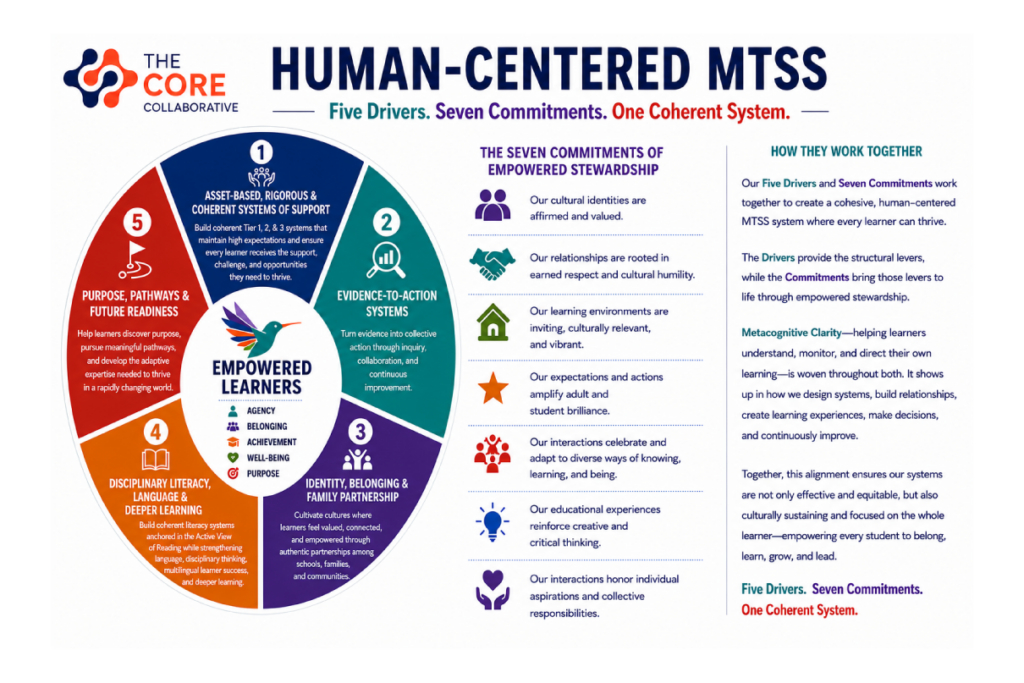
Learn more about The Core Collaborative’s Five Drivers and Seven Commitments of Empowered Stewardship for Human-Centered MTSS.