

A Letter to Our Learning Network
There are moments in the life of every organization that invite reflection—moments when we pause to honor the people who helped shape our journey, celebrate how far we’ve come, and thoughtfully consider what the future is asking of us.
This is one of those moments.
Over the past fifteen years, education has changed in profound ways. Schools are being asked to accelerate learning, strengthen belonging, improve well-being, personalize instruction, thoughtfully integrate artificial intelligence, and prepare learners for an increasingly complex future—all while navigating limited time, finite resources, and growing accountability.
The challenge isn’t a lack of commitment. If anything, educators have never been more committed.
The challenge is complexity.
Too often, schools respond to complexity by adding another initiative, another program, another intervention, or another technology. While each may offer value, together they can create systems that feel fragmented rather than coherent. Educators don’t need more disconnected solutions. They need integrated systems that help people learn, work, and flourish together.
That belief has shaped everything we’ve built at The Core Collaborative.
For the past fifteen years, we have had the privilege of partnering with extraordinary educators, students, and families who believe, as we do, that schools should be places where every learner—and every educator—is known, challenged, supported, and empowered to flourish. Together, we have built far more than a consulting organization. We have built a learning network grounded in relationships, collaborative inquiry, educational equity, and an unwavering belief that lasting improvement happens with people, never to people.
Today, we find ourselves at an important intersection. One path invites us to honor the remarkable people whose leadership helped build this learning network. The other challenges us to imagine what school improvement must become if we are to meet the complexity of the years ahead.
This letter is about both.
 Honoring Sarah
Some people don’t simply work alongside you. They help build something that lasts.
For the past twelve years, Sarah has been that person for The Core Collaborative.
Her care for this learning network, our partners, and each of you has never been transactional. It has always been rooted in friendship, shared purpose, and an unwavering commitment to helping educators and learners thrive.
After much reflection, Sarah has made the decision to step away from her leadership role at the end of July to prioritize her health and create greater balance in her life. While this is bittersweet for all of us, we wholeheartedly support her decision.
For Tony and me, and our team, this transition is deeply personal.
Sarah didn’t simply join The Core Collaborative—she helped build it. Alongside the two of us, she transformed an idea into a national learning network that has partnered with thousands of educators and hundreds of schools and districts across the country. Through every season of growth, every challenge, and every celebration, she has been a trusted leader, a courageous thinker, and one of our closest friends.
More than a colleague, Sarah is family.
Although her leadership role is changing, our relationship is not. We are grateful that she will continue serving The Core Collaborative as a consultant and trusted thought partner, and we know our learning network will continue to benefit from her wisdom, generosity, and belief in educators and learners.
As we prepared for this transition, Sarah remained exactly who she has always been—a thoughtful collaborator and trusted advisor. She helped ensure that this next chapter reflects the relationships, stewardship, and human-centered values that have always defined our work.
For that—and for countless acts of generosity over the past twelve years—we will always be grateful. As we reflected on Sarah’s extraordinary contributions, however, we found ourselves asking a larger question:
What does school improvement need now?
Human-Centered Systems Require Human-Centered Design
If we want learners, educators, and support staff to develop agency, they must have opportunities to practice agency. If we want schools to build trust with families, families must be invited to help shape the systems intended to serve them.
Human-centered school improvement cannot be designed exclusively by educators.
The people who experience the system every day—students, families, educators, and community members—must become partners in improving it.
One of the most powerful lessons we’ve learned came from a district where the students who had struggled the most within the existing MTSS system became members of the design team. Rather than asking adults to redesign supports on their behalf, we invited those students to help imagine something better. Together, they rethought interventions, relationships, learning environments, and the conditions that helped them succeed. Their lived experiences became one of our greatest sources of innovation. The same is true for families.
Families understand their children in ways schools never can. They carry strengths, histories, hopes, and cultural knowledge that are essential to designing equitable systems of support. When families are treated as partners rather than participants, schools make better decisions, build stronger relationships, and create solutions that are more responsive to the communities they serve.
This is why Human-Centered MTSS is more than a framework for delivering support. It is a framework for designing schools with people, not simply for people.
When students, families, educators, and community partners learn together, improve together, and lead together, agency grows, belonging deepens, and stewardship becomes part of the culture. Transformation doesn’t happen because a framework is implemented. It happens because the people most affected by the system become partners in creating something better.
Learning Begins with Identity
At the center of our Human-Centered MTSS Improvement Model is a simple belief: learning begins with identity.
Over the years, our understanding of identity has evolved. Early in our journey, much of our work focused on cultural identity—helping schools create environments where every learner felt seen, valued, and affirmed. We continue to believe that cultural identity is essential. It shapes how people experience belonging, make meaning, and see themselves within their learning communities.
As we partnered with schools, however, we came to recognize something even broader. Every person—whether a student, educator, school leader, or family member—develops a learner identity. We all carry beliefs about our capacity to learn, contribute, persevere, and grow. Those beliefs influence how we respond to challenge, engage in new learning, collaborate with others, and embrace change. Before people adopt new strategies or improve their practice, they must first believe that growth is possible.
For many learners, those beliefs have been shaped by years of success or struggle. A student who has experienced repeated academic failure may come to see themselves as “behind” rather than capable. An educator navigating constant change may begin to question their efficacy. A leader facing persistent challenges may wonder whether meaningful transformation is truly possible. These identities, whether empowering or limiting, shape the decisions people make every day.
This realization changed how we think about school improvement. Effective systems do more than select high-quality programs or implement evidence-based interventions. They intentionally create the conditions in which those programs can thrive by helping learners develop confidence, experience belonging, strengthen their sense of agency, and believe they are capable of continuous growth.
We also came to realize that school improvement is rarely driven by a single theory of action—and it shouldn’t be. School leaders are simultaneously strengthening instruction, implementing intervention systems, cultivating belonging, supporting educator learning, building family partnerships, and preparing learners for the future. These are all essential efforts. The challenge is ensuring they reinforce one another rather than compete for attention.
That realization became the foundation of our Human-Centered MTSS Improvement Model.
Connecting What Matters Most
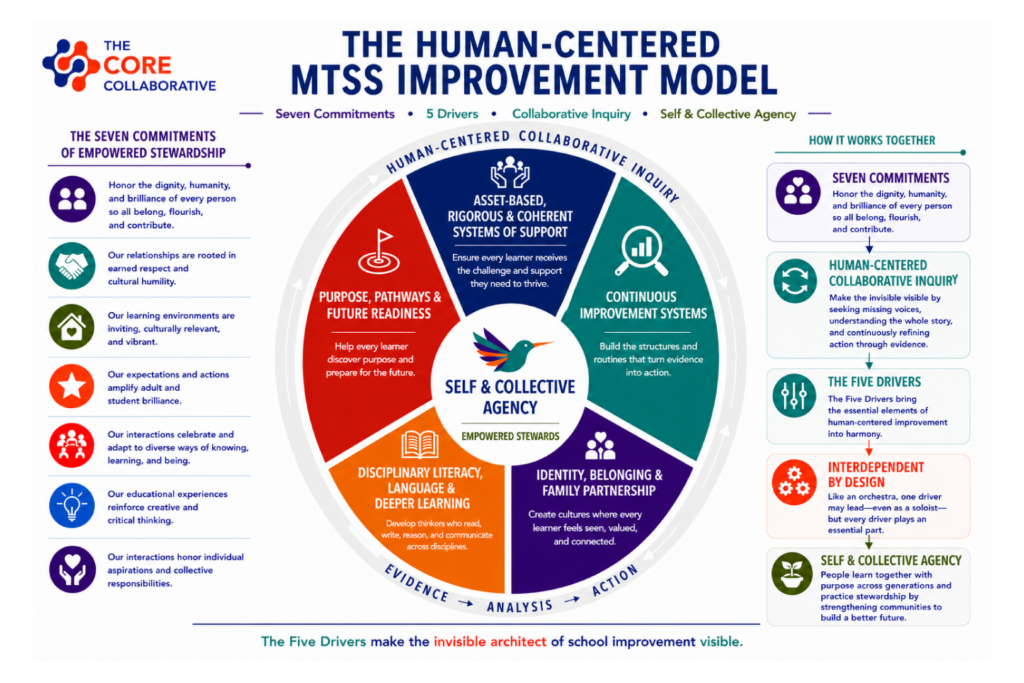
The Five Drivers were developed to help schools connect what matters most. Rather than replacing existing initiatives or evidence-based programs, they provide an interconnected framework that aligns people, practices, and systems around a shared commitment to helping every learner flourish.
The Seven Commitments define the culture we strive to create. The Five Drivers organize the work. Together, they create the conditions where learners, educators, families, and communities can flourish.
This model has become more than the way we partner with schools. It has become the way we organize ourselves. (see graphic below)
Grounded in Shared Commitments
At the heart of our Human-Centered MTSS Improvement Model are seven commitments—inspired by the work of Benjie and Gary Howard—that guide every interaction, every decision, and every improvement effort: trust, belonging, cultural humility, equity, agency, shared responsibility, and stewardship.
These are more than values. They are commitments we strive to live every day.
The Seven Commitments define the culture we seek to create. The Five Drivers organize the work of bringing that culture to life. Together, they create the conditions where learners, educators, families, and communities flourish.
A Leadership Team Designed for the Future
As our Human-Centered MTSS Improvement Model has evolved, so has The Core Collaborative.
Over the past year, we have intentionally redesigned our leadership structure to better reflect the interconnected way we believe school improvement happens. Rather than organizing around individual services or initiatives, we have expanded our leadership capacity to better support schools through innovation, implementation, partnerships, operations, and long-term sustainability.
This next chapter includes welcoming new leaders, expanding the roles of existing leaders, and creating new opportunities to serve educators across the country. Together, we represent one leadership team united by a shared mission: partnering with schools and districts to build human-centered systems where every learner can flourish.
We are excited to introduce the leaders who will guide this next chapter of The Core Collaborative. Each member of our leadership team serves as a steward of one or more aspects of our Human-Centered MTSS Improvement Model. Together, we work as one integrated team to support schools through every stage of their improvement journey.
 Dr. Paul Bloomberg
Founder & Chief Learning Officer
Paul continues to lead the vision and evolution of Human-Centered MTSS while partnering with educators across the country to design equitable, coherent systems that strengthen learning, belonging, and collective agency. He also leads the development of new strategic partnerships and innovative initiatives that expand The Core Collaborative’s impact and advance the future of human-centered school improvement.
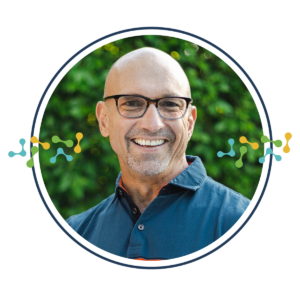 Tony Francoeur
Chief Financial Officer
Tony’s leadership has expanded well beyond financial stewardship. In addition to guiding the long-term financial health of The Core Collaborative, he is leading strategic partnerships with angel investors, helping launch our nonprofit organization, and developing the financial and organizational infrastructure that will allow our mission to grow for years to come.
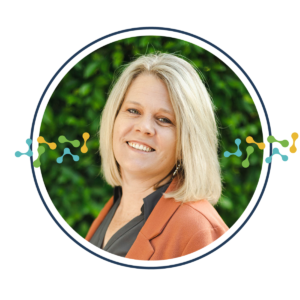 Leah Tierney
Operations & Finance Manager
Leah has expanded her leadership role to oversee both operations and finance, ensuring that the systems supporting our learning network remain aligned, responsive, and sustainable. She leads the operational excellence that allows our team to innovate, grow, and serve schools with consistency and care.
 Katie Smith
Executive Director of Impact & Quality Implementation
Katie leads our work in translating vision into measurable impact—both within The Core Collaborative and in partnership with schools and districts. She ensures that Human-Centered MTSS is implemented with quality and efficacy, collaborative inquiry drives continuous improvement, and every partnership results in meaningful, sustainable change for learners, educators, and educational systems.
 Isaac Wells
Executive Director of Innovation & Publishing
Isaac leads innovation across The Core Collaborative, advancing the AI PLC Agent, emerging technologies, publishing, and new learning experiences that strengthen collaborative inquiry and empower educators to make better decisions while keeping human relationships at the center of the work.
 Dr. Leticia Trower
Professional Learning & Client Success Manager
Leticia leads our professional learning and client success efforts, ensuring every partnership is supported through thoughtful implementation, responsive coaching, and meaningful follow-through. Her work helps transform professional learning into sustainable changes in classroom practice and school culture. Leticia will be connected with all clients to develop a personalized plan for your school or district.
 Joanne Buckheit
Learning Network Partnership Manager
Joanne leads the cultivation and expansion of partnerships across our learning network, with a special focus on strengthening our East Coast presence. She works alongside educators to build enduring relationships, connect innovative practices across districts, and ensure every partner feels supported as part of our growing learning community.
Looking Ahead to the Future
As we begin this next chapter, our mission remains unchanged. We remain deeply committed to partnering with educators, students, families, and communities to build coherent, human-centered systems grounded in trust, belonging, cultural humility, equity, agency, shared responsibility, and stewardship. Together, we believe schools can become places where every learner is known, belongs, grows, and has the opportunity to flourish.
None of this work belongs to us alone. Every idea within our Human-Centered MTSS Improvement Model has been shaped through partnership with remarkable educators, courageous students, engaged families, thoughtful leaders, and communities willing to imagine something better. Thank you for the trust you have placed in us over the past fifteen years. We are honored to continue learning alongside you as we build the future of Human-Centered School Improvement.
Because lasting improvement happens with people, never to people.