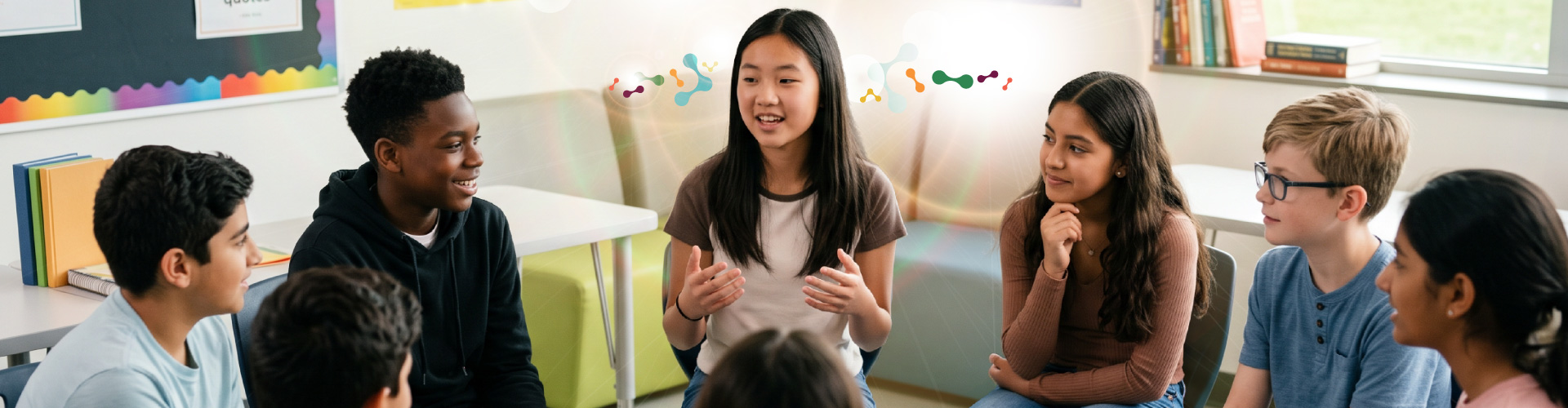
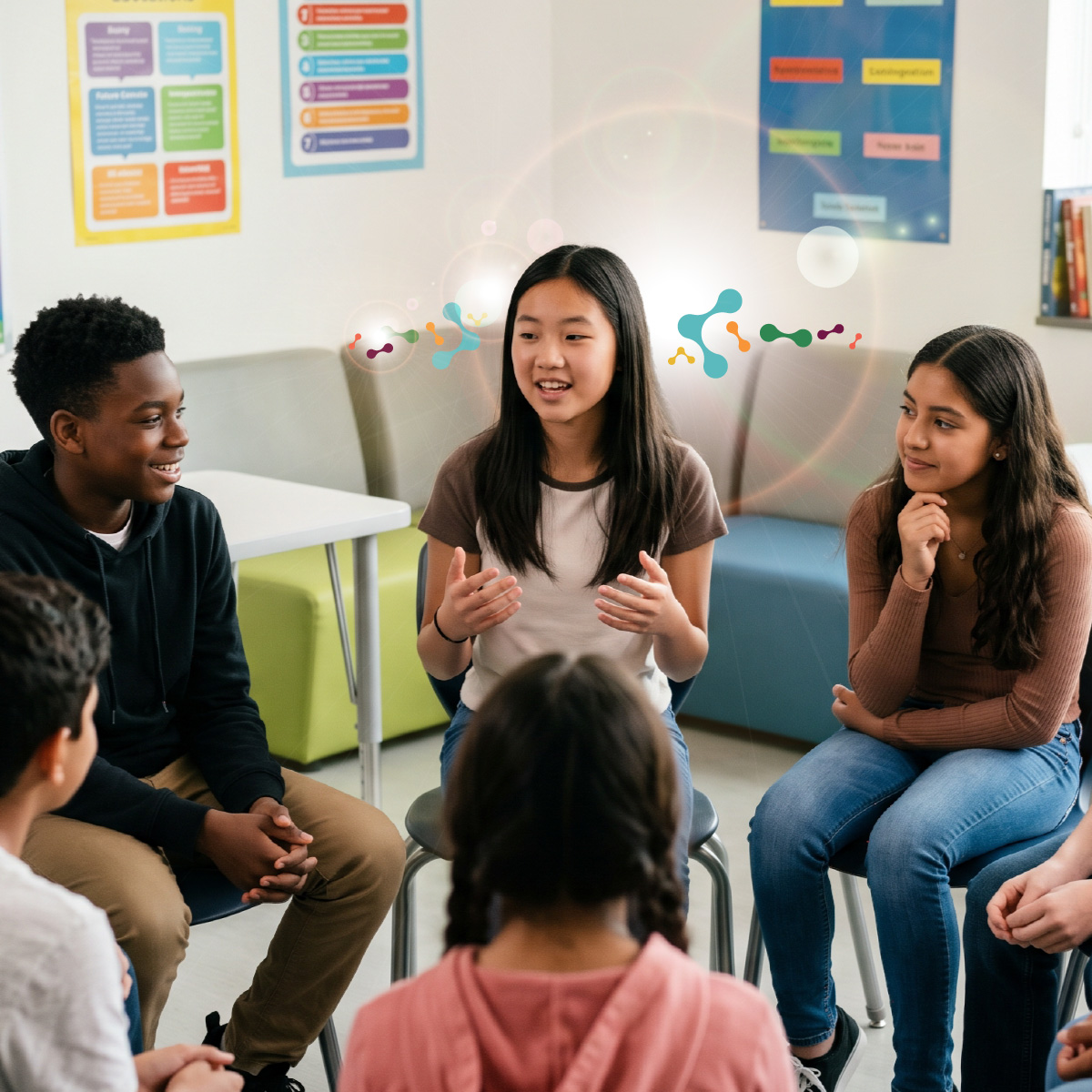
Belonging means being recognized, valued, heard, and able to meaningfully participate in and shape the community around you. It is more than being welcomed through the doors or included in an activity. For students, belonging means knowing that people see who they are, believe they can succeed, care what they think, and expect them to contribute something of value.
That makes belonging inseparable from learning. Students are constantly developing ideas about who they are in school: whether they are mathematicians, readers, problem-solvers, leaders, or simply people who are capable of doing hard things. Their experiences with teachers, peers, academic work, feedback, and school structures all contribute to those identities. A school can say that every student belongs, but students ultimately decide whether that promise is true based on what they experience every day.
Building belonging requires more than good intentions. It requires a disciplined cycle of evidence, voice, and action: evidence to notice where connection may be weakening, student and family voice to understand why, and collective action to change the conditions students experience
Belonging Is a Condition for Success
In Human-Centered MTSS, belonging is not treated as a separate climate initiative sitting alongside academic improvement. It is one of the conditions that makes academic improvement possible.
Human-Centered MTSS is organized around five interconnected Drivers that function as one coherent system for improving learning and the human experience of school. Each Driver offers a distinct lens, but none is designed to stand alone. Driver 2 helps schools learn and improve through evidence, while Driver 3 ensures that evidence is understood in the context of identity, belonging, relationships, and partnership. Together, these Drivers help schools notice what students are experiencing, understand the stories behind the data, and respond collectively. In this article, we focus on Driver 2, Human-Centered Continuous Improvement Systems, and Driver 3, Identity, Belonging, and Family Partnership, because belonging becomes most powerful when schools use evidence, voice, and action to intentionally strengthen the conditions students experience every day.
Students are more likely to engage deeply when they believe they can be successful, ask for help when relationships make that feel safe, and persist when struggle is treated as part of learning rather than evidence that they do not belong. They are also more likely to contribute when adults genuinely want to hear what they have to say.
Driver 3 asks schools to intentionally create the relational and cultural conditions in which learners, educators, and families are known, valued, connected, and able to contribute. Belonging is not something we hope emerges from a positive school culture. It is something we design for.
Freshman On Track gives us one practical way to see whether those conditions are holding during a critical transition. Instead of waiting for much later outcomes to reveal that students have become disconnected, schools can pay attention to what is happening during ninth grade and respond while there is still time to change the trajectory.
How Do We Know Whether Students Are Experiencing It?
Belonging is deeply human, but schools do not have to rely on intuition to understand it. We can look for evidence in attendance, course performance, engagement, behavior, student work, participation, survey responses, student voice, and family experience. None of these measures tells the entire story, but together they help teams see where students are thriving and where the system may be creating barriers.
Freshman On Track is particularly useful because ninth grade is such a consequential transition. Rather than waiting until graduation data tells us which students did not make it across the finish line, schools can study leading indicators early enough to respond. Course performance, attendance, engagement, and behavior all matter, as do relationships, student confidence, family partnership, and whether young people can see purpose in what they are doing.
The goal is not simply to identify which freshmen are off track. The more useful work begins when teams ask why.
Evidence Gives Us a Starting Point, Not an Answer
Through Freshman On Track work with high schools across Oregon, teams have uncovered very different reasons students were struggling. In one setting, students needed stronger relationships with trusted adults, so the school developed a mentoring structure. In another, student feedback revealed that the transition into high school itself was leaving young people feeling disconnected. Another school identified communication with families as an important barrier. Elsewhere, literacy needs were contributing to course failures across multiple content areas.
Those examples matter because there was no universal intervention. The response depended on what students were actually experiencing.
This is where Drivers 2 and 3 have to work together. Driver 2 gives schools the collaborative structures to study evidence, identify patterns, act, and determine whether those actions are working. Driver 3 keeps that process human by asking teams to understand the identities, relationships, strengths, aspirations, and experiences behind the numbers.
A grade tells us something, and so does attendance. Student and family voice adds another layer that helps explain what the numbers cannot. Strong teams put those sources together before deciding what needs to change.
That is also why Freshman Listening Sessions matter. Asking students what helps them feel connected, what gets in the way, which relationships matter, and what would make school more meaningful gives teams evidence no dashboard can provide. The real test comes afterward: Do students see that what they shared influenced what adults did?
Belonging Also Means Being Needed
Youth Empowered Stewardship, or YES, takes us into an even deeper understanding of belonging. There is a difference between being welcomed into a community and knowing that the community is better because you are part of it. That deeper experience requires opportunities for voice, leadership, agency, and meaningful contribution.
One student participating in YES once said, “I only come to school on YES days.” The statement is powerful not simply because the student enjoyed the experience. It invites a more important question: What was happening on those days that this student needed to experience more often?
Perhaps it was meaningful relationships, a stronger sense of purpose, or having ideas that adults took seriously. Whatever the reason, the student was giving the school important evidence about belonging. This same idea sits at the heart of our broader thinking about attendance as a signal of the student experience, rather than simply a number to improve.
YES intentionally creates opportunities for young people to become researchers, leaders, partners, and stewards. Students investigate authentic problems, gather evidence from peers and families, work alongside adults, and help design improvements to their schools. In that environment, students are not simply people the system is trying to support. They become people who help strengthen the system itself.
When Belonging Reaches the Classroom
The work at Alpac Elementary makes another important connection. Through student feedback and Equity Walks, the school examined whether its commitment to equity was actually visible in classroom experiences. The evidence showed strengths, but it also raised questions about student talk, flexible grouping, differentiation, and access to learning.
That matters because belonging cannot stop at relationships. A student can feel cared for and still be denied meaningful access to grade-level learning. A classroom can be warm and welcoming while some learners consistently receive less rigorous work, fewer opportunities to speak, or support that unintentionally lowers expectations.
Belonging means I am part of this learning community, and the learning here is for me too.
This is one reason we have to stop separating equity and academics. Students experience them together. Identity shapes how students encounter learning. Relationships influence whether they seek help and take risks. Instruction influences whether students see themselves as capable. Family knowledge helps educators understand strengths and barriers they might otherwise miss. Student voice can reveal patterns that performance data alone cannot explain.
The question raised in Why Aren’t Freshmen On Track? is therefore much larger than whether students have accumulated enough credits. Readiness, relationships, routines, relevance, attendance, belonging, and academic success intersect throughout the freshman experience.
Belonging without access to rigorous, meaningful learning is not equity. Rigorous instruction without the relationships and supports students need to access it is not equity either.
Building Belonging Through Continuous Improvement
This is where the Human-Centered MTSS frame becomes especially useful. Driver 3 asks whether our schools create the conditions for people to be known, valued, heard, and able to contribute. Driver 2 asks whether we have systems capable of noticing when those conditions are not producing the experiences and outcomes we want, learning why, and doing something about it.
Freshman On Track gives schools a way to see important signals earlier. Listening Sessions help teams understand the student experience behind those signals. YES positions students as partners in improving the conditions themselves. PLCs and other collaborative teams help educators turn what they learn into changes in instruction and support.
None of these is the belonging initiative. Together, they show what it looks like when belonging becomes part of how a school works.
Belonging Is Something We Build Together
Belonging lives in relationships, but it also lives in instruction, schedules, support systems, leadership opportunities, family partnerships, and the decisions adults make every day.
We build it when students know someone sees their strengths, when challenging academic work comes with the support necessary to access it, when families bring knowledge to the table, and when student voice actually influences what changes. We also build it when evidence makes adults more curious about the learner rather than quicker to assign a label.
Most of all, belonging grows when students experience school as a community they help shape. They know they are recognized, valued, and heard, but they also believe they can succeed and understand that what they bring to the community matters.
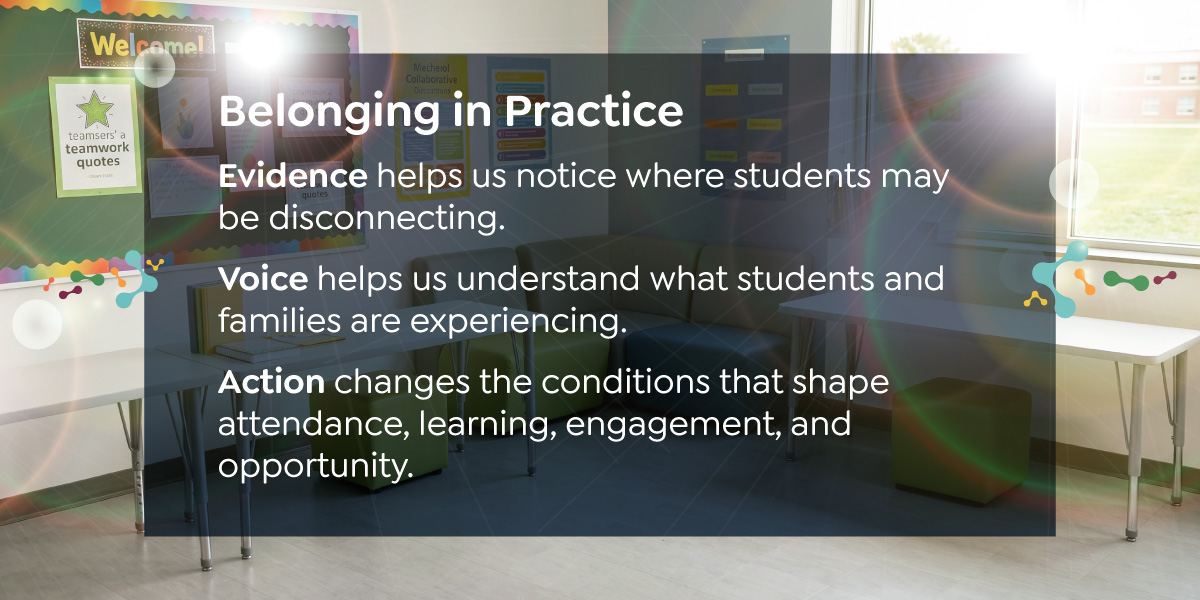
Evidence helps us see where the conditions for belonging are strong and where they are not. Voice helps us understand the experience behind that evidence. Action is how we turn what we learn into something students can actually feel in their classrooms, relationships, and opportunities to contribute.
That is the kind of belonging we want to design for, protect, and continuously strengthen.