


Our country has undergone an extraordinary shift in how we think about reading. The science of reading movement has pushed schools to look beneath an overall reading score. When a student struggles, we increasingly ask: Is the constraint phonemic awareness? Phonics? Fluency? Vocabulary? Language comprehension? We understand that different needs require different instruction.
That urgency is warranted. But I keep wondering:
→ Why don’t we bring the same urgency and precision to mathematics?
In mathematics, it remains culturally acceptable to say, “I’m just not a math person.” We would be alarmed if a student reached middle school unable to decode. Yet students can arrive in middle and high school without secure additive, multiplicative, or proportional reasoning, and too often we describe them simply as “below grade level.”
The consequences extend well beyond school. According to the most recent national assessment of adult skills, 34% of U.S. adults ages 16–65 performed at Level 1 or below in numeracy, compared with 28% in literacy. Only 38% reached Level 3 or above in numeracy. We should be asking harder questions about that.
I’ve written previously about the larger mathematics crisis and what happens when unfinished learning accumulates year after year. And in the story of Marcus, we explored what those system-level numbers can look like in the life of one learner.
This article is about what we can do differently.
We Have Plenty of Math Data. But Do We Know What to Do With It?
Through our work with school systems across the nation, The Core Collaborative has supported leaders in answering that question at two levels.
Our Opportunity Gap Analysis™ provides a 30,000-foot view. It brings together multiple sources of evidence to help a system see where opportunity gaps are emerging, who is being affected, and where Tier 1 instruction, intervention, assessment, or system design may need to change.
Our MTSS Blueprint™ is way more granular. It asks:
→ What does this particular learner need next? What evidence will confirm it? What intervention fits? And approximately how much support might be required?
That distinction matters because “2+ years below” is not an intervention plan.
First, We Need to Understand the Progression
Algebra readiness doesn’t begin in Algebra I. It begins when young children learn to make sense of quantity, compose and decompose numbers, recognize relationships, and reason about unknowns and equality. Those ideas develop over time into additive reasoning, multiplicative reasoning, rational and proportional reasoning, and eventually formal algebraic reasoning.
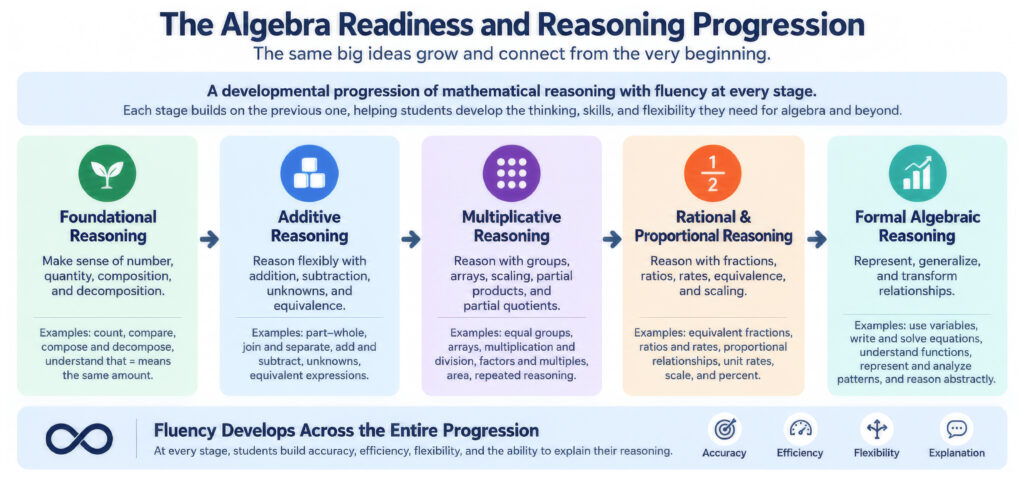
The progression gives us a way to look beneath a grade-level score:
→ Foundational → Additive → Multiplicative → Rational & Proportional → Formal Algebraic Reasoning
Fluency develops throughout the progression. It is not simply memorizing facts or completing problems quickly. Students become increasingly accurate, efficient, flexible, and able to explain their reasoning. That matters for algebra.
Decomposing quantities supports decomposing addends. Flexible additive strategies prepare students to reason with partial products. Partial products and partial quotients make mathematical structure visible in ways that support later work with expressions, equivalence, and algebraic transformations.
So when an older student struggles, the most useful question may not be:
→ “How many years below is this student?”
It may be:
→ “Where has the development of mathematical reasoning and fluency become constrained?”
Step 1: A Screener Gives Us a Signal, Not a Diagnosis
Imagine a sixth-grade MTSS team looking at its universal screening data. A student is identified as: 2+ years below grade level. The team knows the student needs support.
But support with what?
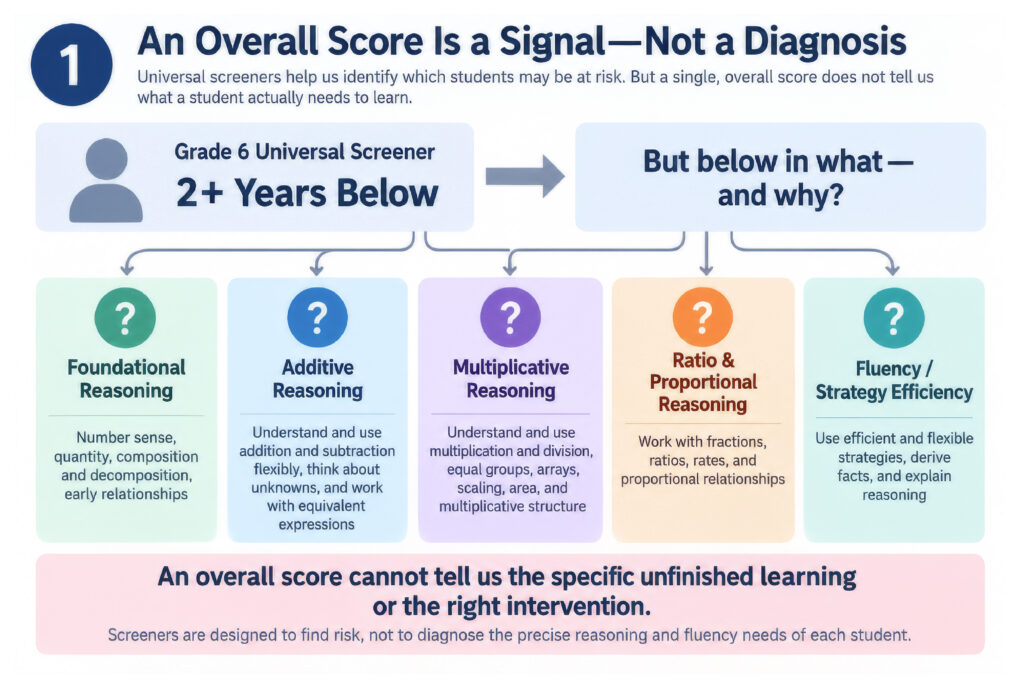
The student could have unfinished foundational reasoning. The constraint could be additive or multiplicative reasoning. The student might understand those relationships but lack the fluency necessary to use them efficiently. Or the difficulty could be emerging as mathematics becomes increasingly rational and proportional. A screener can’t give you all of this information.
And two sixth graders with nearly identical overall scores may have completely different underlying needs. This isn’t a failure of universal screening.
→ The screener did its job. It identified risk.
The mistake happens when we ask a screening score to do a second job: diagnose the precise instructional need and determine the intervention.
Step 2: Look Beneath the Score—and Confirm
Most districts we encounter don’t have a data shortage. They have state assessments, universal screeners, domain scores, curriculum assessments, student work, prior performance, and teacher observations. The challenge is translating all of that evidence into a coherent instructional decision.
The MTSS Blueprint™ brings those sources together and examines the pattern through the Algebra Readiness and Reasoning Progression.
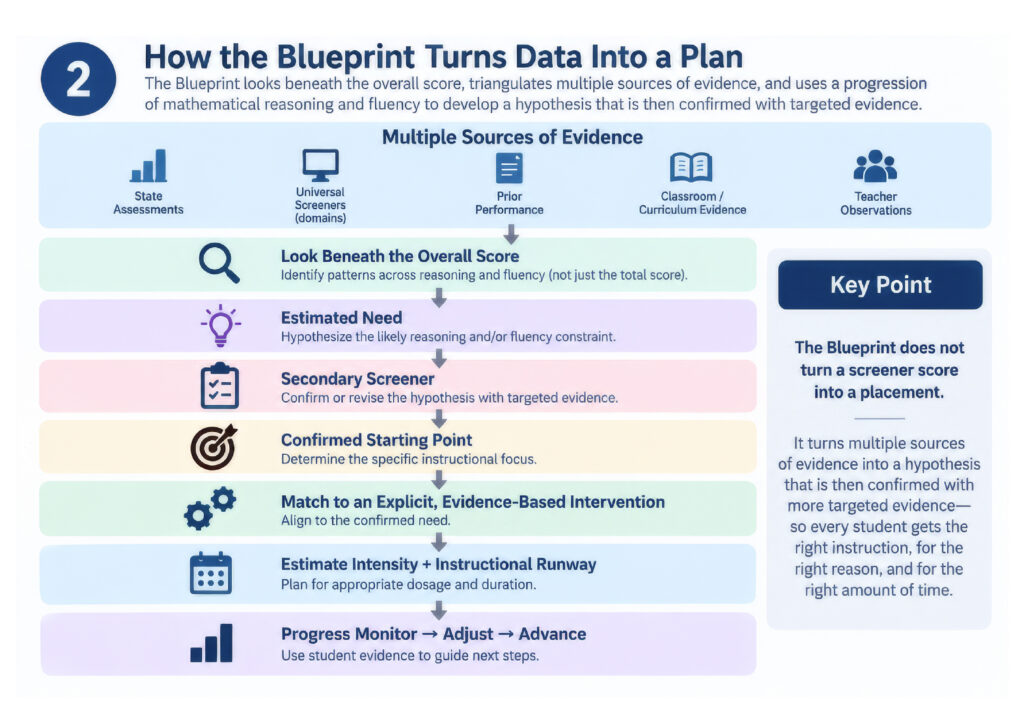
Importantly, the first result is an estimated need—not a diagnosis. If the available evidence suggests that multiplicative reasoning may be the constraint, we don’t automatically place the student into a multiplicative intervention. We investigate. A brief, targeted secondary screener confirms—or challenges—the hypothesis. That creates a disciplined pathway:
→ Evidence → Estimated Need → Secondary Screener → Confirmed Need → Intervention
We aren’t creating another giant assessment system. We’re using existing evidence to determine what additional evidence is actually necessary before making an intervention decision.
Step 3: Give Teachers More Than a Placement
Once we know the need, teachers need an actionable plan.
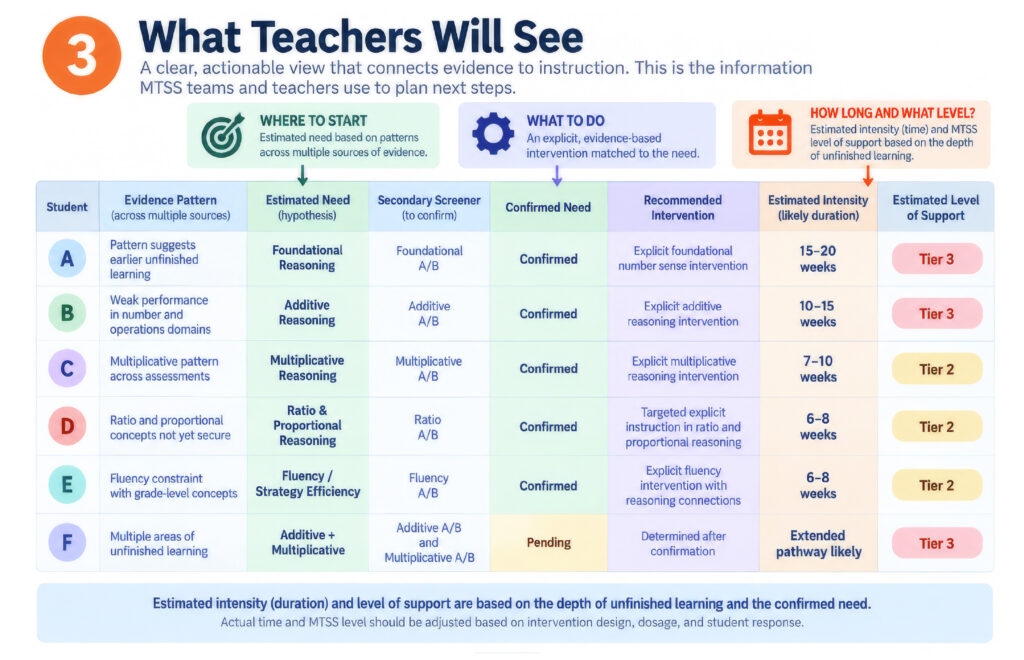
The Blueprint helps answer three questions:
- Where do we start?
The confirmed need identifies the instructional starting point. - What do we do?
The student can be matched to an explicit, evidence-based intervention designed for that need. - How much support should we plan for?
The Blueprint provides an estimated intensity—including likely instructional duration and estimated level of MTSS support.
That last question matters enormously. A student needing targeted work in proportional reasoning may require a very different response from an older learner with unfinished foundational or additive reasoning. Knowing that difference helps schools plan groups, intervention dosage, staffing, materials, and time.
An estimated 10–15 weeks is not an expiration date. A Tier 3 estimate isn’t a permanent label. Student response and progress-monitoring evidence determine what happens next. But systems need a reasonable starting point for planning.
Intervention Cannot Live in a Separate Room
There is another problem we have to address. Suppose a sixth grader has a confirmed multiplicative reasoning gap and receives intensive Tier 3 intervention. That student is still a sixth-grade mathematician. Their core teacher needs to know what is happening.
If unfinished multiplicative reasoning will interfere with fractions, ratios, equations, or other grade-level mathematics, the core teacher needs to understand the student’s learning needs and provide the Tier 2 supports within core instruction that keep grade-level mathematics accessible while Tier 3 addresses the deeper unfinished learning.
Otherwise, we risk repairing yesterday’s learning while the student falls further behind in today’s learning. A coherent MTSS response has to connect intervention and core instruction, not separate them.
And Students and Families Deserve the Truth
“Your child is receiving Tier 3 mathematics intervention” is not enough.
Parents and caregivers deserve to know what their child already understands, what they are working to learn next, approximately how intensive and how long the intervention may need to be, how progress will be monitored, and what the school is doing to help. They should also know how they can support their child—without turning home into another intervention classroom.
Communication cannot happen only when intervention begins or ends. Families should receive a meaningful progress update every two to three weeks. We have supported schools nationally in building this kind of family-engagement infrastructure. Parents should know whether the intervention is working and, when it isn’t, what the school plans to change.
There is another part of this conversation that may be harder: sometimes families deserve an apology.
When years of unfinished learning were not identified or adequately addressed, responsibility cannot simply be placed on the child or family. Sometimes a school or district needs to say: We should have recognized and responded to this sooner. We didn’t, and we’re sorry. Here is what we are going to do now.
As the parent of two adult sons who failed Algebra, this is personal for me. I remember being told they struggled with problem solving. At the time, I accepted that explanation. We wondered whether they needed to work harder, whether they weren’t applying themselves, or whether we should have been doing more at home. As a parent, you carry that.
Now I see it differently. How could they demonstrate strong problem solving when they were being asked to solve problems built on mathematics they had never fully learned? They weren’t lazy. They weren’t incapable. They had unfinished learning, and Algebra exposed it.
I wish someone had told us that then. I wish the school had said, We have some responsibility here, too. Let’s identify what they haven’t yet had the opportunity to learn and make a plan.
This isn’t about blaming individual teachers. It is about system responsibility. Families deserve to know where their child is now, where they are headed, whether they are making progress, and what comes next. They should be partners in the intervention process, not simply recipients of an intervention decision.
From a List of Students to a System Response
This is also where the MTSS Blueprint™ reconnects to the Opportunity Gap Analysis™. Imagine a district has 100 students identified as significantly below benchmark. A list of 100 names tells leaders they have a problem. It doesn’t tell them what they need to build.
But if the district can see how many students appear to need additive reasoning, how many need multiplicative reasoning, how many need proportional reasoning, how many require Tier 3 intensity, and approximately how long those pathways may take, leaders can make very different decisions about staffing, grouping, scheduling, intervention materials, professional learning, and Tier 1 prevention.
That’s the difference between intervention management and a coherent system of support.
→ The Opportunity Gap Analysis™ helps us see the system.
→ The MTSS Blueprint™ helps us see the learner and build the response.
What If Mathematics Received the Same Urgency?
The science of reading has helped move the national conversation away from accepting reading difficulty as an identity. We should expect the same in mathematics.
- A child isn’t simply “bad at math.”
- A score isn’t a diagnosis.
- And “2+ years below” isn’t an intervention plan.
We can identify the unfinished learning. We can make the pathway visible. We can provide explicit intervention. We can support access to grade-level mathematics at the same time. We can show students and families where they are going. And we can use evidence to determine whether what we’re doing is working.
→ Students deserve more than a score.
They deserve to know where they are, where they’re going, and what comes next. Families deserve that clarity too. And educators deserve the precision they need to build a response that gives every learner a genuine pathway forward.
That’s the work of Human-Centered MTSS™.