


 Human-Centered MTSS asks us to see school as a living system of support. That idea matters deeply when we talk about chronic absenteeism.
Chronic absenteeism is often treated as an attendance problem. A student misses too many days. A letter goes home. A team reviews the numbers. A plan is created to get the student back in the building.
But chronic absenteeism is rarely just about attendance. It is a signal. It tells us something important about how a student is experiencing school, how connected they feel, how supported their family feels, how meaningful learning feels, and how well the system is noticing and responding before disconnection deepens.
According to the U.S. Department of Education, chronic absenteeism means missing 10 percent or more of school days. The national rate reached about 31 percent in 2021 to 2022 and decreased to about 28 percent in 2022 to 2023. More recent analyses suggest improvement, but chronic absenteeism remains well above pre-pandemic levels. Attendance Works reminds us that chronic absence includes excused and unexcused absences, as well as suspensions, which means schools need to understand the full pattern of missed learning time, not only whether an absence was “valid.”
That means schools are not facing a small attendance issue. They are facing a systemwide reengagement challenge.
The question is not only, “How do we get students to attend?”
The deeper Human-Centered MTSS question is, “What is the student’s absence telling us about the conditions we need to understand, strengthen, or change?”
Attendance Data Tells Us What. Empathy Evidence Tells Us Why.
Attendance data is essential. It helps schools identify students who need support, notice patterns, and act before absence becomes a crisis. Attendance data can tell us who is missing school, how often they are absent, when the pattern began, whether absences are increasing, and which grades, classrooms, courses, or groups may need attention.
But attendance data alone cannot tell us whether a student feels known or invisible. It cannot tell us whether school feels safe or stressful, whether the student feels too far behind to return, whether transportation, housing, health, caregiving, or work responsibilities are interfering, or whether the family has experienced school as a partner or as a judge.
That is why empathy evidence is essential.
Empathy evidence is the human evidence we gather by listening with curiosity, humility, and care. It includes student stories, family perspectives, barriers, hopes, relationship patterns, classroom experiences, and the moments when students feel either connected or disconnected.
Without empathy evidence, schools are left to guess. With empathy evidence, schools can design supports that respond to what students and families are actually experiencing.
This is where attendance work becomes Human-Centered MTSS work.
The Human-Centered MTSS Connection
Chronic absenteeism connects most directly to three Drivers of Human-Centered MTSS: Evidence Analysis and Action, Identity, Belonging, and Family Partnership, and Purpose, Pathways, and Future Readiness.
 Driver 2: Evidence Analysis and Action
Chronic absenteeism requires more than looking at a list of students who have crossed an attendance threshold. It requires teams to study patterns, listen deeply, identify root causes, and act.
This is where PLCs, Impact Teams, attendance teams, student support teams, and leadership teams become essential. The purpose of the team is not to admire the data. The purpose is to turn evidence into action.
Teams should look across attendance data, empathy evidence, grades, behavior patterns, student work, course performance, family input, and classroom experience. Then they should ask:
- Which students are beginning to drift?
- What patterns are showing up by grade, class, course, student group, or time of year?
- What do students say is making school harder to attend?
- What do families say they need?
- What conditions are helping some students attend consistently?
- What adult action is needed now?
- How will we know whether our response is working?
 Driver 3: Identity, Belonging, and Family Partnership
Students are more likely to attend when they feel known, valued, safe, and connected. Families are more likely to partner when they are approached with respect rather than blame.
This Driver reminds us that attendance work is not only technical. It is relational. A student who has missed school needs more than a reminder. They need a way back in. They need to know someone noticed. They need to be welcomed without shame. They need support to reenter learning. They need a trusted adult who sees the whole story, not just the attendance record.
Families need the same kind of partnership. Attendance conversations should communicate care, curiosity, and shared responsibility. Instead of “Your child has missed too many days,” the message becomes, “We are glad your child is part of this community. We want to understand what is getting in the way, and we want to problem-solve with you.”
That shift does not lower expectations. It makes expectations more reachable.
 Driver 5: Purpose, Pathways, and Future Readiness
Students are more likely to show up when school feels connected to their lives, strengths, identities, interests, and futures.
For some students, chronic absenteeism grows when school feels irrelevant. For others, it grows when school feels overwhelming. For others, it grows when they cannot see a pathway from where they are to where they want to go.
Purpose is not an extra. It is part of the attendance work. Schools strengthen attendance when students can answer: Why does this learning matter? Who knows what I care about? Where do I experience success? How does school connect to my future? How do I contribute to this community?
When students experience school as a place where they are known, needed, challenged, and supported, attendance becomes more than compliance. It becomes participation in a community that matters.
The Commitments That Matter Most
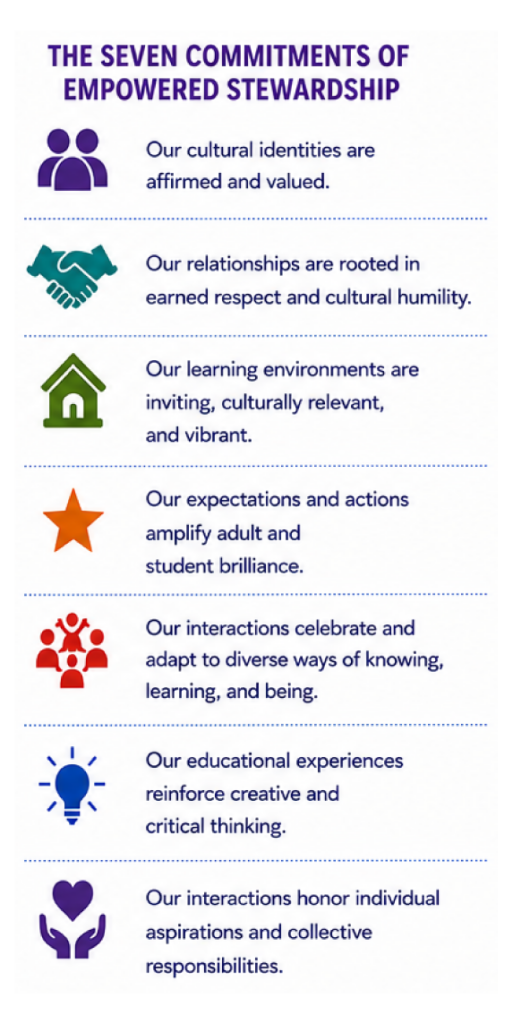 Chronic absenteeism also calls schools back to the Seven Commitments of Empowered Stewardship. The most relevant commitments are the ones that shape how adults respond when students are disconnected.
Attendance work improves when adults commit to relationships rooted in earned respect and cultural humility, learning environments that are inviting, culturally relevant, and vibrant, and interactions that honor individual aspirations and collective responsibilities.
These commitments change the adult stance.
- From blame to curiosity
- From compliance to connection
- From assumption to inquiry
- From counting absences to understanding experiences
- From fixing students to improving systems
Students and families can feel the difference.
A compliance approach says, “You have missed too many days.”
A Human-Centered MTSS approach says,
We noticed you have been away. We care about you. We want to understand what is making school hard to attend, and we want to work with you on a way forward.”
The second approach does not ignore accountability. It deepens it. It holds the system accountable for creating the conditions where students are known, welcomed, challenged, supported, and needed.
Use Empathy Evidence Before Designing the Plan
Attendance Works emphasizes that reducing chronic absence requires a team-based, positive, problem-solving approach that focuses on engagement and belonging, not punishment alone. The Institute of Education Sciences also points schools toward approaches that include family partnership, safe and positive learning environments, data use, early warning systems, and cycles of continuous improvement.
Human-Centered MTSS brings those ideas together. It asks teams to use attendance data as a starting point, not an endpoint.
Before assigning a student to another intervention, teams should gather empathy evidence. That means listening to the student and family in a way that helps the school understand the story behind the attendance pattern.
Schools can use the Empathy Interview Tool to guide this process. The tool includes preparation steps, student-centered interview questions, listening guidance, and reflection prompts for identifying root causes and next supports. It can be used with any student experiencing chronic absenteeism or early signs of disconnection, not only freshmen.
The purpose of the tool is simple: listen to understand, avoid judgment, learn the story behind the data, and turn insight into action.
The most important part is not the script. The most important part is the stance. Curiosity. Respect. Cultural humility. Patience. Active listening. No judgment. No defensiveness.
When teams use empathy evidence well, they do not collect student stories and then move on. They use what they learn to design better supports and improve the conditions students are responding to.
What Schools Can Do Tomorrow
Schools do not need to wait for a new initiative to begin using a Human-Centered MTSS response to chronic absenteeism. They can start with three practical moves.
- Add empathy evidence to attendance data. Choose a small group of students with concerning attendance patterns. Before assigning another intervention, listen to their experience. Ask what makes school easier or harder to attend, where they feel connected, what barriers they are facing, and what adults may not understand. Use student and family voice as evidence, not decoration.
- Bring the evidence to a team. Use PLCs, Impact Teams, attendance teams, or student support teams to look across attendance data and empathy evidence. Identify patterns connected to belonging, relationships, instruction, family partnership, purpose, safety, transitions, and support. The goal is not to admire the problem. The goal is to change the conditions contributing to the problem.
- Design supports that restore connection. For each student, identify the adult action that will help the student reconnect. Who will reach out? How will the student be welcomed back? What support will make learning feel possible again? What does the family need from the school? How will the team know whether the student feels more connected?
These moves help schools shift from reacting to absences to redesigning the conditions for presence.
The Attendance Work Students Deserve
Chronic absenteeism is not separate from Human-Centered MTSS. It is one of the clearest signals of whether the system is working.
When students stop showing up, schools need more than reminders, letters, incentives, and consequences. They need evidence. They need empathy. They need relationships. They need family partnership. They need purposeful action.
The goal is not only to improve attendance. The goal is to build schools students want to attend.
Schools where students are known.
Schools where families are partners.
Schools where absence leads to understanding, not shame.
Schools where data leads to action, not labels.
Schools where adults notice, respond, and adjust before students disappear from learning.
That is the promise of Human-Centered MTSS.
And that is the attendance work students deserve.
References
Attendance Works. Key ingredients for systemic change.
https://www.attendanceworks.org/chronic-absence/addressing-chronic-absence/key-ingredients-systemic-change/
Attendance Works Strategies for school sites.
https://www.attendanceworks.org/chronic-absence/addressing-chronic-absence/strategies-for-school-sites/
Attendance Works. The problem.
https://www.attendanceworks.org/chronic-absence/the-problem/
Attendance Works. Identify the root causes of absence.
https://www.attendanceworks.org/chronic-absence/addressing-chronic-absence/3-tiers-of-intervention/root-causes/
Institute of Education Sciences. Chronic absenteeism. U.S. Department of Education.
Malkus, N. (2025, June). Lingering absence in public schools: Tracking post-pandemic chronic absenteeism into 2024. American Enterprise Institute.
U.S. Department of Education. Chronic absenteeism. U.S. Department of Education.