


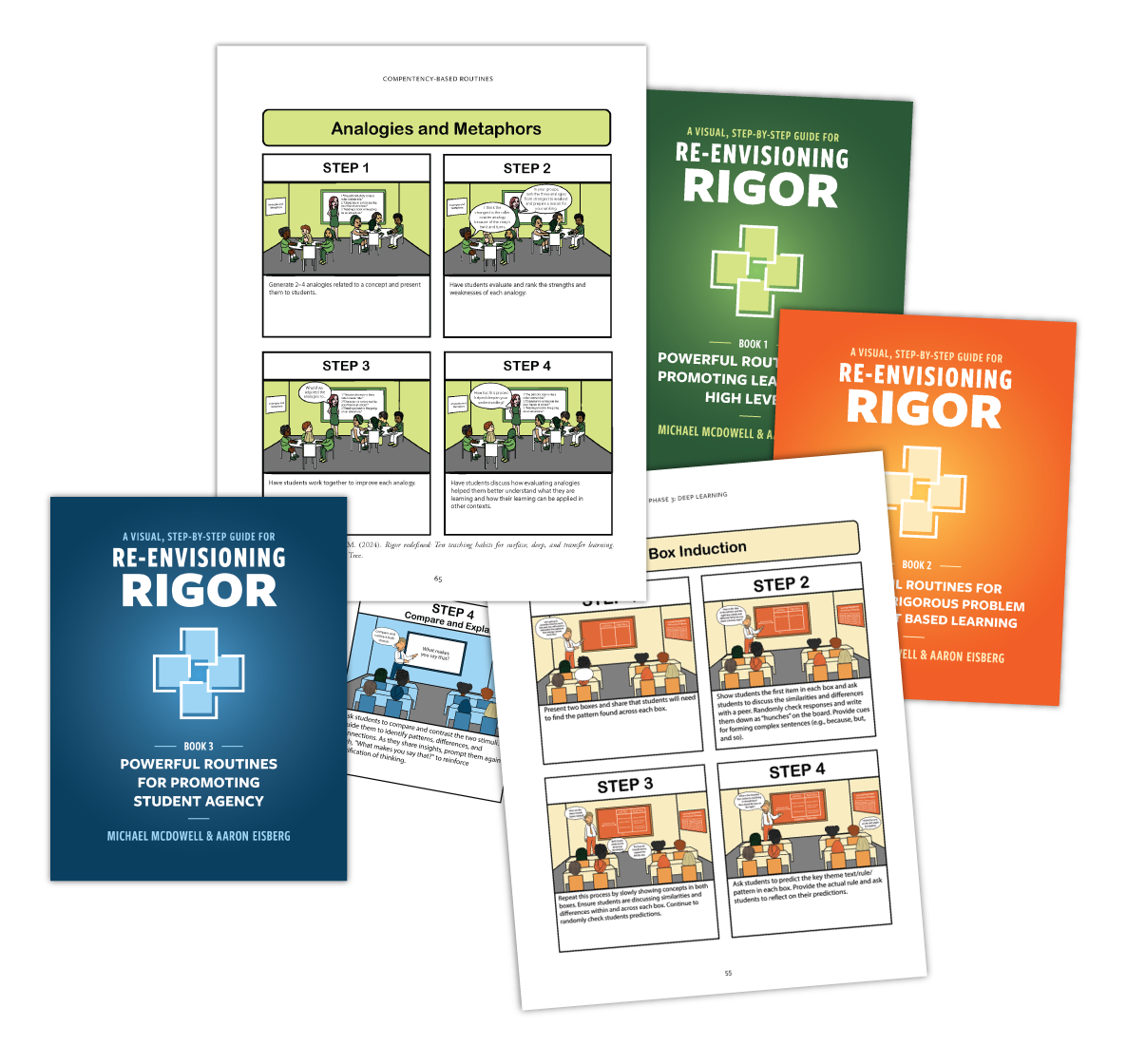
 Utilizing a high-leverage strategy to teach a disciplinary concept enhances learning impact, but stacking or layering multiple high-leverage strategies within a single lesson fosters even deeper understanding, stronger conceptual connections, and greater transfer of learning as students build on foundational ideas in meaningful and cumulative ways (Hattie, 2012).
The Re-Envisioning Rigor Series by McDowell and Eisberg offers educators a flexible set of four-step instructional routines designed to guide students through structured stages of learning:
- Building surface-level understanding (gaining foundational knowledge, vocabulary, and basic skills)
- Developing deep learning (making connections, reasoning, and analysis)
- Achieving transfer learning (applying knowledge and skills independently in new and real-world contexts)
When these strategies are intentionally stacked, students transition from initial concept acquisition to complex analysis, and ultimately to independent application—all within one cohesive lesson. This process not only supports skill mastery but also fosters metacognition and learner agency, empowering students to reflect, adjust, and advocate for their own understanding as they progress.
Let’s see how multiple Re-Envisioning Rigor Strategies could be stacked to teach Manifest Destiny in a high school U.S. History course.
The Historical Concept:
Manifest Destiny is especially well-suited for this layered approach because it is an interdisciplinary, multifaceted concept essential to understanding both historical and contemporary American identity. It weaves together political, social, economic, and geographic threads, requiring students to engage multiple perspectives and types of reasoning. Teaching Manifest Destiny through surface, deep, and transfer routines allows learners to:
- First, recognize and describe its core beliefs and vocabulary (surface)
- Then, analyze and compare diverse motivations and consequences, examining how expansion shaped American society, politics, and the land itself (deep)
- Finally, draw meaningful connections between past beliefs and present-day debates about American identity, policies, and global influence (transfer)
The Objective:
Students will be able to analyze Manifest Destiny and explain its short- and long-term effects on American politics, social structure, economics, and geography.
Success Criteria:
- I can describe how Manifest Destiny influenced U.S. political decisions and territorial expansion in the 1800s.
- I can explain how Manifest Destiny affected social groups and changed communities, including Native Americans and settlers.
- I can identify economic motivations for westward expansion and describe its impact on trade, resources, and wealth.
- I can show how Manifest Destiny reshaped the geography of the United States.
- I can connect the effects of Manifest Destiny to issues that still affect America today.
Instructional Strategies:
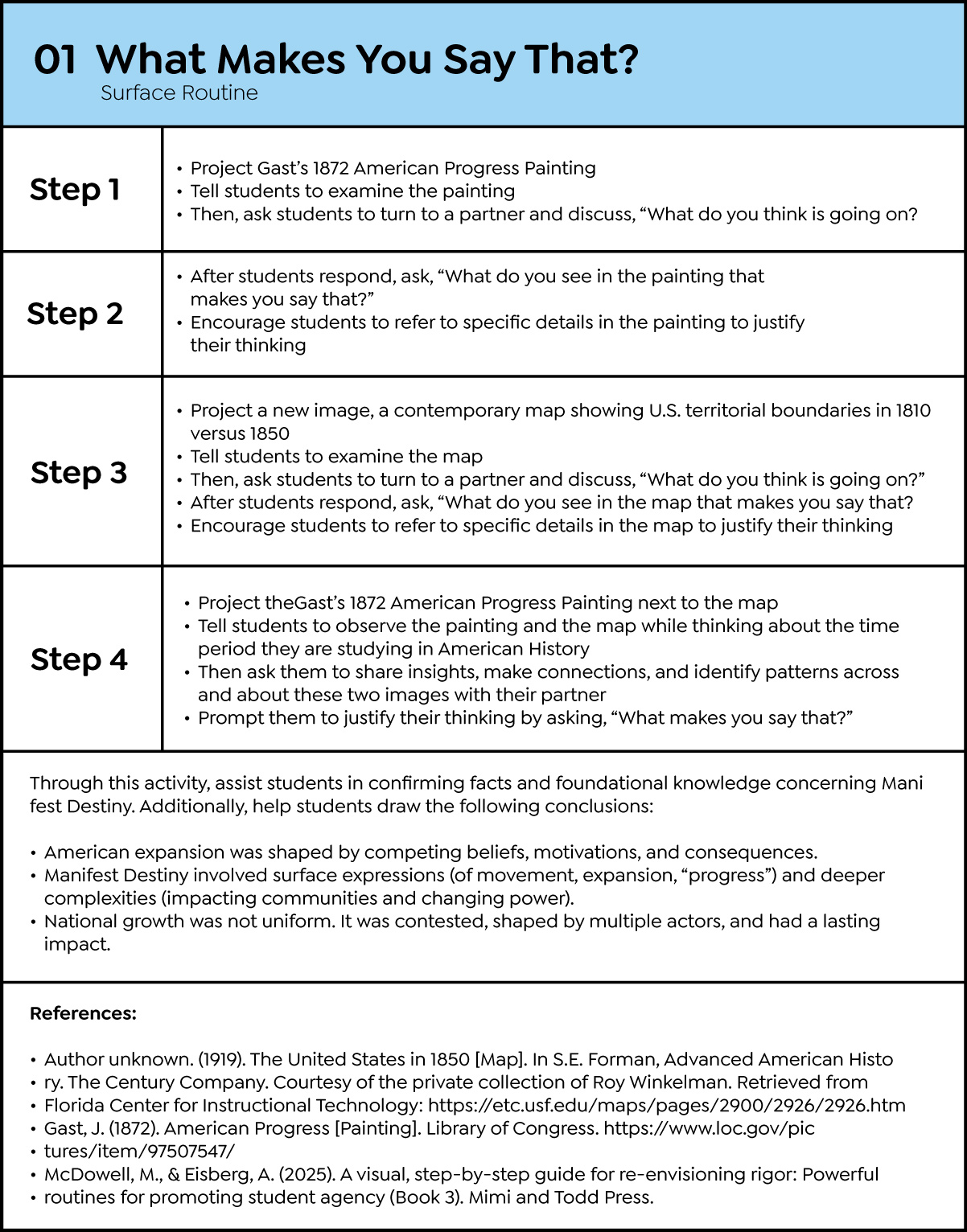
Transition: What Makes You Say That? presented visual evidence concerning the historical time period and the concept of Manifest Destiny. To further understand the impact of this concept on groups, the economy, geography, etc., we are going to sort historical perspectives and outcomes by comparing and contrasting categories—just as historians do.
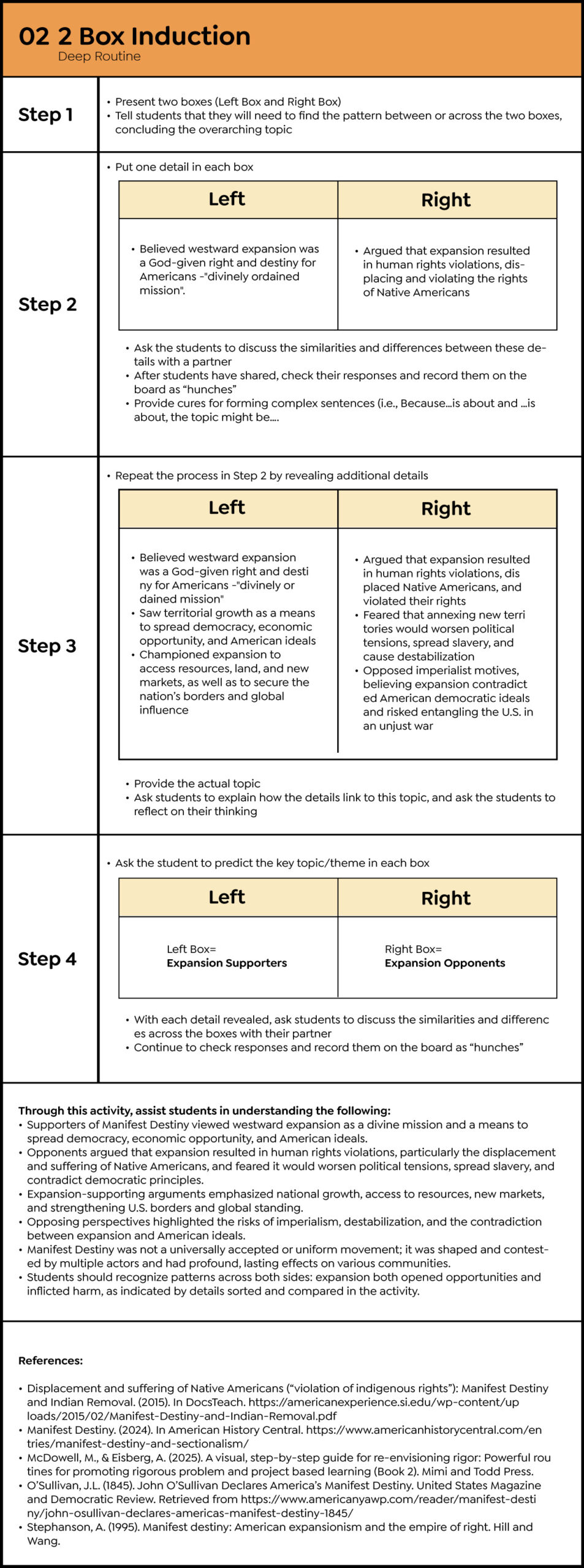
Transition: The 2 Box Induction Strategy allowed us to analyze different perspectives and consequences surrounding Manifest Destiny by sorting evidence and drawing patterns. To see the broader impact of Manifest Destiny, both in the past and in issues that still affect us today, we are going to engage with analogies. We will use these analogies to clarify exactly how Manifest Destiny shaped American politics, society, economics, and geography.
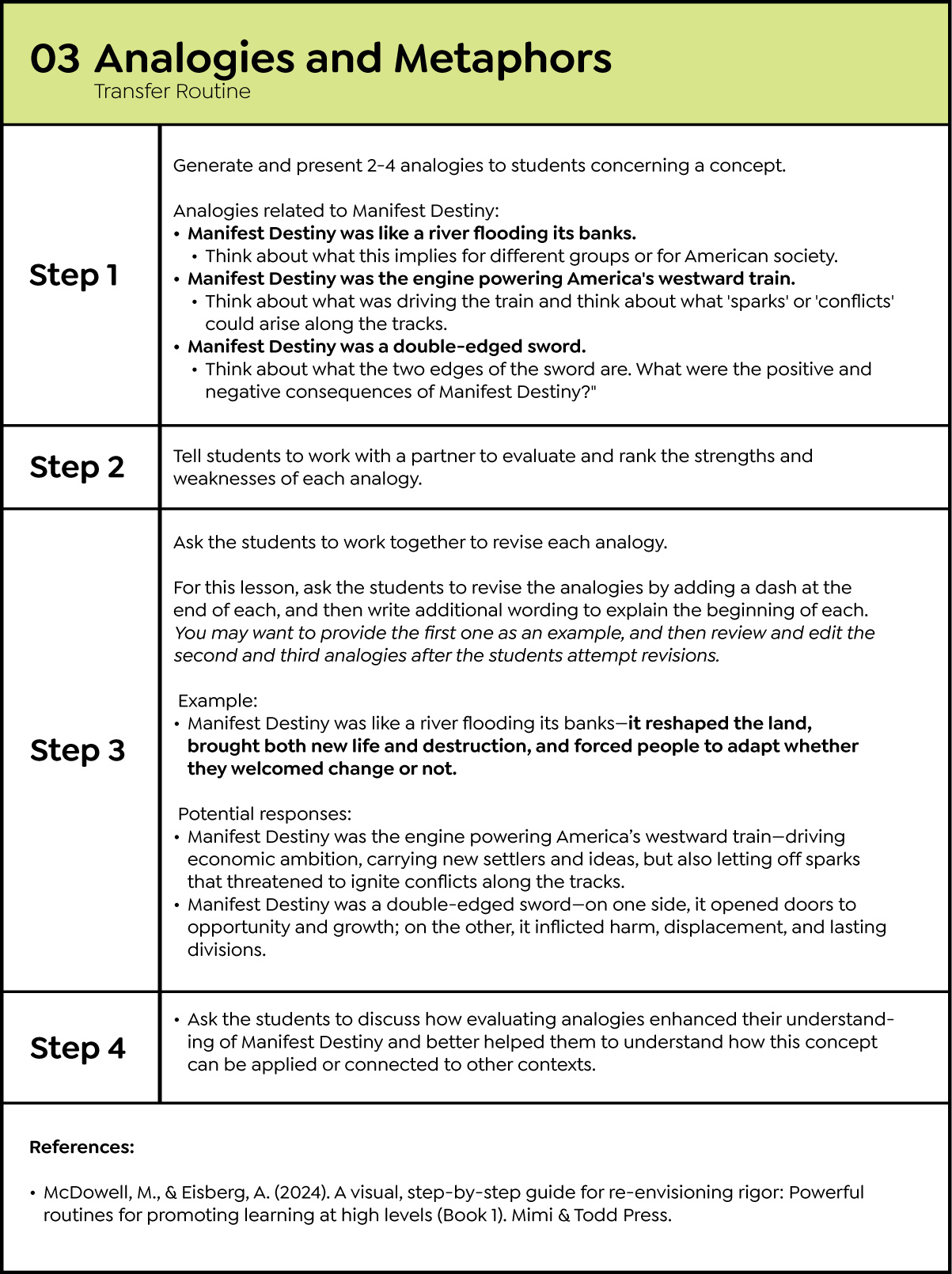
This lesson intentionally layers surface, deep, and transfer learning strategies to guide students step by step toward a complete understanding of Manifest Destiny. Students begin by building foundational knowledge, then examine the political, social, economic, and geographic effects, and finally apply what they’ve learned to contemporary issues. Each activity aligns to specific success criteria, helping students describe territorial changes, explain social consequences, identify economic motivations, and connect historical impacts to modern contexts. Throughout the process, guided discussions prompt reflection and refinement of ideas. Our deliberate design supports both content mastery and the development of critical, transferable thinking skills.
References:
- Author unknown. (1919). The United States in 1850 [Map]. In S.E. Forman, Advanced American History. The Century Company. Courtesy of the private collection of Roy Winkelman. Retrieved from Florida Center for Instructional Technology: https://etc.usf.edu/maps/pages/2900/2926/2926.htm
- Bloomberg, P. J. (2025, March 20). Rigor reimagined: A pathway to learner agency—Advancing assessment capability in absolutely every learner. The Core Collaborative. https://thecorecollaborative.com/category/impact-teams/
- Displacement and suffering of Native Americans (“violation of indigenous rights”): Manifest Destiny and Indian Removal. (2015). In DocsTeach. https://americanexperience.si.edu/wp-content/uploads/2015/02/Manifest-Destiny-and-Indian-Removal.pdf
- Gast, J. (1872). American Progress [Painting]. Library of Congress. https://www.loc.gov/pictures/item/97507547/
- Hattie, J. (2012). Visible learning for teachers: Maximizing impact on learning (1st ed.). Routledge. https://doi.org/10.4324/9780203181522
- Heidler, J. T. (2025, September 25). Manifest Destiny | Summary, Examples, Westward Expansion, & Facts. Encyclopedia Britannica. https://www.britannica.com/event/Manifest-Destiny
- Manifest Destiny. (2024). In American History Central. https://www.americanhistorycentral.com/entries/manifest-destiny-and-sectionalism/
- McDowell, M., & Eisberg, A. (2024). A visual, step-by-step guide for re-envisioning rigor: Powerful routines for promoting learning at high levels (Book 1). Mimi & Todd Press.
- McDowell, M., & Eisberg, A. (2025). A visual, step-by-step guide for re-envisioning rigor: Powerful routines for promoting rigorous problem and project based learning (Book 2). Mimi and Todd Press.
- McDowell, M., & Eisberg, A. (2025). A visual, step-by-step guide for re-envisioning rigor: Powerful routines for promoting student agency (Book 3). Mimi and Todd Press.
- O’Sullivan, J.L. (1845). John O’Sullivan Declares America’s Manifest Destiny. United States Magazine and Democratic Review. Retrieved from https://www.americanyawp.com/reader/manifest-destiny/john-osullivan-declares-americas-manifest-destiny-1845/
- Stephanson, A. (1995). Manifest destiny: American expansionism and the empire of right. Hill and Wang.