
In math classrooms, “proficiency” is often the goal. Students can compute, solve a formula, follow step-by-step algorithms and arrive at an answer. But as educators, we know that true mathematical success goes far beyond correctness; it lives in reasoning, flexibility, and the ability to make sense of complex situations.
This is where the Re-Envisioning Rigor series becomes transformational.
Rather than asking, “Did students get the right answer?” these routines push us to ask,
- “How are students thinking?”
- “What are they noticing, predicting, and refining?”
- “How do they respond when their thinking is challenged?”
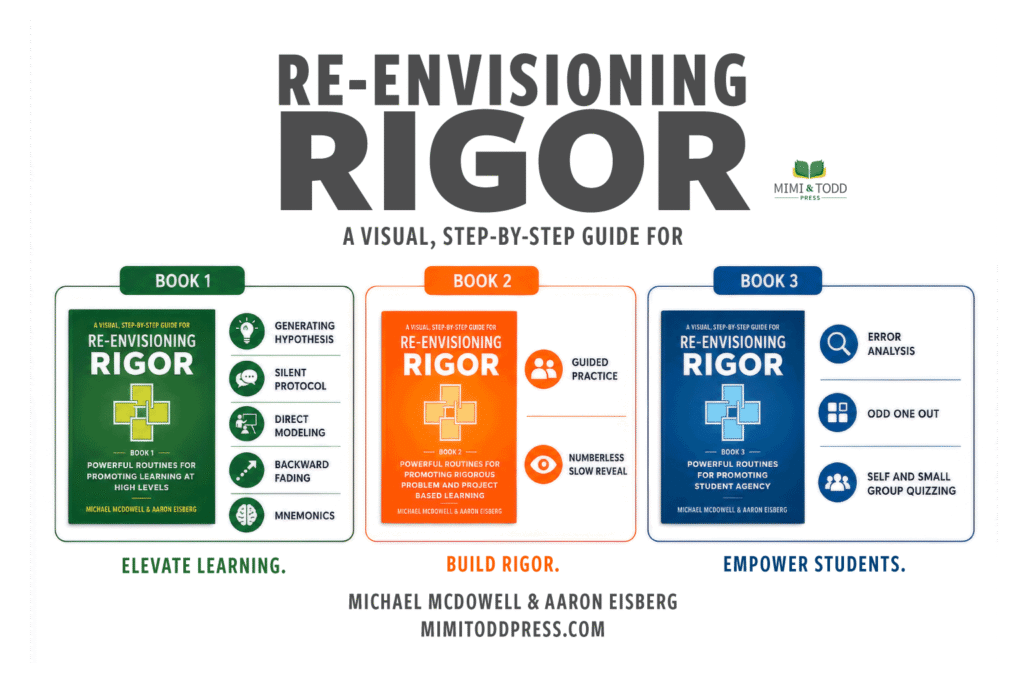
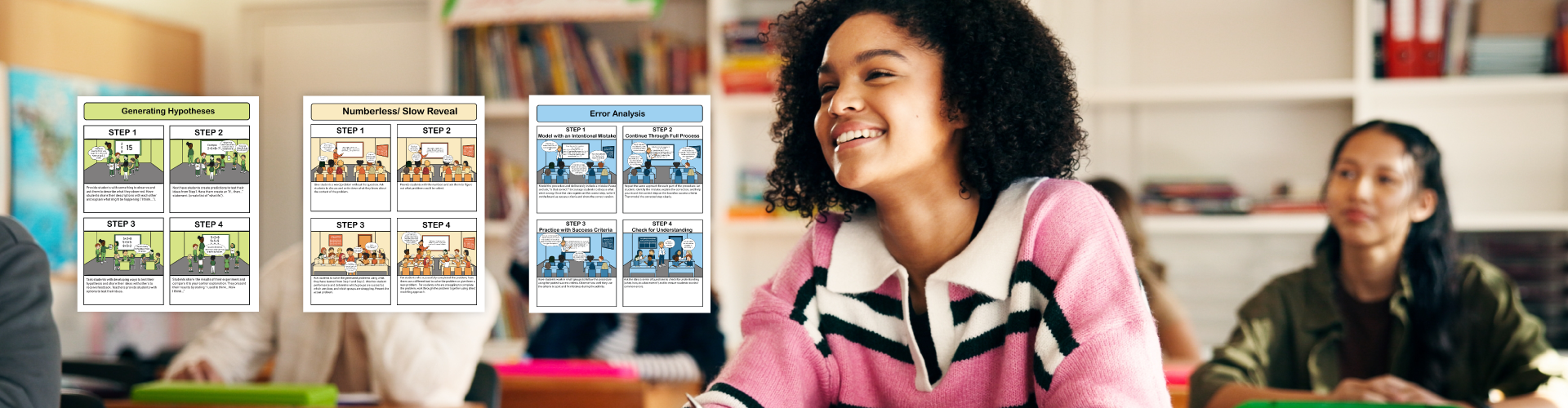
Three routines in particular, Generating Hypotheses, Numberless Slow Reveal, and Error Analysis, create a powerful instructional arc that moves students from surface-level proficiency into deep, transferable mathematical understanding.
 Generating Hypotheses: Positioning Students as Mathematical Thinkers
Before students ever compute, they should think.
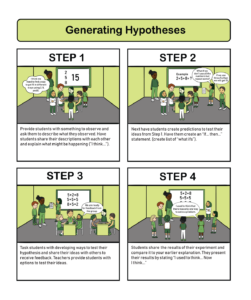
The Generating Hypotheses routine invites students to make predictions, form conjectures, and justify their reasoning before solving a problem. This subtle shift changes the interactions in the classroom and shifts the cognitive load to the students.
Instead of diving straight into procedures (which often provides a false sense of control), we should begin with dispositional prompts. Students start their thinking by asking:
- What do I think is going to happen?
- What relationships do I notice?
- What might the answer look like, and why?
In a math classroom, this could look like presenting a pattern, a graph, or a contextual scenario and asking students to predict outcomes before calculating.
Why this matters for proficiency:
Students build a conceptual framework before applying skills. Students can’t apply what they don’t know, or don’t understand. They are no longer guessing, they are reasoning. With the dispositions in mind, it gives students the endurance and grit needed to move forward.
Why this matters beyond proficiency:
Students begin to see math as a system of relationships, not a set of isolated steps. They develop mathematical intuition, the ability to anticipate, estimate, and justify. All while building confidence and endurance.
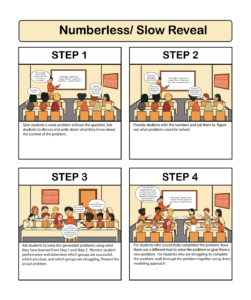 Numberless Slow Reveal: Lowering Barriers, Raising Thinking
Too often, students disengage from math not because they can’t think, but because they are overwhelmed by numbers too quickly. Or can’t translate the word problem into the formula. In my own practice, I think of math as a foreign language for students, so I need to build more access and scaffolds so that students can access the concepts. The new MLL… (transition from multi-language learners to math-language learners…did I just create a new thing!?!!)
The Numberless Slow Reveal routine flips that experience of student disengagement.
By initially removing numbers from a problem and revealing them gradually, students are invited into the context first…creating invitational access. They focus on:
- What is happening in the situation?
- What quantities might matter?
- How those quantities might relate?
Only after sense-making begins are numbers introduced, intentionally and strategically.
Why this matters for proficiency:
Students develop a clear understanding of the problem structure before computation. This reduces errors caused by misinterpretation or lack of understanding.
Why this matters beyond proficiency:
Students become problem solvers, not just calculators. It’s not just about the right answer, it’s about the process. Students learn to analyze situations, identify variables, and construct models which are the skills essential for real-world application and to transfer.
For multilingual learners, students with processing challenges, or those with math anxiety, this routine is especially impactful. It creates access without lowering expectations. It is the impact and access for our MLLs (math language learners).
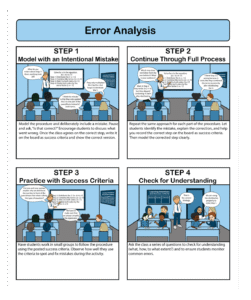 Error Analysis: Turning Mistakes into Momentum
In many classrooms, errors are something to avoid; students are often afraid to be wrong. This is visible during whole-class call and response: one student answers, the rest of the class agrees by saying, “Yeah, I had that same answer,” and then we, as teachers, move on. We need to build a culture of revision and reflection instead.
In rigorous math classrooms, errors are something to leverage, not to shy away from.
The Error Analysis routine positions mistakes as opportunities for deeper understanding. Students analyze incorrect work, sometimes their own, sometimes a peer’s, and then they grapple with questions like:
- Where did the reasoning or thinking break down?
- What assumption did I have that led to this error?
- How can we revise the thinking?
This shifts the classroom culture from performance to progress.
Why this matters for proficiency:
Students become more precise. They identify and correct misconceptions, leading to stronger, more accurate outcomes. The classroom culture shifts from compliance and proficiency to a culture of progress.
Why this matters beyond proficiency:
Students develop metacognition, grit and agency. They learn how to think about their thinking, they learn how to learn, monitor their reasoning, and refine their approach, skills that transfer far beyond math.
Perhaps most importantly, students build resilience and grit. They no longer fear being wrong, but they develop efficacy and they see it as part of the learning process.
The Power of the Sequence: A Coherent Learning Experience
Individually, each routine is powerful. As referenced in previous blogs on stacking routines together, they create a coherent instructional progression:
- Generating Hypotheses – Students anticipate and predict
- Numberless Slow Reveal – Students make sense of the situation
- Error Analysis – Students refine and solidify their understanding
This sequence mirrors how mathematicians work and process:
They suppose → they analyze → they revise.
And when classrooms reflect this process, the culture of the classroom shifts. Students are no longer passive recipients of procedures and algorithms. Students become active constructors and meaning making of knowledge and then their transfer.
From Proficiency to Transfer
We fight, we strive for proficiency in math. The answer isn’t in drill and kill, or in more direct instruction. It is shifting the shifting of culture and the sequencing of routines. When these routines are consistently embedded, we begin to see a different kind of student success:
- Students explain why, not just what
- Students approach unfamiliar problems with confidence
- Students persist through complexity
- Students transfer their understanding to new contexts
Imagine your class, your students who look and sound like the above, not just for fighting for proficiency, but building for adaptability. Because in the real world, math problems don’t come neatly packaged with steps to follow and algorithms. They require thinking, revision, reflection and adaptability.
Solving for ‘x’- Final Thoughts
My older brother once said, Math was great until they started to add letters where numbers should be. I often think about that as we develop more mathematical strategies in 4-step routines. The promise of the Re-Envisioning Rigor series is not that all students will simply perform better on assessments. We want to ensure more students are doing the cognitive load and thinking about those “letters” and what they might mean. Which is why the promise is that students will become better thinkers and learners. And in math classrooms, that is the difference between meeting the standard and exceeding it in ways that truly matter.
To see more ready-made 4-step math routines to implement tomorrow, see the following: