

Teaching is demanding in ways that are easy to underestimate from the outside.
Before the first bell, teachers may already be responding to messages from families, locating missing materials, adjusting for a colleague’s absence, reviewing data, preparing lessons, and anticipating the needs of 25 or 30 students who will enter the room with very different levels of readiness, energy, and support. During class, teachers are teaching content, checking for understanding, managing behavior, responding to questions, supporting students with IEPs and language needs, and trying to keep learning moving forward.
Then a student returns after several absences.
The student may arrive late. They may not have materials. They may not know where the class is in the unit. They may be behind on assignments, confused by new learning, or reluctant to draw attention to themselves. They may ask a question that requires the teacher to pause, revisit learning, or create a plan in the middle of an already crowded lesson.
It is understandable that teachers may feel frustrated, even resentful, at that moment. It is understandable to think, I have already taught this. I cannot stop everything and reteach it again. It is understandable to worry about the students who have been present, ready, and waiting for instruction.
And yet, sometimes the most important thing a student needs at that moment is not a complete solution.
It is a signal that they are still welcome.
I was reminded of that while standing in a painfully slow line to enter an assembly. The student in front of me was talking quietly with a friend. She did not sound angry. She sounded resigned, the way students sometimes sound when they have learned not to expect much from adults.
She had been absent for several days because life outside school had become more than she knew how to carry. Home was clearly hard with unpredictable mornings and chaotic evenings. After missing class, she was terrified of returning because she was already behind, already exposed, and already expecting people to be frustrated with her.
Still, she came back.
She walked through the doors, went to class, and tried to do the right thing. When she did not understand the assignment, she raised her hand and asked her teacher what she was supposed to do.
“Well, you would know what to do if you came to school,” the teacher said.
The student told her friend that she just stared at her paper after that.
In another class, she tried again. She explained that she had been out and asked where she should begin.
“It’s online,” the teacher said, barely looking at her before walking away.
Not one adult said they were happy to see her or glad she had returned.
Not one teacher asked if she was okay.
Had anyone wondered what had kept her away or whether she needed help finding a way back into her schoolwork?
Instead, the student who had worked up the courage to return was made to feel as though her absence was proof that she did not deserve support.
Perhaps the teachers did not know what was happening in her life. Perhaps they had a room full of students waiting for them. Perhaps they were exhausted, overwhelmed, or already trying to solve problems no one else could see.
But the student did not experience their workload, their fatigue, or the complexity of their day.
She experienced their words.
And those words told her that school was not a place she could safely return to when life became difficult.
The Attendance Challenge
Chronic absenteeism is not simply an attendance-office issue. It is a learning, engagement, belonging, and equity issue that shows up every day in classrooms.
A student is considered chronically absent when they miss at least 10% of the school year (about 18 days in a typical 180-day calendar) for any reason, including excused absences, unexcused absences, suspensions, illness, family responsibilities, transportation problems, or other barriers (Germain et al., 2024; U.S. Department of Education, 2025).
The national rate rose sharply during the pandemic, reaching approximately 31% in 2021–22 before falling to about 28% in 2022–23. That rate remained substantially above the pre-pandemic level of roughly 15% (Germain et al., 2024; National Assessment Governing Board, 2024; U.S. Department of Education, 2025).
More recent Return to Learn Tracker data indicate continued improvement, although chronic absenteeism remains well above pre-pandemic levels. Using district-level data from 44 states and Washington, DC, the American Enterprise Institute estimated chronic absenteeism at 25.4% in 2023 and 23.5% in 2024. More recent tracker data estimated the rate at 22.6% in 2025 (or 1 in 5 students as chronically absent), demonstrating progress but underscoring that chronic absenteeism remains a significant national concern (Malkus, 2025, 2026).
The numbers matter, but they can also make the issue feel distant. Behind each percentage point is a student like the one in the lunch line: a student who may be navigating anxiety, illness, caregiving, unreliable transportation, housing instability, family crisis, bullying, academic struggle, or the growing fear of returning after falling behind. Chronic absenteeism is associated with diminished opportunities for learning and adverse effects on student well-being, while persistent absence can increase the likelihood of academic difficulty, disengagement, and long-term risks such as not completing high school (Germain et al., 2024; Learning Policy Institute, 2024).
Teachers Cannot Carry This Alone
Teachers should not be expected to solve every barrier that affects a student’s attendance. A teacher cannot repair a family’s transportation challenges, eliminate housing instability, provide mental-health treatment, arrange child care for younger siblings, or resolve every crisis a student experiences outside school.
Effective attendance improvement requires coordinated schoolwide systems that involve families, administrators, counselors, social workers, nurses, attendance teams, community partners, and, when appropriate, student support services. The most persistent attendance challenges cannot be solved through a single classroom strategy or a punitive response (Germain et al., 2024; Learning Policy Institute, 2024).
Still, teachers have a uniquely important role.
Teachers shape what it feels like to return. They are often the adults students see most consistently. Their classrooms can become places where a student who has been absent feels exposed and unwelcome or they can be the place where that same student feels noticed, capable, and able to begin again.
This does not require a teacher to abandon the lesson, reteach every missed day immediately, or accept an impossible workload. It requires a brief but intentional response that communicates both care and high expectations.
What Welcome Looks Like
A welcoming response is not a free pass. It is not lowering standards, overlooking missed work, or pretending absence has not affected learning.
It is a way of saying: You are here now. Your return matters. Let’s identify the next right step.
Teachers can use language such as:
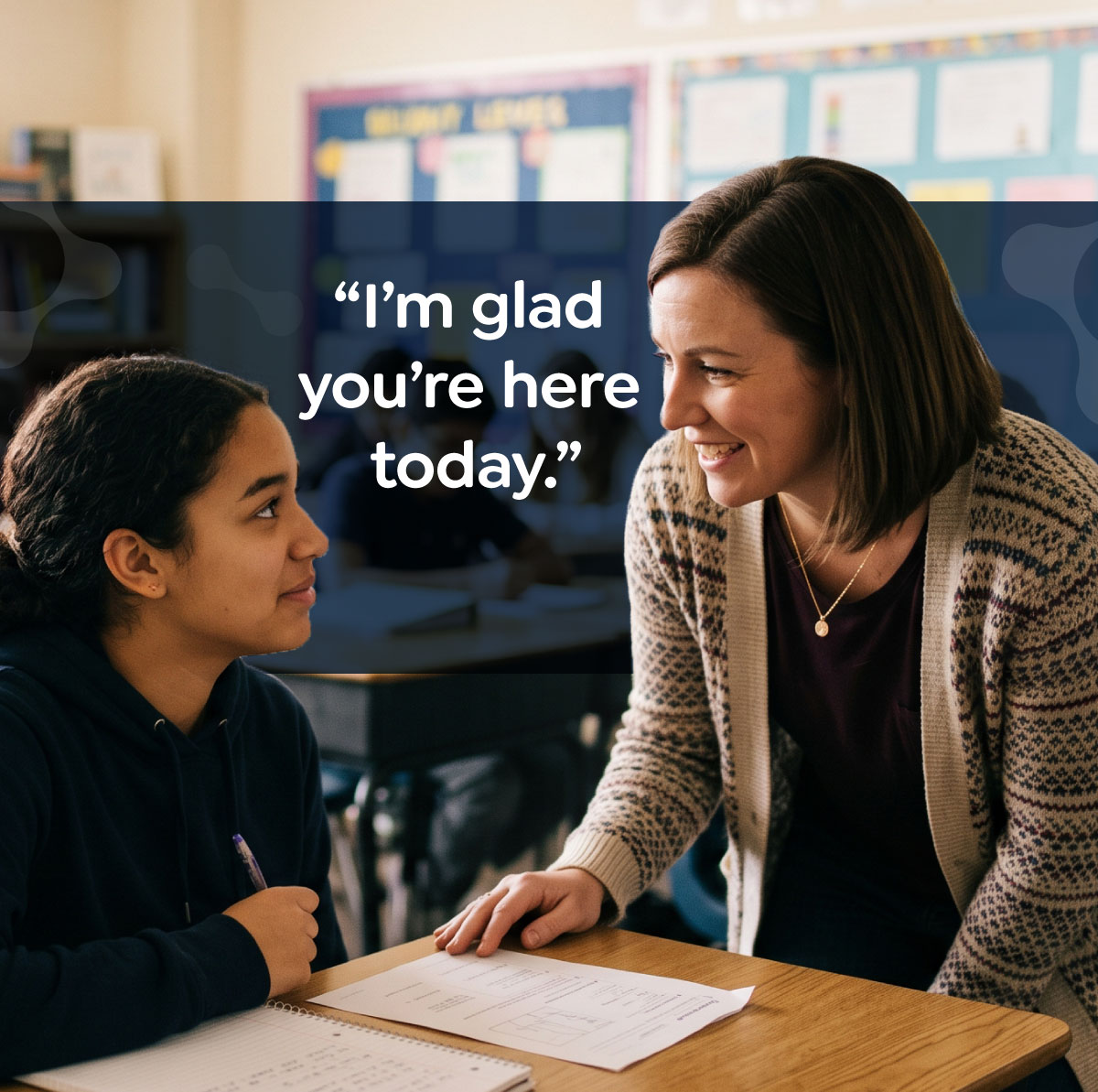
- “I’m glad you’re here today. Start with this one task, and I’ll check in with you in a few minutes.”
- “We missed you. You do not need to make up everything today. Let’s identify the most important place to begin.”
- “We are in the middle of new learning, so I’ll give you a quick overview and a manageable starting point.”
- “I’m not sure what has been going on, but I want to help you reconnect with the work.”
- “Would it help to talk with your counselor, case manager, or another adult you trust?”
- “Let’s focus on today’s learning first. We can make a plan for the rest.”
Warmly welcoming students and families is recognized as a practical way to strengthen students’ connection to school and support attendance. Attendance improves when students experience physical and emotional safety, belonging, and meaningful relationships—not merely pressure to comply (Balfanz & Byrnes, 2024).
The difference may take less than a minute. A teacher can greet the student, offer a clear first task, quietly identify what matters most, and schedule a later check-in. The student does not need an entire missing unit placed in front of them at once. They need a bridge back into the classroom.
A Better First Moment
Imagine the student in the lunch line entering class and hearing something different.
“I’m glad you made it in today,” her teacher might say quietly. “We are in the middle of something new, so just start with this first problem. I’ll come over in a few minutes and help you figure out what you need next.”
The teacher would still be managing a full class. The student would still have missed instruction. The work would still need to be addressed. Expectations would still matter.
But the student might leave with a fundamentally different belief:
I can come back. Someone noticed. I am not too far behind to belong here.
That is not a small thing.
For students facing chronic absenteeism, returning to school can require courage long before they ever walk through the front door. The welcome they receive when they arrive may not solve every problem, but it can determine whether they believe returning tomorrow is possible.
References
American Enterprise Institute. (2025, June 13). Lingering absence in public schools: Tracking post-pandemic chronic absenteeism into 2024. https://www.aei.org/research-products/report/lingering-absence-in-public-schools-tracking-post-pandemic-chronic-absenteeism-into-2024/
Balfanz, R., & Byrnes, V. (2024, June 18). Good attendance starts in the classroom. Educational Leadership, 81(8). ASCD. https://www.ascd.org/el/articles/good-attendance-starts-in-the-classroom
Germain, E., Hernández, L. E., Klevan, S., Levine, R., & Maier, A. (2024). Reducing chronic absenteeism: Lessons from community schools. Learning Policy Institute. https://doi.org/10.54300/510.597
Learning Policy Institute. (2024, September 18). How community schools are addressing chronic absenteeism. https://learningpolic
National Assessment Governing Board. (2024, August 13). A primer on attendance and absenteeism on the Nation’s Report Card. https://www.nagb.gov/naep/chronic-absenteeism.html
U.S. Department of Education. (2025, August 21). Chronic absenteeism. https://www.ed.gov/teaching-and-administration/supporting-students/chronic-absenteeism