


Taking your car in for a tune-up starts by checking what is working and where performance breaks down. Authors Kristen Eveland, Duane Habecker, and Cole Sampson apply the same thinking to math PLCs with ten warning lights to investigate and practical ways to strengthen the collaboration they already have.
Students may carry out a familiar procedure successfully while their understanding of why it works remains uncertain. Your team sees the completed work, records the score, and plans the next lesson but may still not have evidence that the students understand the mathematics behind those steps.
Indicator 4 in The Math PLC Tune-Up: 10 Indicators to Get Collaboration Back on Track takes up this challenge. The authors invite teams to investigate the mathematics themselves and use student thinking to shape what and how they teach next.
Make Room for Mathematical Curiosity
The creativity lies in opening a familiar problem to fresh examination: What does this method mean? How else could we represent it? What might a student’s explanation reveal?
Make time for your PLC to explore these questions together, connecting models, words, and symbols to understand the reasoning behind the steps.

Look Closely at Two Correct Answers
Imagine your team examines two student responses to 23 × 4. Both students arrive at 92.
Student A writes, “Four groups of 20 is 80. Four groups of 3 is 12. That makes 92.”
Student B explains, “Four times three is twelve. Write the two and carry the one. Four times two is eight, plus one is nine.”
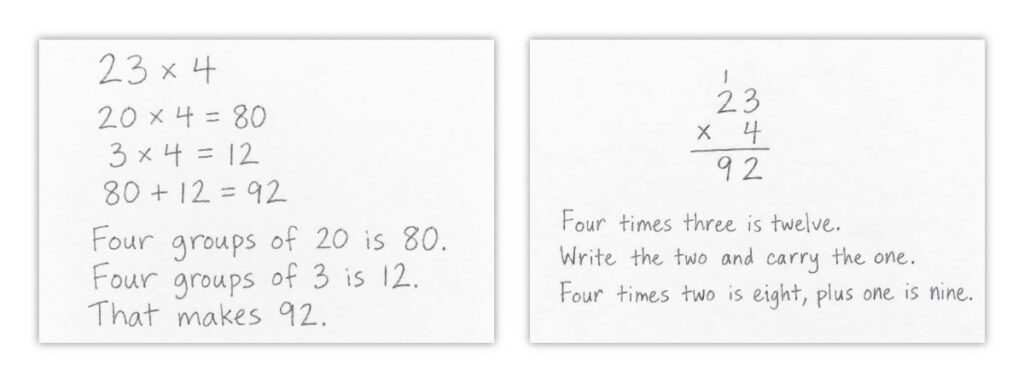
Use these fictional but realistic student work samples
to consider what you know and what you’re curious about.
The first response makes the value of the tens and ones explicit. The second describes the calculation but leaves the meaning of the regrouped 1 unclear. That student may understand regrouping; the explanation does not yet tell us.
A useful next question is: “What does the 1 you “carried” or regrouped represent? Show where it comes from using a drawing or materials.” The response can help the team decide whether the student needs support with place value, regrouping, or explaining a connection they already understand.
Try a Fifteen-Minute PLC Investigation
Choose one task from your current unit and bring a few student responses, including correct work. Use this short investigation as a starting point inspired by Indicator 4.
1 Solve and Connect for Four Minutes
Work the task yourselves using two representations. For 23 × 4, you might build four groups of 23 with base-ten blocks, sketch the groups, and connect the model to 80 + 12 = 92. Choose two forms and explain how they connect.
Locate the meaning of each step in the procedure. Where are the eight tens? Where do the twelve ones come from? How does regrouping ten of those ones explain the “carried” 1? Teachers’ own questions help identify what students may need to explore.
2 Study the Evidence for Six Minutes
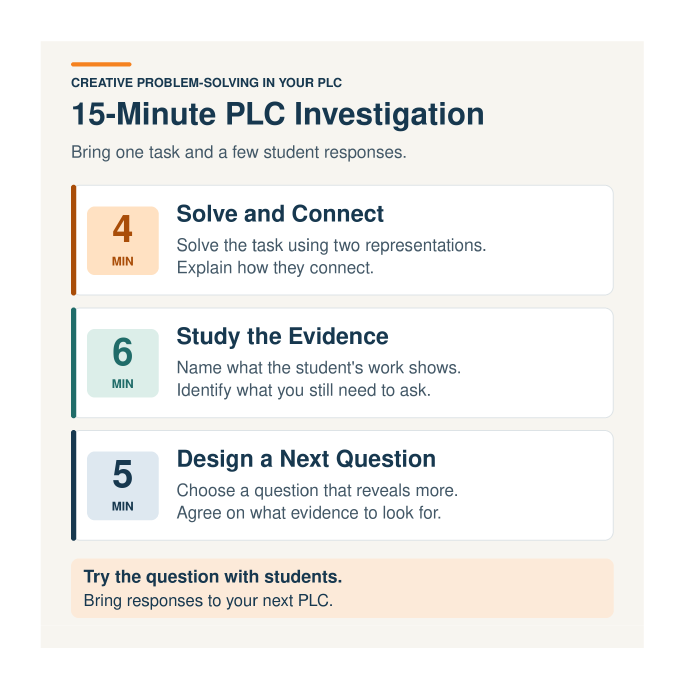 Examine one student response together. Name what the student’s words, marks, or model actually show. Then separate what you can see from what you still need to ask.
For the second response, notice that the student describes the written multiplication steps accurately. However, we still don’t know if the student understands regrouping. Write that question down before selecting an instructional response.
This habit keeps the team curious about correct answers and about partial understanding within unfinished or incorrect work.
3 Design a Next Question for Five Minutes
Generate ways to determine whether or not the student is making the connection. You could ask the student to circle ten ones in a drawing, or to explain how 80 + 12 connects to the written algorithm.
Choose the prompt that best addresses your uncertainty. Agree on what evidence you’ll look for in the student’s words, drawing, or model: ten of the twelve ones form one ten. That ten joins the eight tens, leaving nine tens and two ones. Try the question with students and bring a few responses to the next PLC or a quick check-in.
Creative problem solving happens as teachers connect representations, consider possible meanings in student work, and design a question that reveals more. Each explanation gives the team something specific to respond to.
Give the Why a Place in Your PLC
At your next meeting, choose one procedure students can perform and ask, “What would show us that they understand why it works?” Solve it together, examine an explanation, and choose one question worth asking students.
The Math PLC Tune-Up extends this work through concrete, visual, and symbolic representations, classroom examples, and the Unpacking for Clarity Protocol. Throughout the book, teams will find practical ways to deepen their own mathematical understanding and plan instruction that helps students connect the steps to their meaning.