Walk into almost any classroom and you’ll see students who appear “off task.”
- A student staring at the paper but not writing.
- Another blurting out an answer before thinking it through.
- Another quietly disengaged, waiting for it all to pass.
Too often, we interpret this as a lack of effort.
But what if it’s actually a lack of access?
For students receiving Special Education services, and especially those with ADHD, the challenge is rarely about willingness. It’s about processing. It’s about how information is taken in, organized, and expressed. And when the design of learning doesn’t account for that, rigor becomes something students are locked out of rather than invited into.
This is where the shift matters.
Rigor is not about making learning harder. It’s about ensuring students can engage in complex thinking and sustain it.
Through the lens of Universal Design for Learning (UDL), we begin to see that the barrier is not the learner. The barrier is the design.
And design is something we can change.
Within the Re-Envisioning Rigor framework, we provide 4-step routines that are the change. They are not just strategies to increase participation; they are structures that support how students think.
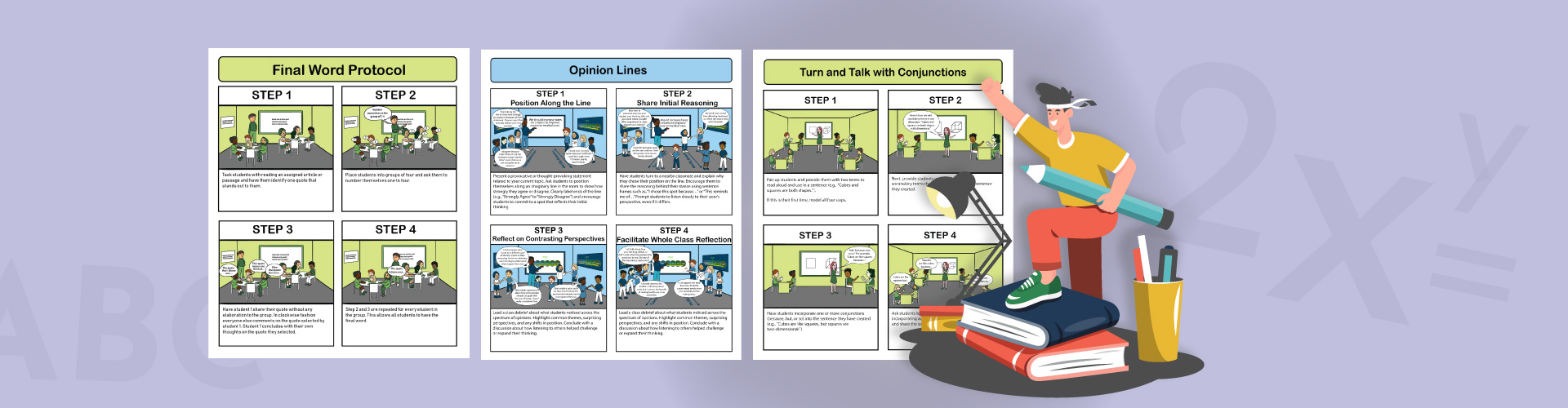
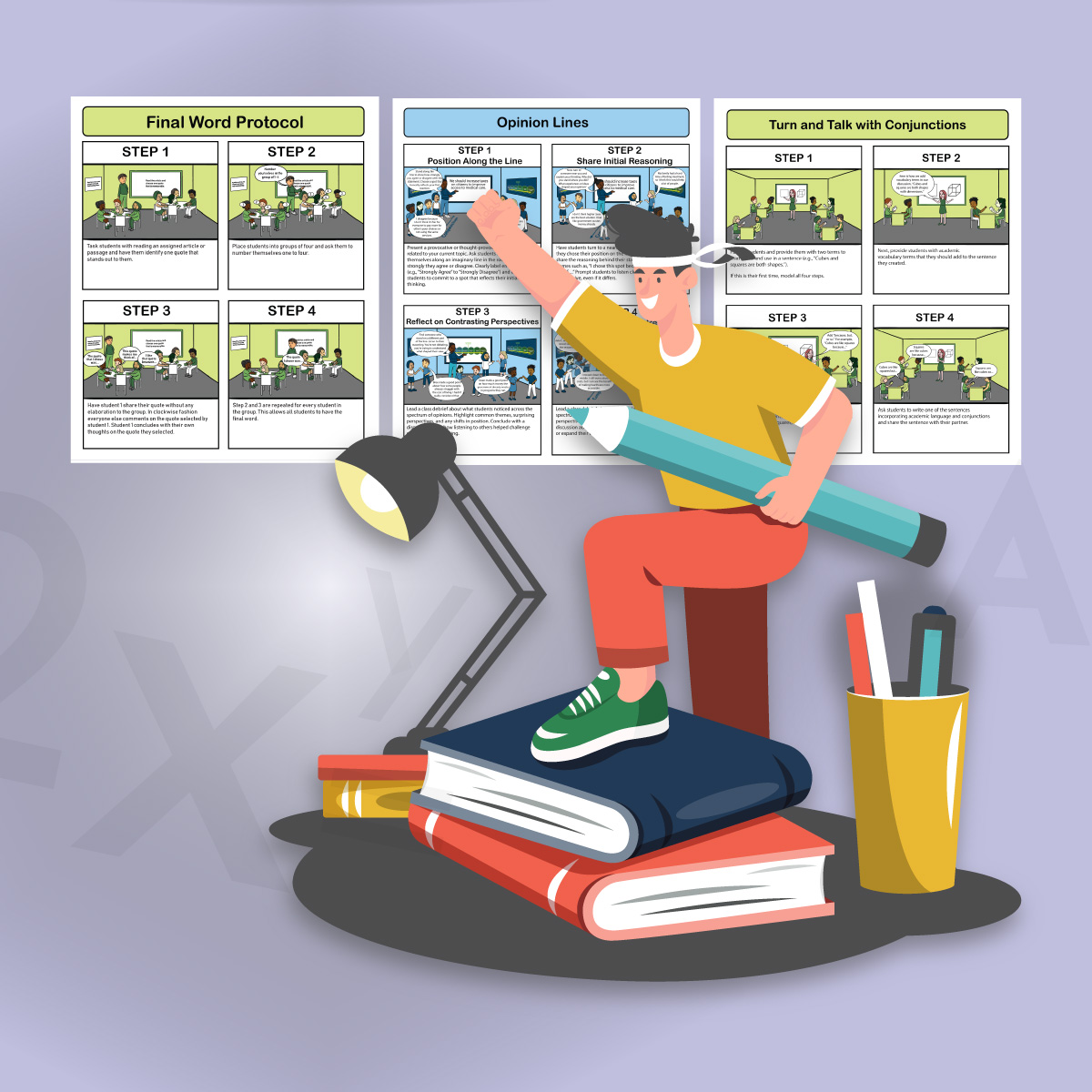
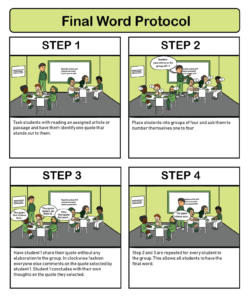 Starting with Entry: Final Word Protocol- Visual
Class starts by engaging students in an inquiry moment. An adaptation of the Final Word Protocol, students are given an image (rather than a text) to examine and reflect. As an example, a teacher projects an image of a pond ecosystem and provides two prompts.
“What do you see?” “What do you think? What do you wonder?”
At first glance, it feels almost too simple to be rigorous.
The student who typically hesitates to write begins sketching what they see. Another quietly shares an observation with a partner. A student who struggles to find the “right answer” offers a question instead.
We have removed the barrier of correctness. From a visual perspective, this protocol gives students permission to ask and be curious.
For students with ADHD, who may struggle with task initiation, this matters. The brain is no longer overwhelmed by where to start. For SPED learners, who may need additional processing time, the routine provides space to enter the learning on their own terms.
This is not a lowering of rigor; it is the beginning of it.
Final Word Protocol is excerpted from McDowell, M., & Eisberg, A. (2024). A visual, step-by-step guide for re-envisioning rigor: Powerful routines for promoting learning at high levels. Mimi and Todd Press.
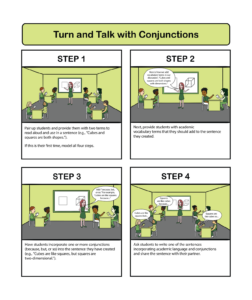 Building Thought: Turn & Talk with Conjunctions
One of the most frustrating parts of being an educator is when you ask a question and students give one-word answers or appear to shut down. We work hard to ask the right questions: open-ended, higher-order thinking, transfer-level questions. In math, we may ask a question such as:
“Is a table or graph more helpful for understanding proportional relationships?”
This is where many students would typically shut down or respond with a one-word answer.
However, we need strategies that build academic language and vocabulary by introducing the 4 step routine of Turn & Talk with Conjunctions. Rather than one-word answers, now students turn and talk to a partner, which sounds like:
“I think a graph is more helpful because…”
“I agree with you, but…”
“That matters so…”
The classroom, academic language, and engagement begin to shift. Conversation slows down. Thinking becomes more deliberate. Ideas begin to connect.
For students with ADHD, who often think quickly but struggle to organize those thoughts, conjunctions act as a cognitive bridge. They don’t just support language, they support reasoning. For SPED learners, the structure reduces the invisible demand of holding and organizing ideas internally. The thinking becomes external, shared, and refined in real time.
What might have been a surface-level response becomes something deeper, not because the task changed, but because the pathway to thinking did.
Turn and Talk with Conjunctions is excerpted from McDowell, M., & Eisberg, A. (2024). A visual, step-by-step guide for re-envisioning rigor: Powerful routines for promoting learning at high levels. Mimi and Todd Press.
Bring Re-Envisioned Rigor to Your Classroom
Explore A Visual, Step-by-Step Guide for Re-Envisioning Rigor for practical routines that help every learner engage in meaningful, rigorous thinking.
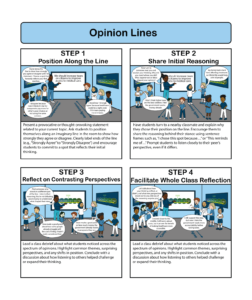 Making Thinking Visible: Opinion Lines
As kids come into class, they are being compliant and sit down and wait for attendance to be taken. Now, imagine a class that is efficient on time, providing prompts on the board where students arrive and are engaged as they arrive. Now imagine the class grappling with a bigger question:
“Was the Gold Rush more helpful or harmful to California?”
Instead of writing immediately, students stand. They move.
They place themselves along a continuum, some firmly at one end, others uncertain, standing somewhere in between. They see various perspectives.
And then they begin to talk. They give their reasoning for why they chose where they stand on the continuum. One student shifts position after hearing a peer’s reasoning. Another defends their stance using evidence from earlier in the lesson. A student who rarely participates is now fully engaged, because thinking is no longer confined to paper.
For students with ADHD, movement is not a distraction; it is a pathway to focus. For SPED learners, abstract thinking becomes more concrete when it is tied to physical space and social interaction.
Opinion Lines do something essential: they make thinking visible, flexible, and revisable. It provides a space for students to share their thinking by movement, and for teachers, it provides immediate formative feedback for the next steps of instruction.
And that is the heart of rigor and the re-envisioning rigor series: ensuring students do the heavy thinking, no matter who they are, and that all students belong and are included.
Opinion Lines is excerpted from McDowell, M., & Eisberg, A. (2025). A visual, step-by-step guide for re-envisioning rigor: Powerful routines for promoting student agency. Mimi and Todd Press.
The Throughline: Designing for How Students Think
When you step back, these routines are not just isolated strategies. Breaking down larger concepts and ensuring that all students have access to high-quality instruction and content. The strategies are part of a larger shift:
- From asking students to immediately perform → to giving them space to process
- From expecting students to organize thinking independently → to providing structures that support it
- From equating rigor with difficulty → to defining rigor as accessible complexity
Inclusive of All Learners
Students with ADHD and those receiving SPED services are often asked to do the most cognitively demanding work, but without the structures that make that work possible.
- Organize the thinking
- Stay focused
- Explain their reasoning
- Engage in complex tasks
These are not just academic skills; they are demands on executive functioning.
When we embed routines that lower the barrier to entry, structure how thinking develops, and provide multiple ways to engage and respond, we are not making learning easier; we are making thinking possible.
Have we designed a pathway that allows them to access it?
Final Reflection
As educators, the question is no longer: “Can this student handle rigorous work?” The question becomes: “Have we designed a pathway that allows them to access it?” Because when we do, when we intentionally design for variability, for processing, for movement, for language,
We don’t just support SPED and ADHD learners.
We create classrooms where every student can think deeply, contribute meaningfully, and experience true rigor.
Bring Re-Envisioned Rigor to Your School
Partner with The Core Collaborative to build classrooms where rigor, belonging, and access work together for every learner.