
Continuous Improvement Capacity
How do we learn and improve together?

Monitor improvement beyond collecting data.

Leverage the expertise already on your team.

Cultivate collaborative inquiry instead of isolated practice.

Strengthen systems that outlast individual leaders.
Build a Continuous Improvement Mindset
Explore the pathways that support collaborative, continuous learning and improvement.
Identify system strengths, gaps, and priorities to guide a coherent Human-Centered MTSS roadmap.
View PD OptionsAlign leadership, tiered supports, assessment, and collaborative inquiry within one coherent improvement system.
View PD OptionsHelp teams turn evidence into shared decisions, responsive action, and continuous improvement.
View PD OptionsElevate learner perspectives to strengthen teaching, learning, school culture, and shared responsibility.
View PD OptionsUse early indicators and coordinated supports to keep learners on track through ninth grade and other critical transitions.
View PD OptionsHelp collaborative teams analyze evidence faster while keeping educators at the center of professional judgment.
View PD OptionsInspect Human-Centered MTSS
Human-Centered MTSS Systems Review helps districts understand how well their instructional, intervention, attendance, behavior, well-being, and improvement systems work together. Through evidence gathering, stakeholder conversations, classroom observations, and document review, leaders identify strengths, priorities, and practical recommendations for building a more coherent system that helps every learner thrive.
Educators Will Develop the Capacity To:
- Evaluate the current effectiveness of their Human-Centered MTSS implementation.
- Identify strengths and opportunities across academics, attendance, behavior, well-being, and organizational systems.
- Understand how the Five Drivers function together as one coherent improvement model.
- Build consensus around the district’s highest-leverage priorities.
- Develop a shared vision for continuous improvement grounded in evidence rather than assumptions.
- Use the findings to inform a comprehensive Human-Centered MTSS implementation roadmap.
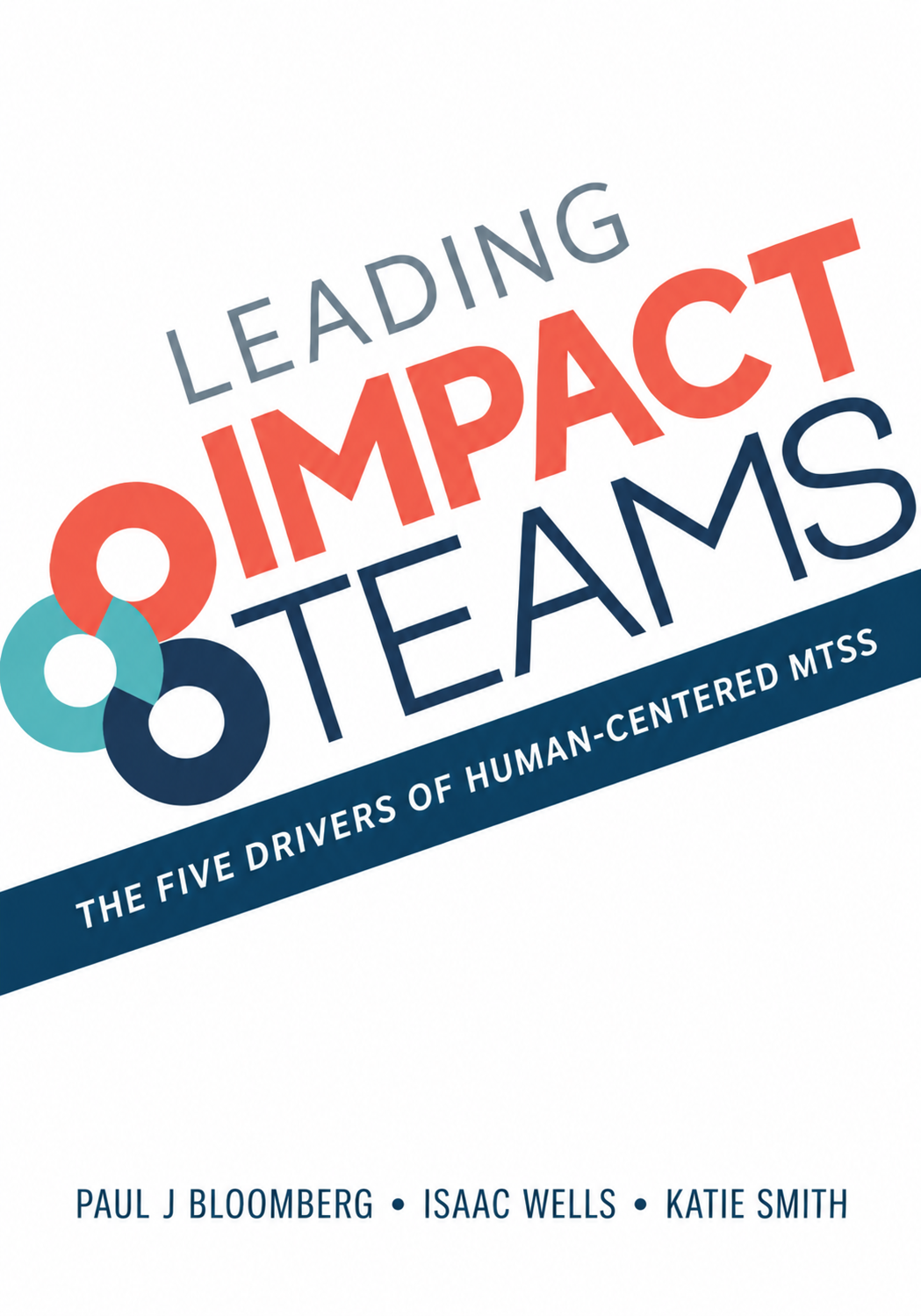
Leading Impact Teams: The Five Drivers of Human Centered MTSS
Paul Bloomberg, Katherine Smith and Isaac Wells
Design Human-Centered MTSS
Human-Centered MTSS Systems Design helps district and school leaders build a clear blueprint that aligns leadership, tiered supports, assessment, collaborative inquiry, and continuous improvement. Teams design the structures, routines, roles, and decision-making processes needed to provide timely academic, attendance, behavior, and well-being support while strengthening the human experience of school.
Educators Will Develop the Capacity To:
- Design a coherent Human-Centered MTSS system aligned to district priorities.
- Align academic, attendance, behavior, and well-being supports within one integrated framework.
- Build leadership and collaborative team structures that strengthen continuous improvement.
- Develop assessment and progress monitoring systems that inform timely instructional and organizational decisions.
- Create a Human-Centered MTSS Blueprint that guides implementation and continuous improvement.
Leading Impact Teams: The Five Drivers of Human Centered MTSS
Paul Bloomberg, Katherine Smith and Isaac Wells
Build Collective Agency Through Impact Teams
Leading Impact Teams for Collective Agency gives PLCs, leadership teams, MTSS teams, and other collaborative groups a shared Evidence-to-Action process for turning information into meaningful improvement. With support from the AI PLC Agent, teams can identify patterns more efficiently, strengthen professional judgment, choose responsive actions, monitor impact, and build shared responsibility for every learner’s success.
Educators Will Develop the Capacity To:
- Facilitate collaborative inquiry that transforms evidence into meaningful action.
- Build high-functioning PLCs, ILTs, DLTs, MTSS teams, and cross-functional leadership teams.
- Use the AI PLC Agent to accelerate evidence analysis, instructional planning, and progress monitoring.
- Analyze multiple sources of evidence to identify strengths, opportunities, and priorities.
- Monitor the impact of instructional, behavioral, attendance, and well-being initiatives over time.
- Build collective agency through shared responsibility, continuous learning, and evidence-informed decision-making.
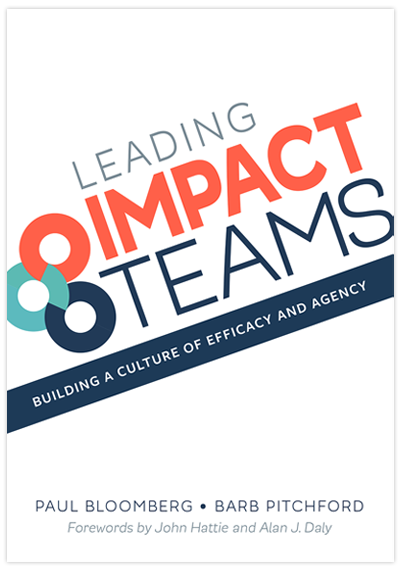
Leading Impact Teams: Building A Culture of Efficacy and Agency
Paul J. Bloomberg Ed.D. and Barb Pitchford
Engaging in Student-Led Instructional Rounds
Student-Led Instructional Rounds prepare students to become trusted partners in improving teaching, learning, and school culture. Students use a shared lens to observe learning, gather evidence, identify patterns, and engage in dialogue with educators, helping schools make decisions that reflect learners’ experiences and strengthen shared responsibility.
Educators Will Develop the Capacity To:
- Engage students as authentic partners in school improvement.
- Gather meaningful evidence from the learner perspective.
- Facilitate reciprocal feedback conversations grounded in trust and curiosity.
- Strengthen instructional decision-making through student insights.
- Build shared responsibility for improving learning and school culture.
- Create sustainable structures that elevate student voice within continuous improvement systems.

Student-Led Rounds: Democracy in Action
Joanne Buckheit, Paul Bloomberg, Carly Castro and Dallas Guy
Get Freshman on Track
Freshman On Track helps schools identify leading indicators, respond early, and coordinate academic, attendance, behavior, and well-being supports during the critical transition into ninth grade. The same Human-Centered MTSS principles can also strengthen other major transitions, helping learners and families set goals, monitor progress, remove barriers, and stay connected to a successful pathway.
Educators Will Develop the Capacity To:
- Identify leading indicators that predict learner success at critical benchmark years.
- Build coherent early-warning and progress-monitoring systems.
- Coordinate academic, attendance, behavior, and well-being supports across schools and grade levels.
- Design proactive Tier 1, Tier 2, and Tier 3 systems that respond before learners become off track.
- Engage learners and families in setting goals, monitoring progress, and celebrating growth.
- Apply Human-Centered MTSS principles to critical transitions from Kindergarten through postsecondary readiness.
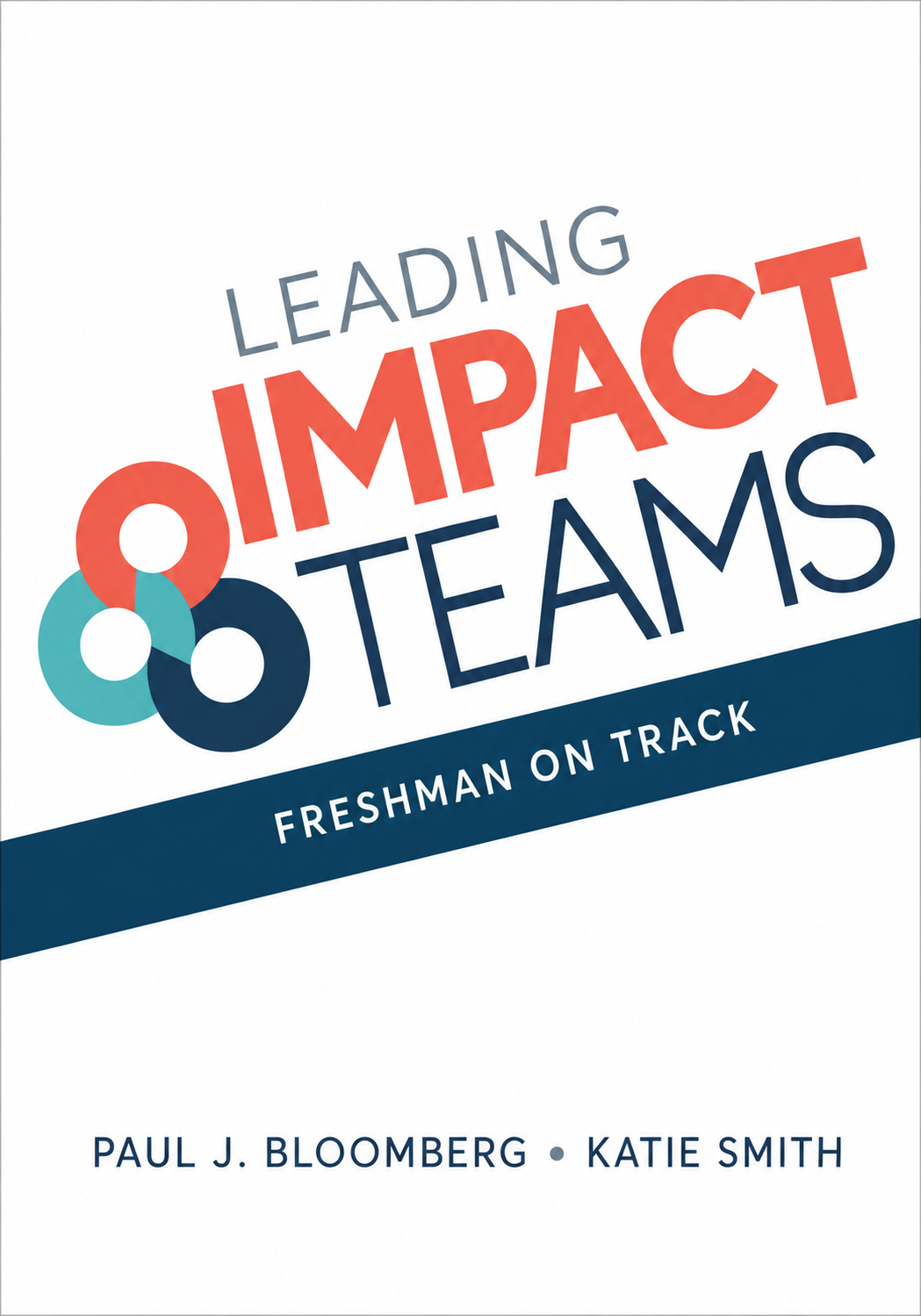
Leading Impact Teams: Freshman On Track
Paul Bloomberg and Katherine Smith
Expand Human Capacity with the AI-PLC Agent
The AI-PLC Agent accelerates collaborative inquiry by helping teams analyze evidence, identify patterns, generate asset-based feedback, develop instructional recommendations and action plans, and monitor progress. It reduces the burden of organizing and interpreting evidence while preserving educator professional judgment and instructional decision-making, allowing PLCs, coaches, school leaders, and district leaders to spend more time learning from evidence and determining what to do next.
Educators and Leaders Will Develop the Capacity To:
- Accelerate evidence analysis while preserving professional judgment.
- Use asset-based feedback to identify strengths, needs, and opportunities.
- Translate evidence into actionable instructional recommendations and next steps.
- Develop and monitor responsive action plans over time.
- Strengthen collaborative inquiry and evidence-informed decision-making.
AI-PLC Agent
The Core Collaborative
Resources
Meet the Pathway Team
Complete the form below and we’ll be in touch to create a solution that addresses your needs and achieves your goals in learning spaces.
Prefer to talk on the phone? No problem! You can give us a call at: 619-432-2673
This form is on the "Let's Connect" Section on the Homepage
"*" indicates required fields