
The United States faces a serious mathematics challenge. In 2024, 39% of fourth graders and 27% of eighth graders performed at or above NAEP Proficient in mathematics. By grade 12, only 22% of students reached that level, while 45% performed below Basic—the highest share recorded on that assessment (National Center for Education Statistics [NCES], 2025a, 2025b).
These results should not lead us to conclude that students are incapable of learning mathematics. They should lead us to examine the learning experiences students are having. Too many learners move through mathematics classrooms without consistently experiencing clear instruction, meaningful problem solving, productive practice, useful feedback, and opportunities to explain their thinking. Too many students come to believe that mathematics is something they either “get” quickly or will never be good at.
Math Identity Matters
 A student’s math identity is the story they tell themselves about who they are as a learner of mathematics.
- Do I belong in this class?
- Can I make sense of difficult problems?
- Are my ideas worth sharing?
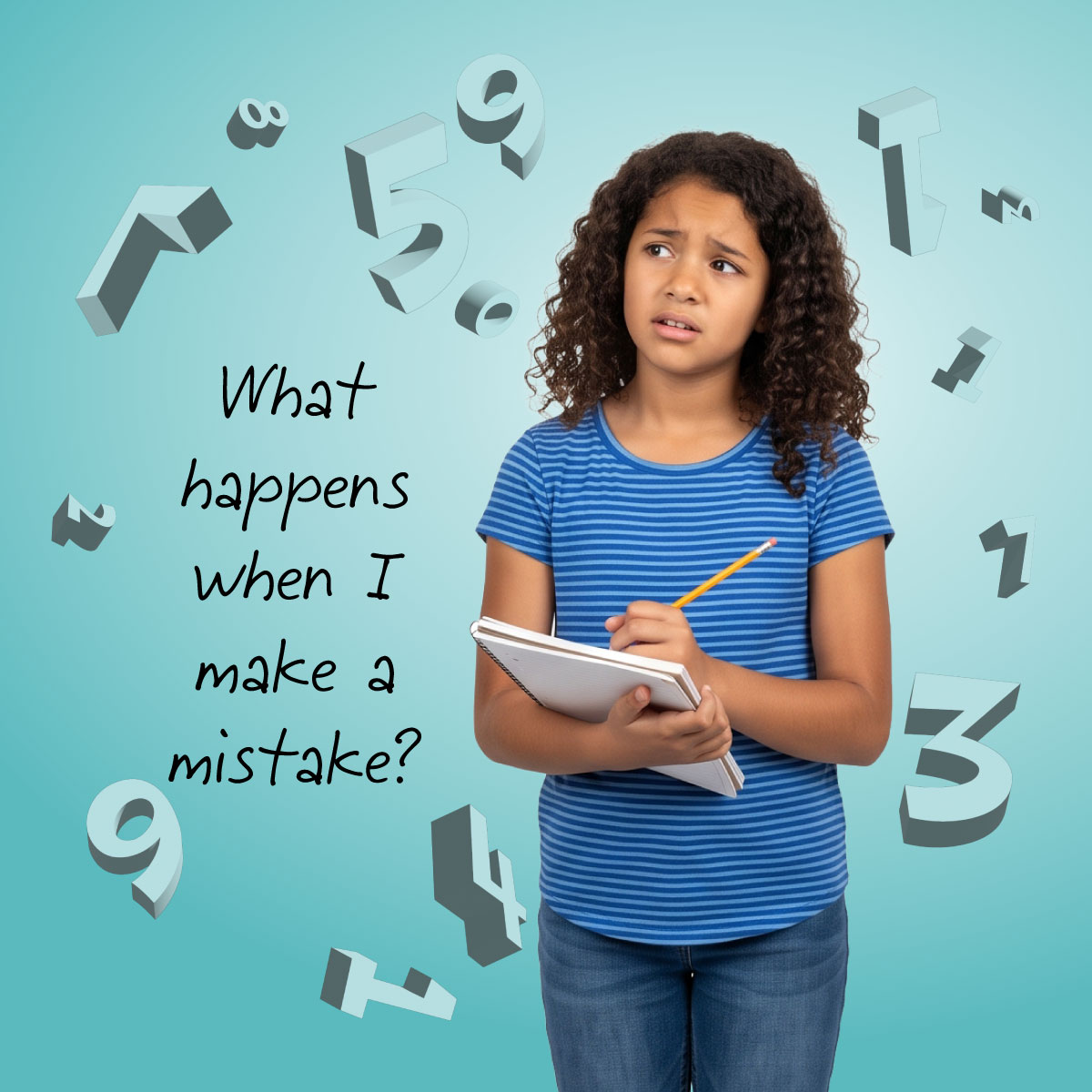
- What happens when I make a mistake?
- Do adults believe I can learn this?
Students answer these questions every day through their experiences in classrooms. They develop confidence when teachers invite their reasoning, provide specific feedback, make mistakes safe to discuss, and communicate that understanding develops through effort, strategy, explanation, and revision.
They develop doubt when they are repeatedly given easier work, removed from grade-level learning, rushed past when they are confused, or told—directly or indirectly—that they are not “math people.” When students lose confidence, they may stop volunteering, avoid difficult work, disengage from discussion, or decide that failure is inevitable. Achievement and identity begin to reinforce one another in the wrong direction.
This does not mean that relationships replace strong mathematics instruction. It means the two are inseparable. Students need coherent grade-level content, explicit modeling, well-designed tasks, meaningful practice, formative assessment, feedback, and targeted support. They also need classrooms where it is safe to ask questions, share unfinished thinking, revise an approach, and persist through productive struggle.
Teachers can strengthen math identity through brief, intentional messages:
- “Show me how you were thinking.”
- “That strategy gives us something important to examine.”
- “You do not have it yet, but you can learn it.”
- “Let’s identify the first part you understand and build from there.”
- “Your question may help someone else, too.”
Students’ identities, languages, interests, lived experiences, and funds of knowledge can also provide meaningful bridges into rigorous mathematical learning. Relevant contexts do not make mathematics less demanding. They give students more than one way into the concepts, representations, problems, and reasoning that mathematics requires. Culturally responsive pedagogy is designed to address social barriers that can contribute to differences in student outcomes and to help educators use students’ cultural and experiential knowledge to support learning (Institute of Education Sciences [IES], 2021, 2025).
What Human-Centered Math MTSS Looks Like
Human-Centered Math MTSS is not a new program, a separate intervention block, or a process for sorting students into labels. It is a way for schools to organize mathematics improvement around a simple belief: every student deserves access to rigorous learning, responsive support, and a classroom experience that protects their confidence and identity as a mathematician.
It starts by strengthening the experience every student has in Tier 1 mathematics—not waiting until students fail to provide meaningful help. Schools examine whether students are regularly engaging with grade-level ideas, explaining their thinking, receiving actionable feedback, and seeing multiple ways to approach a problem. They look at assessment results, but they also ask students what helps them learn, where they get stuck, and whether they feel comfortable asking for help.
When students need more support, Human-Centered Math MTSS does not remove them from rich learning and replace it with disconnected remediation. It provides targeted support connected to the mathematics students are learning now. It identifies the specific ideas, representations, vocabulary, or prerequisite understandings students need, then creates a bridge back into current grade-level work.
For students who need intensive support, the focus remains on both learning and identity. The question is not, “How do we fix this student?” It is, “What has this learner experienced, what strengths do they bring, and what instruction and support will help them re-enter meaningful mathematics?” This approach uses evidence alongside student and family voice so that teams understand not only what students are struggling with, but why (The Core Collaborative, n.d.-a).
An Example: Fractions in Grade 5
Imagine a Grade 5 team reviewing a common assessment on adding and subtracting fractions. The results show that many students can follow a procedure when denominators are the same, but struggle to explain why fractions must have common denominators before they can be combined. A traditional response might be to identify the lowest-scoring students and assign them to a separate remediation group focused on fraction rules.
A Human-Centered Math MTSS response begins differently.
The team first examines Tier 1 instruction. Did all students have opportunities to use visual models, number lines, and concrete representations? Did they discuss why 12\frac{1}{2}21 and 24\frac{2}{4}42 name the same amount? Did they explain and compare strategies? Did the task reveal conceptual understanding, or mainly whether students remembered a rule?
The teachers then listen to students. Several say that they understand what to do when the teacher shows an example, but become confused when a problem looks different. Others say they are afraid to share because they do not want to be wrong. One student says, “I thought you just add the numbers on the bottom, but everyone said that was wrong.”
The team responds by strengthening the next Tier 1 lesson for everyone. Students work with fraction strips and number lines to represent 12+14\frac{1}{2} + \frac{1}{4}21+41, 23+16\frac{2}{3} + \frac{1}{6}32+61, and other examples. They discuss what the denominator means, why units must be the same size before they can be combined, and how equivalent fractions help create common units. The teacher intentionally shares several student strategies—not only the fastest correct method—and uses errors as opportunities to reason.
At Tier 2, students who need additional support meet in a short, targeted group connected to the current unit. Rather than repeating isolated worksheets, they use visual models, language supports, guided practice, and immediate feedback to strengthen the precise ideas they need. The group’s goal is clear: help students participate more confidently in the next grade-level lesson.
At Tier 3, a student with substantial unfinished learning receives more frequent, individualized support. The interventionist coordinates with the classroom teacher, uses assessment evidence to identify the student’s specific needs, and ensures the student continues engaging with the core Grade 5 concepts. The adults also check in on the student’s experience: Does the student understand the purpose of the support? Does the student believe they can learn mathematics? What helps them feel successful enough to persist?
The result is not simply that students get “more math.” They receive better-connected mathematics, more precise support, and a clearer message: You are a mathematician. Your thinking matters. We will help you make sense of this.
The Tiered Model
| Tiers | What it looks like in Human-Centered Math MTSS |
|---|---|
| Tier 1 | Every student experiences coherent, grade-level mathematics; explicit teaching; meaningful tasks; mathematical discourse; multiple representations; formative assessment; actionable feedback; and predictable routines that make it safe to ask questions and revise thinking. |
| Tier 2 | Students receive brief, targeted, evidence-informed support connected to the current unit. Teachers address specific unfinished understandings while maintaining access to grade-level learning, mathematical talk, and productive problem solving. |
| Tier 3 | Students receive intensive, individualized instruction that responds to their particular strengths and needs. Classroom teachers, interventionists, families, and students coordinate around a plan that builds learning, confidence, attendance, and sustained participation in core mathematics. |
The Work Ahead
The country does not need a math response centered only on test preparation, repetitive practice, or an ever-growing menu of interventions. It needs schools to build a coherent mathematics system in which strong Tier 1 instruction, formative evidence, timely support, student voice, family partnership, and learner confidence work together.
Human-Centered Math MTSS keeps the focus on the conditions students experience every day. It asks schools to examine not only who is struggling, but also whether their mathematics system gives every learner a real opportunity to engage, persist, explain, receive support, and succeed.
The central question is no longer, Which students are failing mathematics?
It becomes: What will we change so every learner can see themselves as a capable mathematician—and have the instruction, support, and opportunity to prove it?
References
Institute of Education Sciences. (2021, July 20). An introduction to culturally responsive education (CRE). U.S. Department of Education. https://ies.ed.gov/learn/blog/valuing-student-experiences-introduction-culturally-responsive-education-cre
Institute of Education Sciences. (2025). Culturally responsive pedagogy. U.S. Department of Education. https://ies.ed.gov/use-work/resource-library/resource/fact-sheetinfographicfaq/culturally-responsive-pedagogy
National Center for Education Statistics. (2025a). Explore results for the 2024 NAEP mathematics assessment: Grades 4 and 8. The Nation’s Report Card. https://www.nationsreportcard.gov/reports/mathematics/2024/g4_8/
National Center for Education Statistics. (2025b). NAEP mathematics: Grade 12 national trends and student skills. The Nation’s Report Card. https://www.nationsreportcard.gov/reports/mathematics/2024/g12/national-trends/
The Core Collaborative. (n.d.-a). Rethinking MTSS: A human-centered approach to school improvement [Unpublished framework].
The Core Collaborative. (n.d.-b). Driver 3: Building identity, belonging, and family partnership [Unpublished professional learning pathways document]