
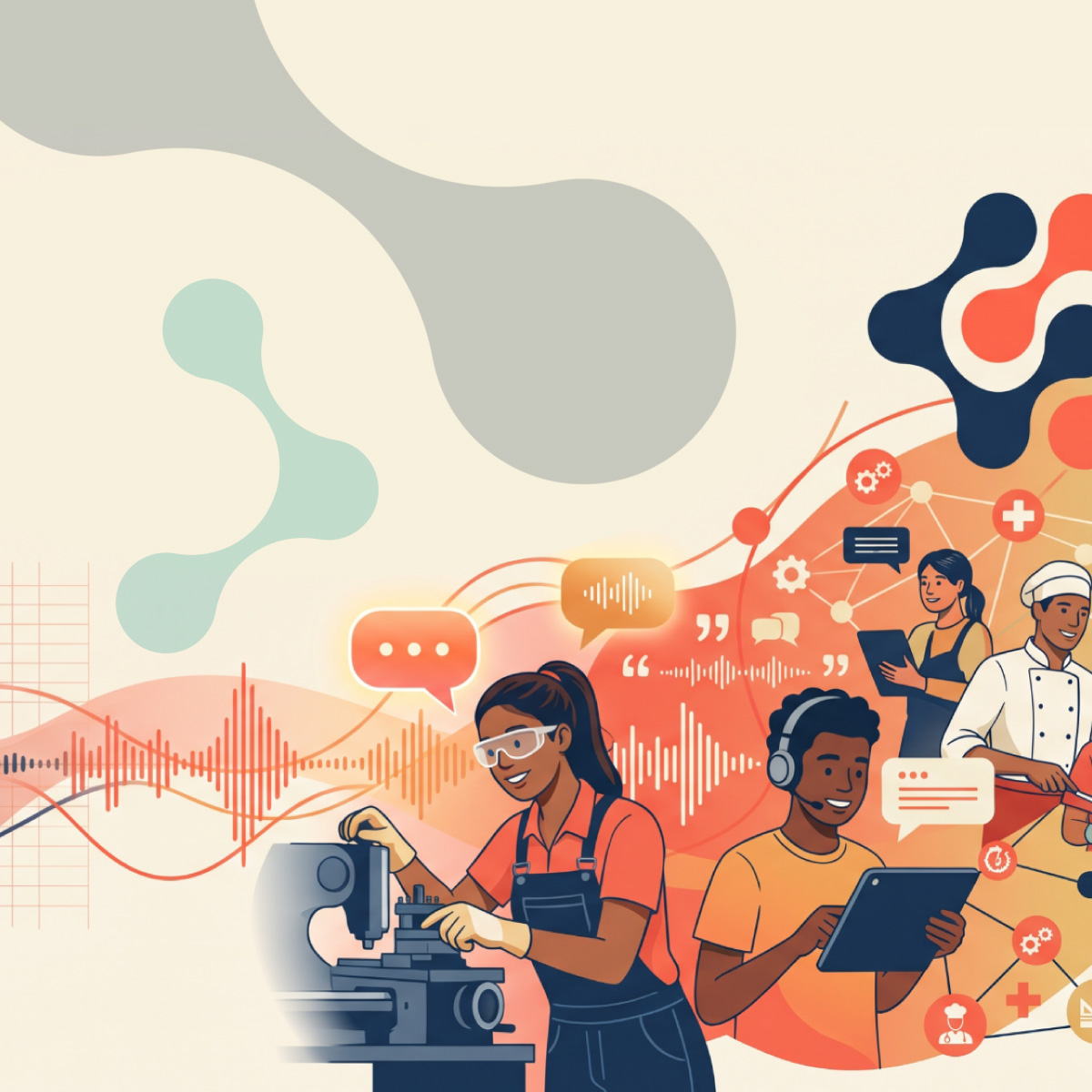
The jobs CTE students are preparing for are changing almost as quickly as schools can prepare them for them.
Artificial intelligence, automation, emerging technologies, workforce shortages, and shifting skill demands are changing not only which jobs exist, but what workers need to know and be able to do. The World Economic Forum reports that 63% of employers identify skills gaps as a major barrier to business transformation, while approximately 39% of workers’ existing skills are expected to change or become outdated by 2030. Analytical thinking, resilience, flexibility, technological literacy, creative thinking, and lifelong learning are among the capabilities employers increasingly value.
That makes Career and Technical Education more important than ever.
CTE sits at the intersection of school, work, identity, and opportunity. It is where students begin testing not only what they know, but what they can do, how they solve problems, how they respond when something goes wrong, and who they might become.
If adaptability, problem solving, communication, and lifelong learning are becoming more important in the workplace, CTE leaders need evidence that tells them whether students are actually developing those capacities. Traditional measures alone cannot answer that question.
Enrollment, credential attainment, academic proficiency, pathway completion, and Perkins indicators tell us what is happening. But they often cannot tell us:
- Do students feel prepared?
- Can they recognize and explain the skills they are developing?
- Do they see connections between mathematics, literacy, technical learning, and the workplace?
- What helps them persist when the work becomes difficult?
- What gets in their way?
Those questions require us to listen.
The Data We Cannot See in a Spreadsheet
In Street Data, Shane Safir and Jamila Dugan (2021) argue that schools need evidence gathered close to the learner experience, particularly evidence that illuminates what large-scale measures cannot see.
That idea is especially relevant in CTE.
Imagine a student in construction calculating measurements, adjusting for error, interpreting plans, collaborating with a team, and solving an unexpected problem during a job site simulation. A standardized assessment may capture part of that student’s mathematical proficiency, but it cannot fully capture confidence, adaptability, problem solving, persistence, or the ability to apply mathematics when the answer actually matters.
Those experiences are not peripheral to workforce readiness. They increasingly resemble the very capabilities employers say they need.
Voice data helps us see them.
Why Listening Matters
Research reinforces the value of listening.
Mitra (2004) found that meaningful student voice can strengthen agency, belonging, and competence. More recently, Conner, Mitra, Holquist, and Boat (2025) studied 1,751 middle and high school students and found that having even one teacher who sought student input was associated with stronger outcomes in areas including agency, mathematics grades, grade point average, and attendance.
But asking is not enough.
Kahne, Bowyer, Marshall, and Hodgin (2022) found that responsiveness to student voice matters. Students need to see that their perspectives are not merely collected, but considered and capable of influencing what happens next.
A twenty-five-year systematic review of student and teacher voice research reached a similar conclusion. Gillett Swan and Baroutsis (2024) found that meaningful voice goes beyond consultation. Participants need to experience their perspectives as having value and influence within the improvement process.
That distinction is essential: Collecting voice is not the goal. Using voice to improve the system is.
Why This Matters So Much in CTE
CTE students occupy a unique position.
They are still students, but they are also beginning to think and act like health professionals, engineers, technicians, designers, entrepreneurs, chefs, educators, and skilled tradespeople. That gives them a perspective on readiness that neither a test score nor a credential can fully provide.
Their experiences can tell us things traditional metrics cannot.
A mathematics score may show that a group of CTE students is below a proficiency target. Voice data might reveal that those same students are successfully using measurement, ratios, fractions, or data analysis in technical settings but do not recognize the connection between that work and academic mathematics.
A pathway completion report may show where students leave. Interviews can help leaders understand whether scheduling, belonging, prerequisite knowledge, confidence, access, or support is contributing to the pattern.
A credential report may show what students earned. Students themselves can help us understand whether they also developed the judgment, adaptability, confidence, and professional identity needed to use that credential successfully.
Numbers identify the pattern. Voice helps us understand the experience behind it.
Turning Voice Into Action
Listening becomes valuable when it changes what we do. But moving from individual stories and perspectives to meaningful improvement requires more than simply conducting interviews. Leaders need a way to determine what they want to understand, whose experiences matter, what patterns are emerging, how those patterns connect to other evidence, and what should happen as a result.
That is the purpose of The Core Collaborative’s CTE Human Centered Voice to Action™, a district-level inquiry and continuous improvement process that moves deliberately from listening to understanding to action. Rather than treating voice as a one-time data collection activity, the process creates a cycle in which stakeholder experiences inform decisions and stakeholders are invited back to help determine whether those decisions are making a difference.
The process moves through six connected steps:
01 | Define the inquiry.
Start with the question that matters most. It may involve mathematics proficiency, literacy, pathway access, persistence, belonging, learner agency, completion, or another Perkins related priority.
02 | Identify whose voices matter.
Determine which students, educators, leaders, families, or partners have experiences that can help answer the question.
03 | Listen.
Use structured interviews and focus groups to uncover strengths, barriers, experiences, and opportunities.
04 | Analyze and connect.
Look for patterns and meaningful differences, then connect voice data with CTE, Perkins, academic, access, climate, and student outcome evidence.
05 | Act.
Determine what should be protected, changed, tested, or investigated next.
06 | Listen again.
Return to stakeholders and ask: Did the change help? What are you experiencing now? What should we do next?
Together, these steps create an ongoing improvement cycle: Listen. Analyze and connect. Act. Listen again.
Preparing Students for a World That Will Keep Changing
Perhaps the most compelling reason to elevate voice in CTE is that the future of work will not stand still. Students cannot be prepared only for the job that exists today. They need to become people who can learn, adapt, solve problems, communicate, reflect, and continue developing as technology and industries change. If those are the outcomes we value, then we need evidence that helps us understand whether students are actually becoming those kinds of learners and workers.
That is why CTE leaders need both quantitative data and voice data. Numbers can tell us who is enrolling, persisting, completing, earning credentials, and demonstrating proficiency. Voice can help us understand what students are experiencing, what they are learning to recognize in themselves, where the system is helping them succeed, and where it is getting in their way.
In a world where the skills students need will continue to change, CTE cannot measure readiness only by what students have completed. We also need to understand who they are becoming. Doing that well requires looking at the numbers and listening closely to the people behind them.
References
Conner, J., Mitra, D. L., Holquist, S. E., & Boat, A. (2025). How teachers’ student voice practices affect student engagement and achievement: Exploring choice, receptivity, and responsiveness to student voice as moderators. Journal of Educational Change, 26(1), 89–118.
Gillett Swan, J., & Baroutsis, A. (2024). Student voice and teacher voice in educational research: A systematic review of 25 years of literature from 1995 to 2020. Oxford Review of Education, 50(4), 533–551.
Kahne, J., Bowyer, B., Marshall, J., & Hodgin, E. (2022). Is responsiveness to student voice related to academic outcomes? Strengthening the rationale for student voice in school reform. American Journal of Education, 128(3), 389–415.
Mitra, D. L. (2004). The significance of students: Can increasing student voice in schools lead to gains in youth development? Teachers College Record, 106(4), 651–688.
Safir, S., & Dugan, J. (2021). Street data: A next generation model for equity, pedagogy, and school transformation. Corwin.
World Economic Forum. (2025). The Future of Jobs Report 2025.